Guide
Chinese Porcelain Glossary: Terms Collectors Use
This Chinese porcelain glossary explains about 150 terms that collectors and dealers use for Chinese porcelain: materials and firing, glazes, decoration, shapes, marks, condition and the kilns and wares of the Song to the Qing. Each entry is a short definition, with a link to a fuller guide where we have one.
What to look for
- Guan ware, the Song ware, and guanyao, official kiln ware, are different things.
- A reign mark records what was written on a piece, not when it was made.
- Crazing lies in the glaze only; a hairline runs through the body.
- Underglaze colours lie beneath the glaze; enamels sit on top and can often be felt.
- A firing crack has glaze flowed into it; later damage has sharp, bare edges.
- Famille verte and famille rose are nineteenth-century French terms, not period names.
How to use this Chinese porcelain glossary
The glossary is arranged by subject: materials and firing, glazes and colours, decoration, motifs, shapes, marks, condition, and kilns and wares. Chinese terms are given in pinyin, in italics, beside the English word collectors use, and where one is more common than the other it comes first.
Definitions are kept short. Where we have a fuller guide, the entry links to it. For the wider picture, start with our guide to buying antique Chinese porcelain and our guide to antique porcelain age signs. Period overviews are in our pages on Song ceramics, Yuan blue and white and Qing porcelain.
A to Z of all 151 terms
C
E
F
G
P
R
S
Materials, bodies and firing
Biscuit (biscuit porcelain). Porcelain fired without glaze, or the unglazed parts of a piece. Some wares were fired to the biscuit stage first so that enamels or low-fired glazes could be applied directly to the body, as on Kangxi famille verte on biscuit.
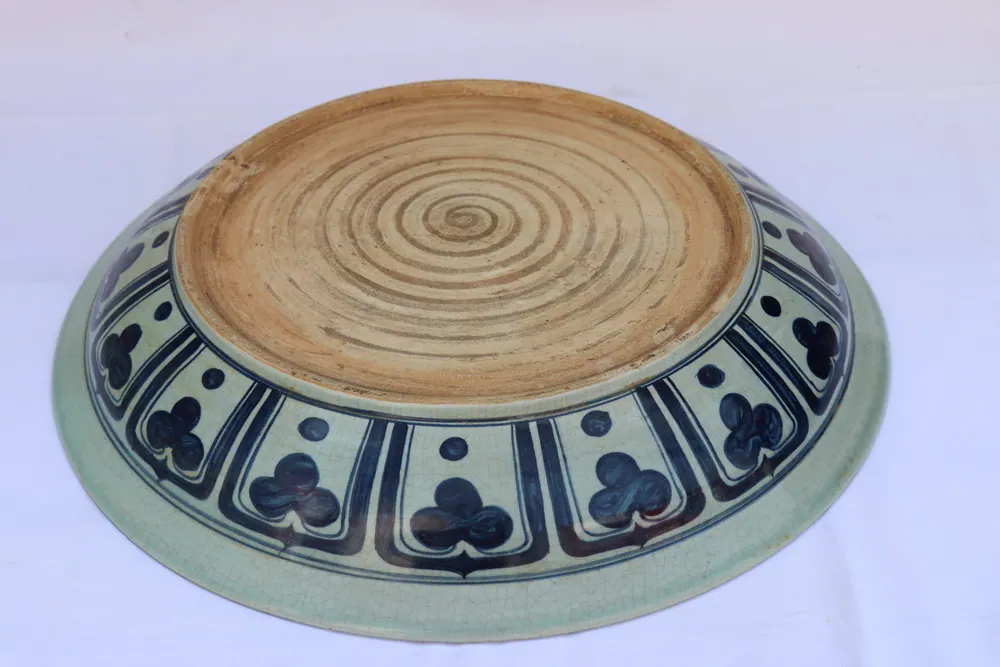
Body. The fired clay of a piece, also called the paste. Its colour, grain and weight, best seen where it is left bare on the foot, are among the most useful guides to kiln and period. See our guide to foot rings and bases.
Chatter marks. Fine ridges radiating across a base, left when the trimming tool juddered against the turning pot. They are common on Ming market wares and on kraak porcelain.
Dragon kiln (longyao). A long tunnel kiln built up the slope of a hillside and fired in stages from the bottom to the top. Dragon kilns were used across southern China, including at Longquan.
Earthenware. Low-fired, porous pottery. Tang sancai tomb figures and vessels are earthenware, not porcelain.
Eggshell porcelain. Porcelain potted so thinly that it is translucent. Chinese texts call the thinnest early Ming white wares tuotai, "bodiless". The technique was revived at several later dates, including the late Qing and the Republic.
Egg-shaped kiln (zhenyao). The large, wood-fired kiln of Jingdezhen, shaped in plan like half an egg, used from the late Ming onward.
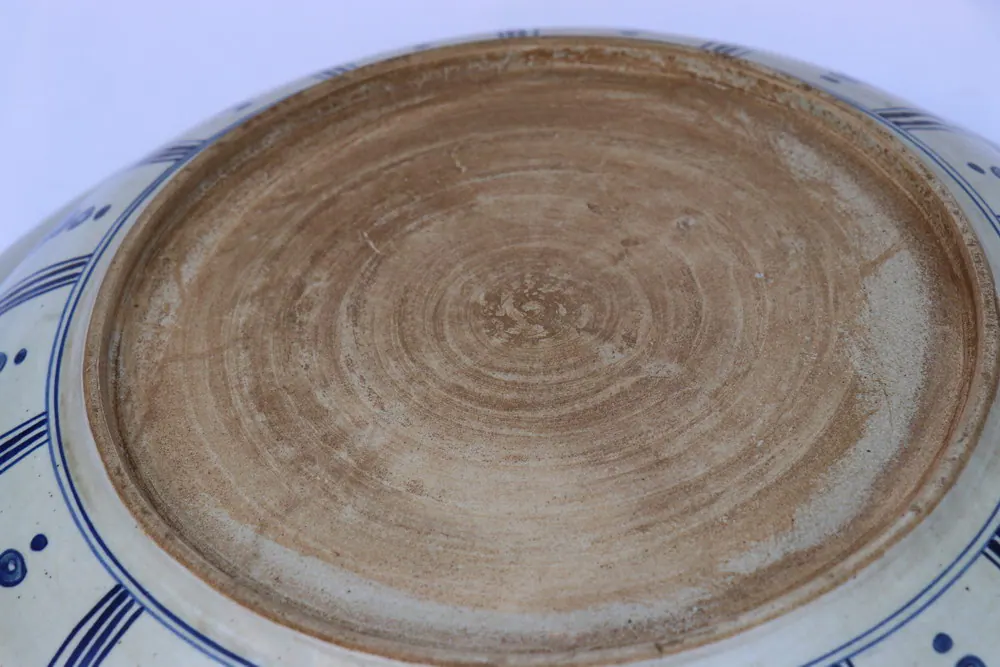
Firing blush. The orange or reddish-brown colour that bare porcelain body takes on where iron in the clay oxidised in the kiln. It is typical of Yuan and Ming foot rims and is discussed in our guide to kiln firing faults.
Kaolin (gaoling). A white clay named after Gaoling, a hill near Jingdezhen. It adds whiteness and strength to the porcelain body and allows it to stand the heat of the kiln without slumping.
Kiln grit. Sand or grit from the kiln floor or a support, fused to the foot rim during firing. Genuine grit is fused into the clay; grit glued on by a copyist sits on the surface.
Luting. Joining separately made parts, such as a neck to a body or a handle to a jug, with slip before firing. Joins are a common place for firing cracks.
Moulding. Shaping clay by pressing it into or over a mould. It was used for lobed dishes, figures and relief decoration, and for making many identical pieces.
Petuntse. The European name for porcelain stone, from the Chinese baidunzi, "little white bricks", the form in which the refined stone reached the potters.
Porcelain. A ceramic made from kaolin and porcelain stone and fired at about 1,300°C until it is hard, white, vitrified and, where thin, translucent. The Chinese word ci covers a wider group of high-fired wares, including stonewares such as celadon.
Porcelain stone (cishi). A decomposed granite rock that gives porcelain its plasticity and fuses in the kiln. From the Yuan period, potters at Jingdezhen mixed it with kaolin, which allowed larger and more reliable pieces.
Porcellanous. Close to porcelain in hardness and whiteness but not fully so. The word is often used of provincial Chinese and Vietnamese bodies.
Reduction and oxidation. Reduction is firing with the kiln starved of oxygen, which turns iron in a glaze green or bluish, as in celadon, and copper red. Oxidation is firing with plenty of air, which turns iron yellow or brown.
Saggar. A lidded box of fireclay in which pieces were placed to protect them from flame, ash and smoke in the kiln.
Slip. Clay mixed with water to a creamy liquid, used to join parts, to coat a body or to paint raised or white decoration.
Stoneware. Pottery fired hard and non-porous, but usually grey or buff and not translucent. Many Song wares, including Jun, Cizhou and Jian, are stonewares.
Translucency. The passage of light through thin porcelain. Holding a piece against a strong light shows the colour and evenness of the body and reveals hairlines.
Glazes and colours
Anhua. "Hidden decoration": a design faintly incised or painted in white slip under a white glaze, visible only when the piece is held against the light. It is associated above all with the white wares of the early fifteenth century.
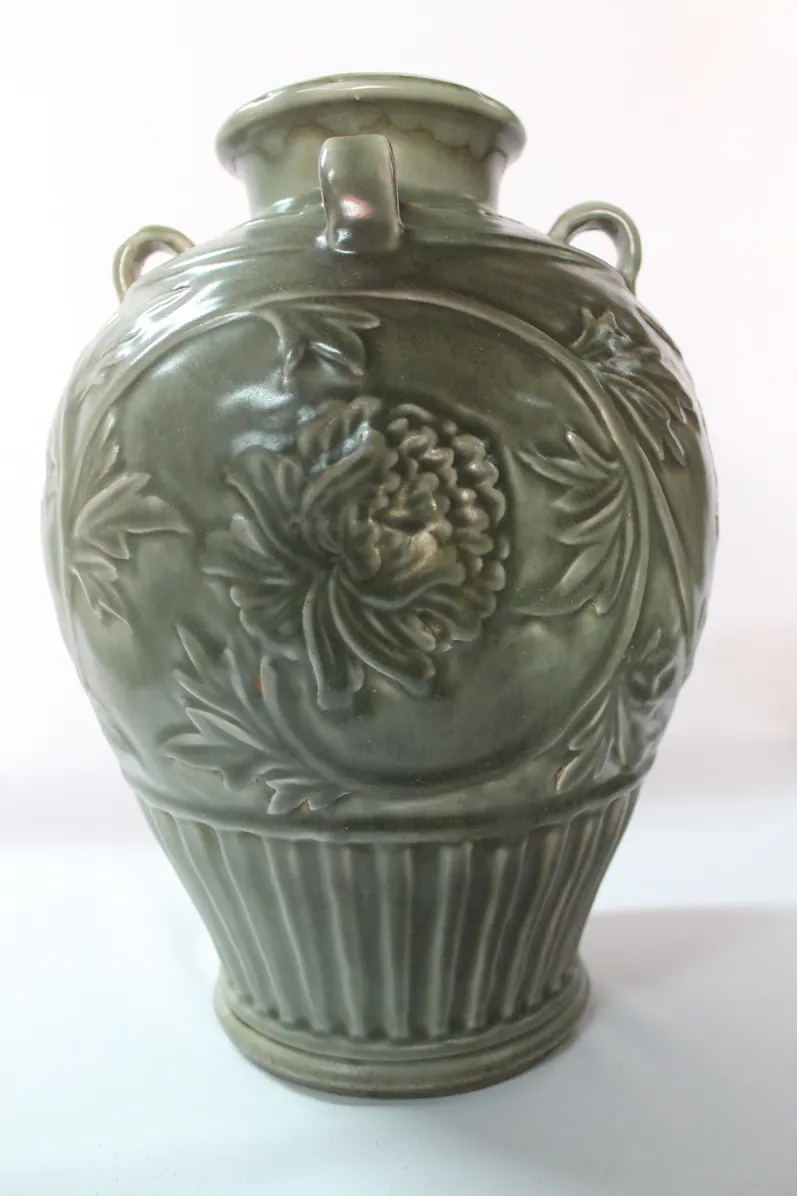
Celadon. A glaze tinted green, grey-green or bluish by a little iron fired in reduction. The most famous Chinese celadons come from Longquan; see our guide to Longquan celadon.
Cobalt. The mineral pigment that gives underglaze blue. Its tone changed with its source, and our guide to cobalt blue explains how it helps with dating.
Copper red. Glazes and pigments coloured by copper fired in reduction. Copper is hard to control and often fires grey, brown or patchy.
Crackle. A network of fine cracks in the glaze, deliberate on Guan and Ge wares and on many later imitations. See crackles and crazing.
Doucai. "Contrasting" or "joined" colours: underglaze blue outlines filled in with overglaze enamels, perfected under Chenghua and revived in the eighteenth century. See doucai and wucai.
Enamels. Coloured glass pigments painted over a fired glaze and fixed in a second firing at a much lower temperature. They stand slightly proud of the surface and wear on the high points.
Fahua. Ming wares decorated with raised lines of slip that separate areas of turquoise, dark blue, aubergine and yellow glaze.
Famille verte, famille rose, famille noire, famille jaune. French terms coined in the nineteenth century for groups of Qing enamelled porcelain: green-dominated Kangxi enamels, the pink-based palette introduced about the 1720s, and pieces with black or yellow grounds. Many famille noire pieces were made in the late nineteenth and early twentieth centuries. See famille verte and famille rose.
Fencai and yangcai. Chinese terms for the famille rose enamels: "powder colours" and "foreign colours".
Gilding. Gold applied over the glaze and fixed in a low firing. It wears easily, and worn gilding is normal on old pieces.
Glaze. A thin coat of glass fused to the surface of a pot in the kiln, making it smooth and impermeable.
Heaped and piled (duiji). Dark iron spots in the blue of Yuan and early Ming porcelain, formed where imported cobalt was applied thickly. They often sink into the glaze with a metallic sheen and were imitated by later potters with painted dots. See rust spots.
Huiqing. A cobalt described in Ming records as imported, often called Mohammedan blue, used from the later Zhengde reign and above all under Jiajing, giving a strong purplish blue.
Iron red. An orange-red overglaze enamel made from iron oxide, used in wucai, famille verte and Chinese Imari.
Monochrome. A piece covered in a single glaze colour, such as copper red, yellow, celadon or white.
Orange peel. A gently dimpled glaze surface like the skin of an orange, typical of early Ming Jingdezhen porcelain and imitated later.
Peach bloom. A soft pink copper red mottled with green and russet, made in the Kangxi reign, mainly for small pieces for the scholar's desk.
Powder blue (chuiqing). A speckled blue ground made by blowing cobalt onto the body through a tube covered with gauze, introduced in the Kangxi reign.
Qingbai. "Bluish white": the translucent pale blue glaze of Jingdezhen porcelain in the Song and Yuan, also called yingqing, "shadow blue". See qingbai porcelain.
Qinghua. "Blue flowers", the Chinese term for blue and white porcelain. See Chinese blue and white porcelain.
Sacrificial red (jihong). A deep, even monochrome copper red associated above all with the early Ming, especially the Xuande reign, and revived in the Qing.
Sancai. "Three colours": low-fired lead glazes, typically amber, green and cream, best known on Tang earthenware and used again in the Ming.
Sang de boeuf (langyao). A deep, glossy copper red of the Kangxi reign, often streaked and paler at the rim, traditionally linked with Lang Tingji, governor of Jiangxi.
Shufu. An opaque, bluish-white Yuan glaze named after the characters shu and fu moulded on some pieces.
Sumali. The name used by later Ming writers for the imported cobalt of the early fifteenth century that produced the heaped and piled effect. Its origin is debated.
Sweet white (tianbai). The soft, warm white glaze of the Yongle reign, often over anhua decoration.
Tea-dust (chayemo). An opaque, finely speckled olive-green glaze especially admired in the eighteenth century.
Underglaze blue. Cobalt painted on the unfired body and covered with a clear glaze before a single high firing. The blue lies within the glaze and is flush with the surface.
Underglaze red (youlihong). Copper painted under the glaze in the same way as cobalt, used mainly in the Yuan and early Ming and again in the Qing. See underglaze red.
Wucai. "Five colours": overglaze enamels, often combined with underglaze blue, at their strongest in the Jiajing and Wanli reigns.
Decoration techniques
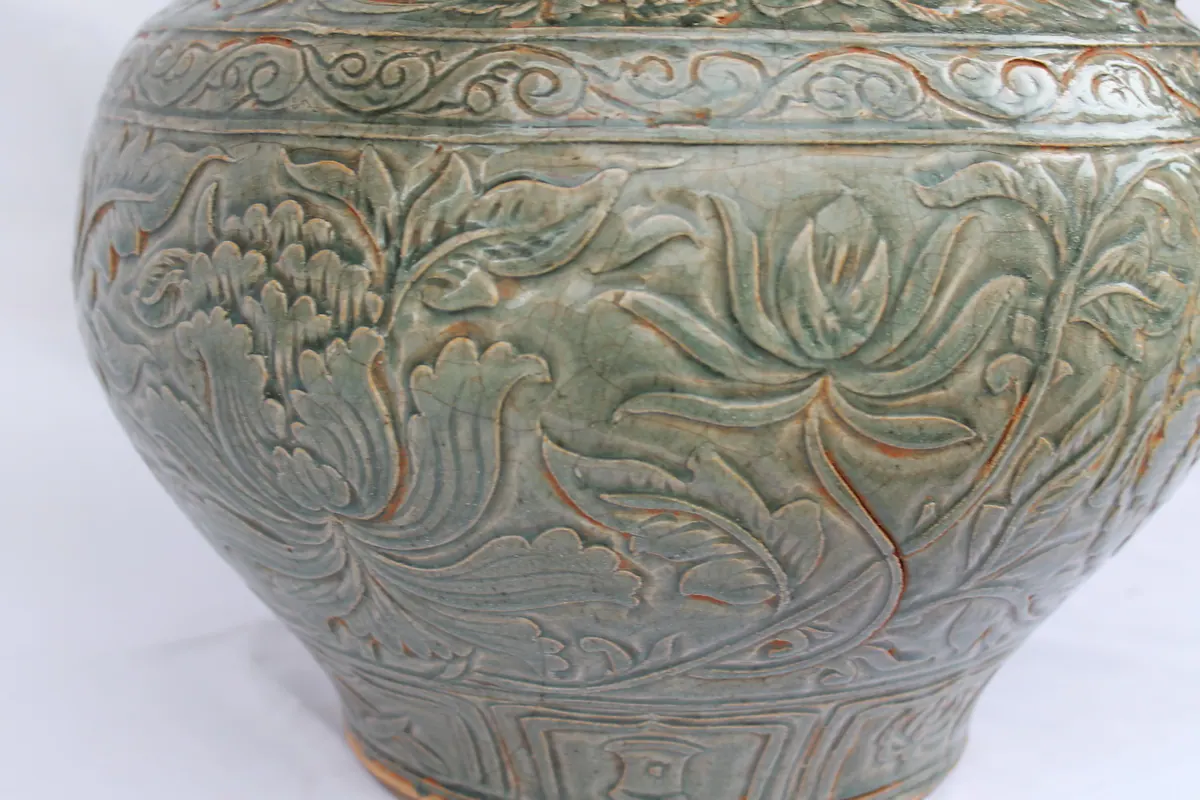
Carving. Cutting a design into the leather-hard body with a blade, deeper than incising, so that the glaze pools in the hollows. It is typical of Song celadon, qingbai and Ding ware.
Clobbering. Enamel colours added in Europe, mainly in the eighteenth century, to Chinese blue and white to make it look more fashionable.
Combing. Groups of fine parallel lines drawn with a comb-like tool, often alongside carving on Song wares.
Incising. Drawing a design with a fine point into the unfired body.
Outline and wash. Painting in which the design is first drawn in outline and then filled with washes of diluted cobalt. Kangxi painters used several strengths of wash to grade the blue within a scene.
Overglaze. Any decoration applied on top of the fired glaze, such as enamels and gilding.
Printed decoration. Designs applied by transfer or stamp instead of by brush, found on some Chinese porcelain from the late nineteenth century. Look for identical repeats and lines made of dots.
Reserve. An area left white, or in the ground colour, so that the design shows against a coloured ground.
Reticulation (loukong). Openwork cut right through the wall of a piece.
Rice-grain decoration (linglong). Small openings cut in the body and filled with glaze so that they show as translucent points. It is known from the eighteenth century and very common in the nineteenth and twentieth.
Sgraffito. Scratching through a coat of slip or enamel to reveal the colour beneath, as on Cizhou stoneware.
Slip decoration. Designs painted, trailed or raised in slip, such as the white-on-blue slip decoration of some Ming and Qing pieces.
Motifs and borders
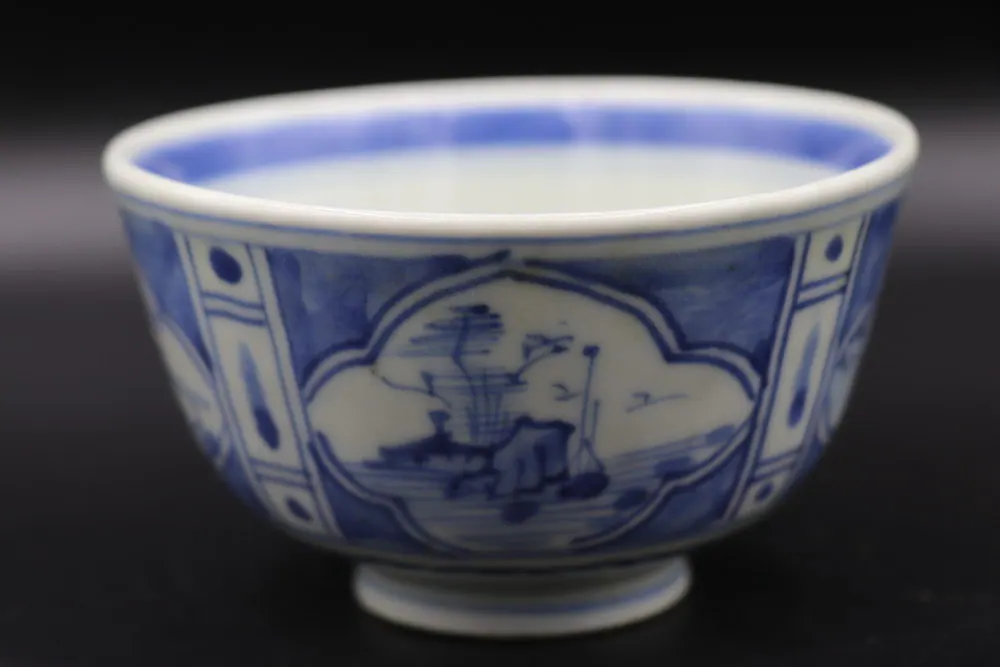
Cartouche. A framed panel, often lobed, containing a separate scene or motif.
Classic scroll. A border of continuous, stylised scrolling, common on Yuan and Ming porcelain.
Cloud collar (yunjian). A band of large, pointed ruyi-shaped panels around the shoulder of a jar or vase, typical of the Yuan period.
Eight Buddhist emblems (bajixiang). The wheel, conch, umbrella, canopy, lotus, vase, paired fish and endless knot. See symbols on Chinese porcelain.
Hundred antiques (bogu). Groups of vases, bronzes, scrolls and scholars' objects, a favourite subject of Kangxi painting.
Keyfret (huiwen). A border of squared, meandering lines.
Lotus panels (lianban). A band of upright petal-shaped panels, usually around the foot or shoulder, also called lappets.
Long Eliza. From the Dutch lange lijzen, tall and slender women, the name European collectors gave to the elegant female figures of Kangxi blue and white.
Ruyi. A cloud-head motif taken from the curved head of the ruyi sceptre, a symbol of good wishes.
Three friends of winter. Pine, bamboo and prunus, plants that endure the cold, painted together as a symbol of steadfastness.
Shapes
Our guide to Chinese porcelain shapes describes the main forms in more detail.
Baluster vase. A vase with a swelling body tapering to a narrow neck and foot.
Bianhu (moonflask). A flattened, round flask, often with two handles at the neck, derived from Middle Eastern metal and glass flasks.
Bitong. A brush pot, a straight-sided cylinder for the scholar's desk.
Brush washer. A shallow bowl for rinsing brushes.
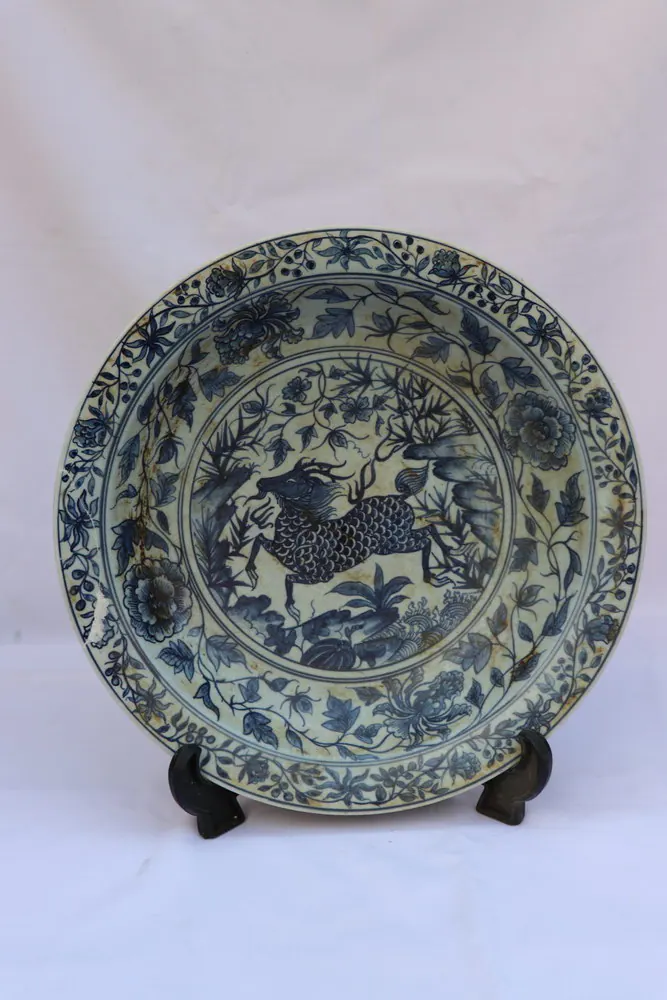
Charger. A large dish, often painted as a single picture.
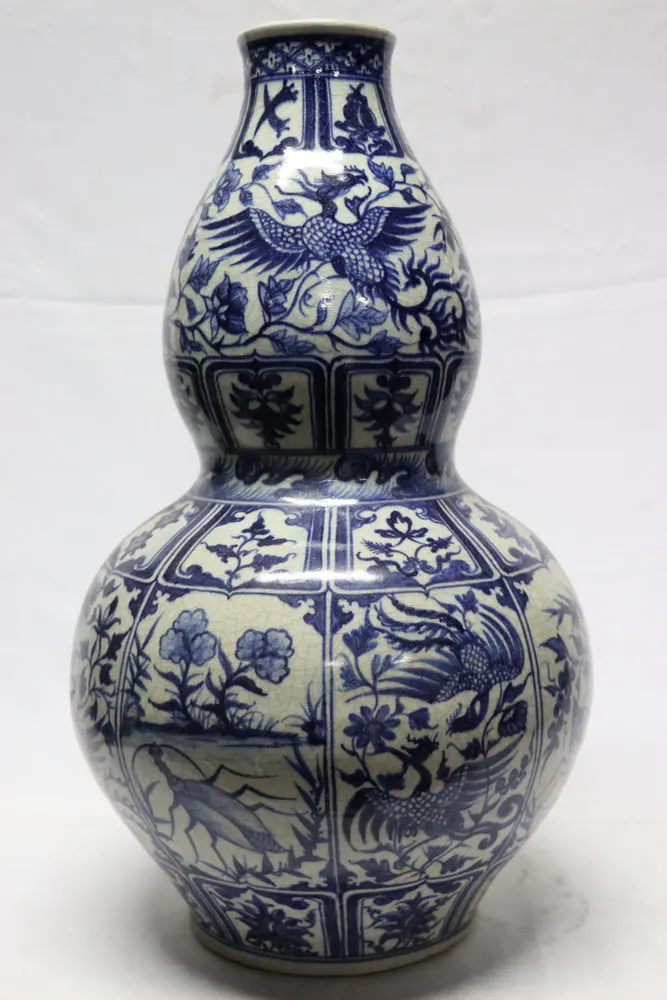
Double gourd (hulu). A vase or bottle formed as two stacked bulbs, a symbol of long life and fertility.
Ewer. A pouring vessel with a spout and a handle.
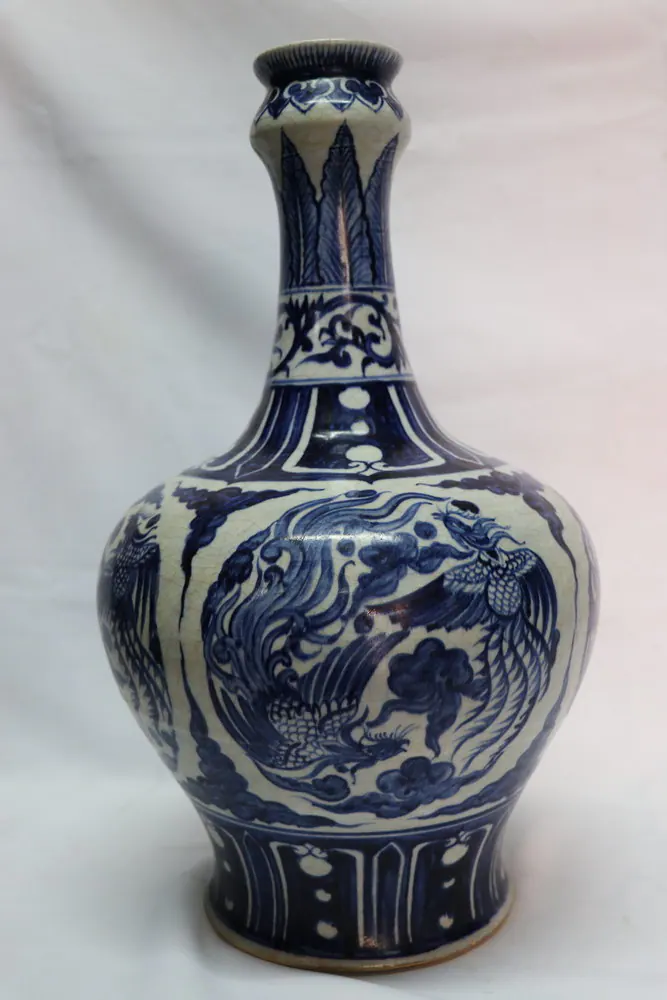
Garlic-head vase (suantouping). A bottle vase whose mouth swells like a head of garlic, common from the late Ming.
Garniture. A matched set of vases and covered jars, usually three or five, made for display on a European mantelpiece or cabinet.
Ginger jar. The Western name for an ovoid jar with a domed cover.
Gu. A tall, flaring beaker vase modelled on an archaic bronze wine vessel.
Guan. A jar, usually wide-mouthed and ovoid.
Hu. A pear-shaped vessel with a flared foot, modelled on an archaic bronze.
Kendi. A pouring vessel with a spout on the shoulder and a straight neck for filling, made chiefly for Southeast Asian markets. See the kendi.
Klapmuts. A Dutch name, after a peasant's cap, for a bowl with a wide, flattened rim, typical of kraak porcelain.
Meiping. "Plum vase": a tall vase with broad shoulders, a narrow base and a small mouth.
Rouleau vase. A tall, cylindrical vase with a short neck and dish-like mouth, typical of the Kangxi reign.
Stem cup (gaozubei). A cup or bowl raised on a tall hollow stem, popular from the Yuan period onward.
Tianqiuping. "Celestial sphere vase": a large globular body with a tall cylindrical neck.
Yen yen vase. A Kangxi vase with a baluster body and a tall, flaring neck, a form popular in the export trade.
Yuhuchunping. A pear-shaped bottle vase with a slender neck and flared mouth.
Zhadou. A jar with a wide, flaring mouth, used for discarded tea leaves and other waste, sometimes called a leys jar.
Marks and inscriptions
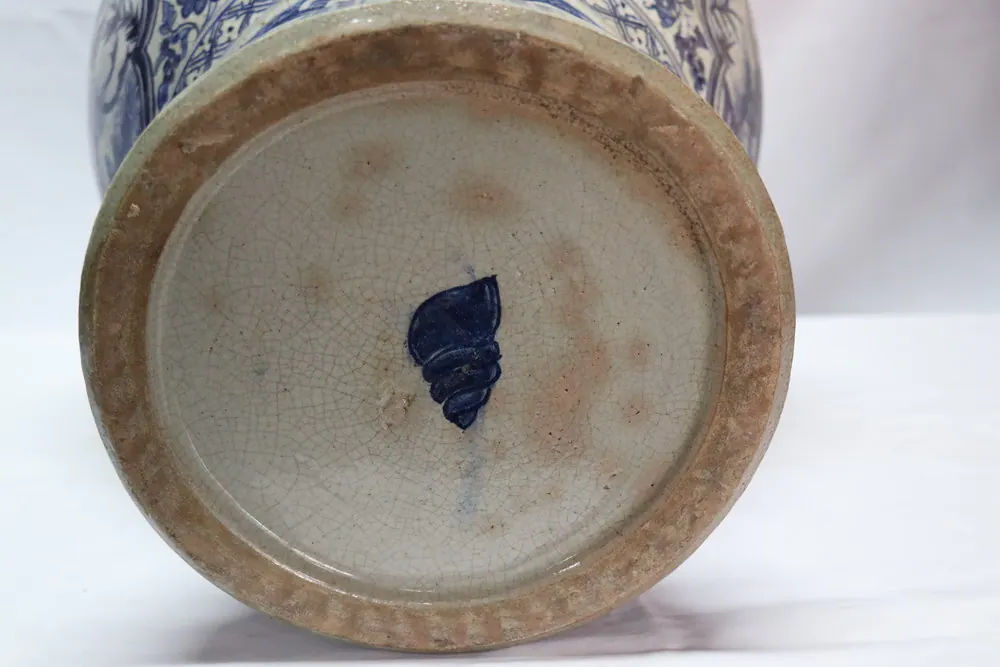
Reign mark (nianhao kuan). A mark naming the reign in which a piece was made, or claims to have been made, in four or six characters. A mark records what was written on a piece, not when it was made. See Chinese porcelain marks.
Six-character mark. The fullest form of reign mark, for example Da Ming Xuande nian zhi, "made in the Xuande reign of the Great Ming". A four-character mark omits the dynasty. See our charts of Ming reign marks.
Regular script (kaishu). Standard written Chinese characters, used for most Ming marks. Compare our Qing reign marks.
Seal script (zhuanshu). An archaic, angular script, increasingly common in Qing reign marks from the eighteenth century.
Apocryphal mark. A reign mark of an earlier period written on a later piece, often in respect for the past rather than to deceive. See apocryphal marks.
Double ring. A pair of concentric blue circles around a mark or in its place. Many Kangxi pieces have an empty double ring.
Hall mark (tangming kuan). A mark naming a hall, studio or workshop, not a reign. See symbol, hall and workshop marks.
Symbol mark. A small picture used as a mark, such as an artemisia leaf, a conch shell or a lingzhi fungus, common in the Kangxi period.
Commendation mark. An auspicious phrase or character, such as fu (good fortune), shou (long life) or fu gui jia qi ("fine vessel for the rich and honourable").
Cyclical date. A date in the sixty-year cycle of the Chinese calendar. Without a reign name it can be read in more than one cycle, sixty years apart.
"China" mark. The word China in English points to export after about 1891, when the United States began requiring country-of-origin marks. "Made in China" is later still. Its absence proves nothing.
Guanyao. "Official ware": porcelain made at the kilns that supplied the court. Not to be confused with Guan ware of the Song.
Minyao. "Folk" or private kiln ware, made for the market rather than to official order. See Ming folk kiln porcelain.
Yuqichang. The Ming name for the court's porcelain works at Jingdezhen, which made official wares. In the Qing the works is more often called the yuyaochang.
Condition terms
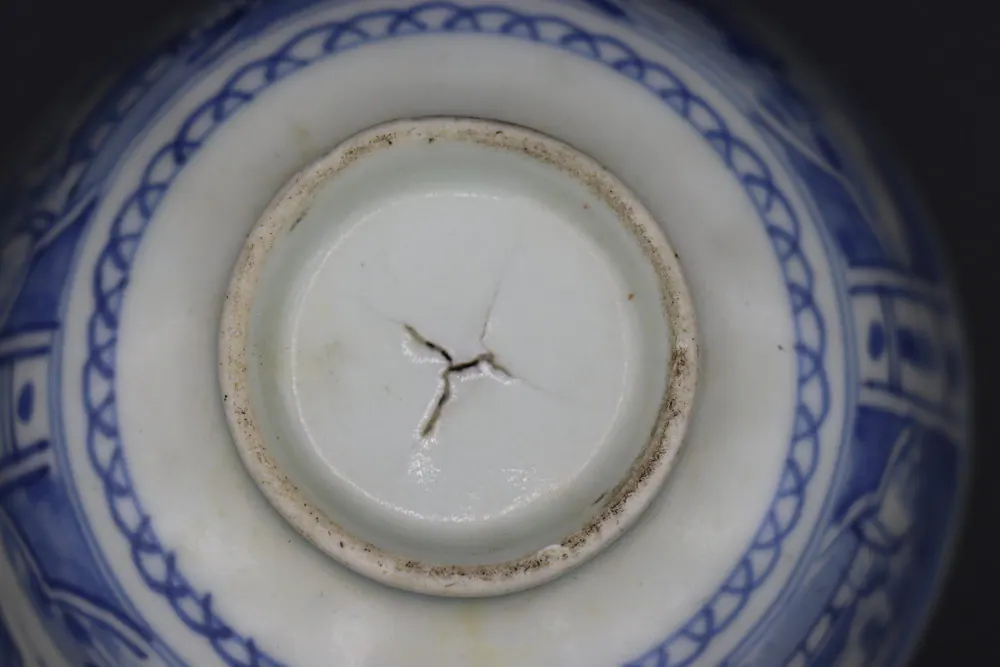
Chip. A loss that takes away body as well as glaze.
Crazing. A network of fine cracks lying in the glaze only. It does not weaken a piece as a crack does.
Dunting. Cracking caused by heating or cooling too quickly in the kiln.
Firing crack. A crack that opened in the kiln. Glaze has often flowed into it and its edges are smooth, which distinguishes it from later damage.
Flake. A shallow, scooped loss, usually of glaze.
Frit. A tiny chip of glaze along a rim or foot, sometimes called a nibble.
Glaze contraction. A small patch where the glaze drew back from the body in the kiln, leaving bare clay with a rolled glaze edge. See glaze contractions.
Glaze line. A short line within the glaze that does not reach the body.
Hairline. A very fine crack through the body, often visible only against a light. See hairlines, glaze lines and cracks.
Mushikui. "Moth-eaten": a Japanese term for the small losses where glaze has flaked from the rims of thinly potted late Ming wares made for Japan, prized in Japanese taste.
Overpaint. Paint and clear coating applied over a repair, often sprayed beyond the damaged area to hide the join.
Pinholes. Tiny craters where gas escaped through the molten glaze.
Restoration. Any repair meant to disguise damage, from filling a chip to rebuilding a neck. See condition and restoration.
Rubbing. Loss of gloss, enamel or gilding on the high points from handling.
Rust spots. Dark iron spots in early cobalt, or brown iron specks in body and glaze. See rust spots.
Staple repair. An old mend in which a break was held together with metal staples set in drilled holes.
Star crack. A crack radiating from a single point, usually in a base or the centre of a dish.
Ultraviolet examination. Viewing a piece under a longwave ultraviolet lamp, under which fills and overpaint often show differently from fired glaze.
Wear. The fine scratches and dulling of old use, strongest on the foot, rim and interior. See signs of wear.
Kilns, wares and periods
Canton porcelain. Export porcelain enamelled in the workshops of Guangzhou (Canton) on blanks made at Jingdezhen, in the eighteenth and nineteenth centuries.
Chine de commande and armorial porcelain. Porcelain made to European order, to European shapes or designs; armorial porcelain carries a family's coat of arms.
Chinese Imari. Chinese porcelain of the early eighteenth century decorated in underglaze blue, iron red and gilding in imitation of Japanese Imari.
Cizhou. Northern stoneware from the Song onward, decorated with white slip, black painting and sgraffito.
Dehua and blanc de chine. The kilns of Dehua in Fujian and their ivory-white porcelain of the Ming and Qing, known especially for figures and cups.
Ding. Northern white ware of the Song, ivory-toned, often carved or moulded, and frequently fired upside down, leaving an unglazed rim that was bound in metal.
Five Great Kilns. Ru, Guan, Ge, Jun and Ding, the wares later writers ranked highest among Song ceramics. See the five great kilns.
Ge. "Elder brother" ware: a greyish or creamy glaze with a double crackle of dark and golden lines. Its kiln and date are still debated.
Guan. "Official" ware of the Song court, best known from the Southern Song kilns near Hangzhou, with thick, crackled bluish or grey glaze over a dark body.
Imari and Arita. Japanese porcelain made around Arita from the seventeenth century and shipped through the port of Imari. See Chinese, Japanese or Vietnamese?.
Interregnum. The years 1436 to 1464, covering the Zhengtong, Jingtai and Tianshun reigns, from which few reign-marked pieces are known.
Jian. Fujian stoneware tea bowls of the Song with dark iron glazes, including hare's fur and oil spot; known in Japan as tenmoku.
Jingdezhen. The porcelain city of Jiangxi province, an important kiln centre in the Song and the leading centre of Chinese porcelain production from the Yuan to the present.
Jizhou. Jiangxi stoneware of the Song, known for tea bowls with tortoiseshell glazes and leaf or paper-cut decoration.
Jun. Northern stoneware of the Song to Yuan with a thick, opalescent lavender-blue glaze, often splashed with copper purple.
Ko-sometsuke. Chinese blue and white of the late Ming made for the Japanese market, loosely painted and often with mushikui rims.
Kraak porcelain. Late Ming export blue and white with panelled borders, named after the Portuguese carracks that carried it. See kraak porcelain.
Longquan. The celadon kilns of southern Zhejiang, active from the Song to the Ming.
Ru. A rare court ware of the late Northern Song from Henan, with a bluish-grey glaze and fine crackle, fired on small spurs that left tiny marks on the base.
Swatow (Zhangzhou) ware. Late Ming export porcelain from the Zhangzhou kilns of Fujian, named after the port of Swatow, with coarse bodies and sand adhering to the base.
Transitional porcelain. Jingdezhen porcelain of about 1620 to 1683, between the late Ming and the reorganisation of the kilns under Kangxi. See Transitional porcelain.
Yaozhou. Northern celadon from Shaanxi, olive green and crisply carved or moulded.