Guide
Symbols on Chinese Porcelain: Fish, Lotus, Phoenix, Qilin and Figure Scenes
Much of the decoration on Chinese porcelain carries a meaning. Fish, lotus, phoenix, peony and qilin each stood for something a buyer would have recognised at once, and many Chinese porcelain symbols are also puns on the words for good fortune. This guide explains how to read the commonest motifs, what the figure scenes on vases and jars show, and how borders and bands help to date a piece.
What to look for
- Name the main motif, then look for its partner: fish with lotus, phoenix with peony, egret with lotus, bats with clouds.
- Say the objects' names aloud in Chinese if you can: many designs are puns that spell out a wish.
- Read the borders as well as the main scene: lotus panels, cloud collars, waves and scrolls changed over time.
- Check that the motif and the way it is drawn both fit the period the piece claims.
- Treat any single motif with caution: popular designs were copied for centuries.
How to read Chinese porcelain symbols: rebus and wish
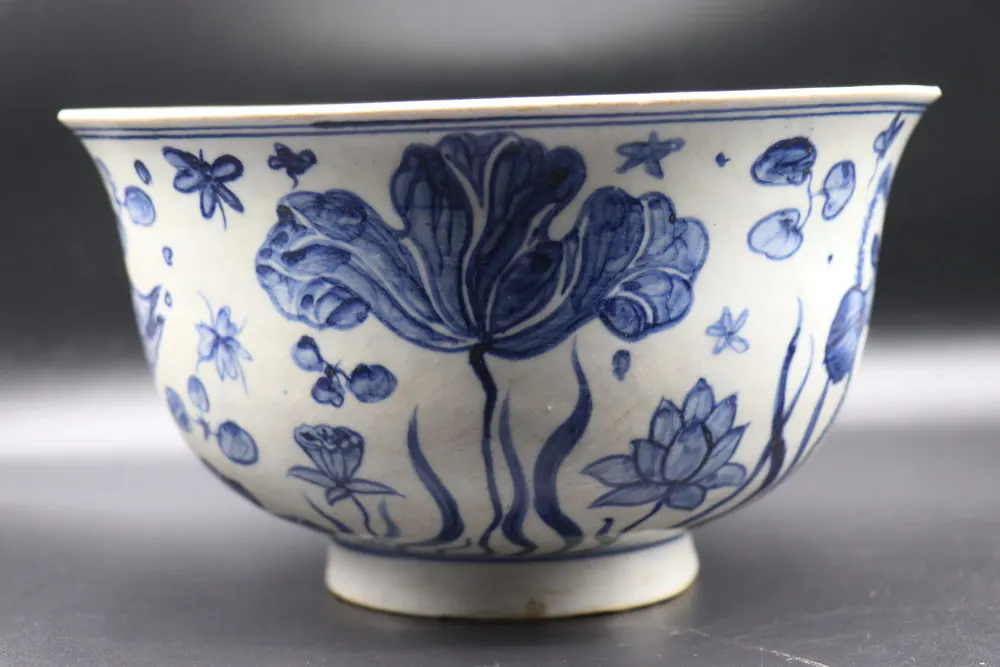
Chinese decoration works in two ways. Some motifs carry a meaning of their own: the lotus stands for purity, the peach and the crane for long life, the pine, bamboo and prunus, the ‘three friends of winter’, for endurance. Others are rebuses, visual puns built on the many words in Chinese that sound alike. A bat, fu, reads as fortune; a vase, ping, as peace; a deer, lu, as an official's salary; a fish, yu, as surplus.
Put together, these images spell out whole phrases. A magpie on a branch of prunus says ‘joy up to the eyebrows’, because the words for magpie and prunus echo those for joy and eyebrows. An egret among lotus wishes a scholar success in one examination after another. Five bats around the character for long life wish for the five blessings. A buyer of the time read such a design as easily as we read the words on a card.
There are also sets of emblems. The eight Buddhist emblems (the wheel, conch, umbrella, canopy, lotus, vase, paired fish and endless knot) appear on porcelain from the Yuan onward, as do the attributes of the Eight Daoist Immortals and the ‘hundred antiques’ of the scholar's study. Not every motif was chosen for its message, and it is easy to over-read. Still, knowing the vocabulary makes sense of combinations that otherwise look random.
The table gathers the puns explained on this page.
| Motif | Chinese word | Sounds like | Meaning |
|---|---|---|---|
| Bat | fu | fortune | Good fortune; five bats wish for the five blessings |
| Vase | ping | peace | Peace |
| Deer | lu | an official's salary | Official success and long life |
| Fish | yu | surplus | Abundance, ‘surplus year after year’ |
| Mandarin fish | gui | high rank | High rank |
| Goldfish | jinyu | gold and jade | Gold and jade |
| Lotus | lian | continuous; incorruptible | Purity; with an egret, success in one examination after another |
| Lotus | he | harmony | Harmony |
Fish, water plants and lotus: abundance and purity
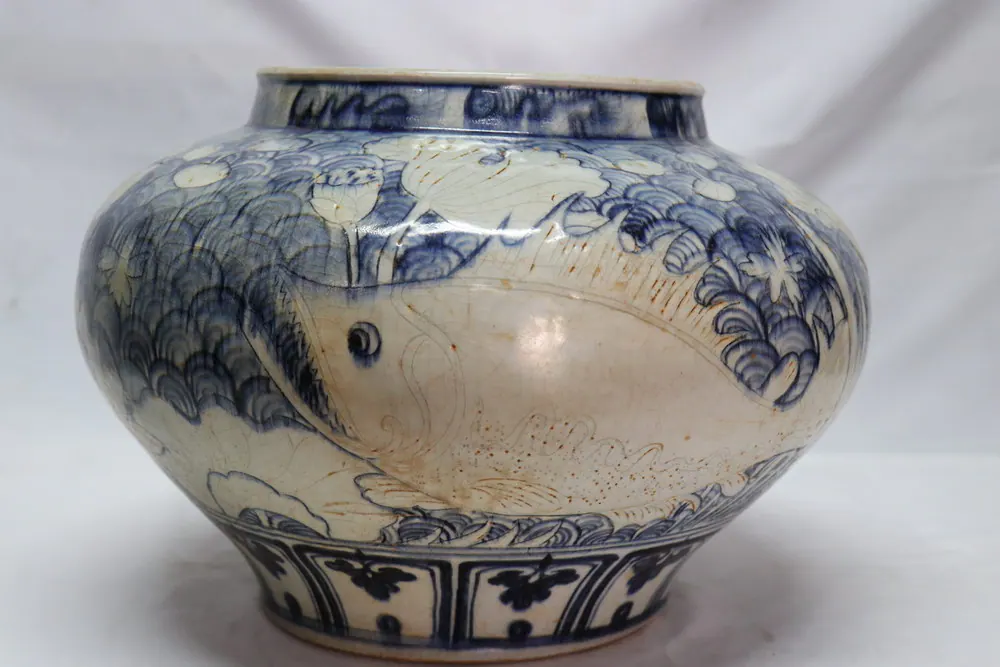
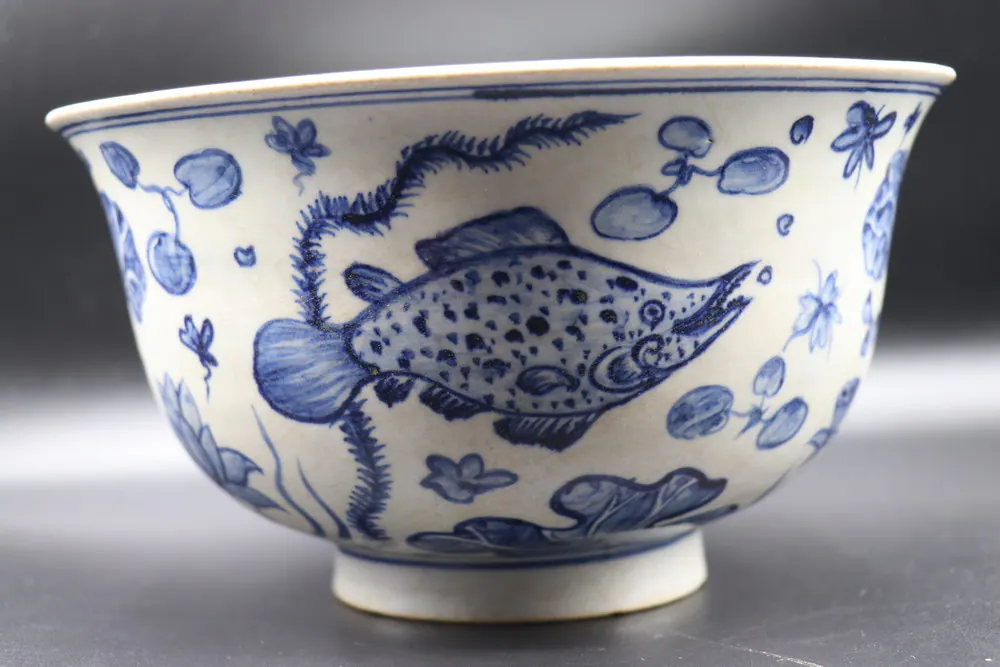
The fish is one of the most popular Chinese porcelain symbols because its name, yu, sounds like the word for surplus. ‘May you have surplus year after year’ is a New Year wish still written today. Particular fish add further meanings. The mandarin fish, gui, echoes the word for high rank. The carp that leaps the Dragon Gate and becomes a dragon stands for success in the examinations. Goldfish, jinyu, sound like ‘gold and jade’, and a pair of fish, one of the eight Buddhist emblems, also stands for a happy marriage.
Yuan painters made the fish among waterweed one of the great subjects of early blue and white: carp, mandarin fish and others swimming among eelgrass, duckweed and lotus, drawn with real observation. Our Yuan blue and white bowl with fish and lotus shows a fish among lotus, ferns and water plants in this tradition. In the Jiajing reign, large jars were painted in enamels with golden carp among water plants.
The lotus grows from mud yet flowers clean, and in Buddhism it stands for purity. Its names also make puns: lian, lotus, sounds like the words for ‘continuous’ and ‘incorruptible’, and he, another word for lotus, sounds like harmony. Lotus appears as a single flower, in continuous scrolls around the body of a vessel, as lotus-petal panels around the foot, and in whole pond scenes with ducks and egrets, a Yuan design sometimes called manchijiao, ‘a pond full of beauty’. Mandarin ducks swimming as a pair in such a scene wish for a faithful marriage.
Phoenix, peony and the flowers of the seasons
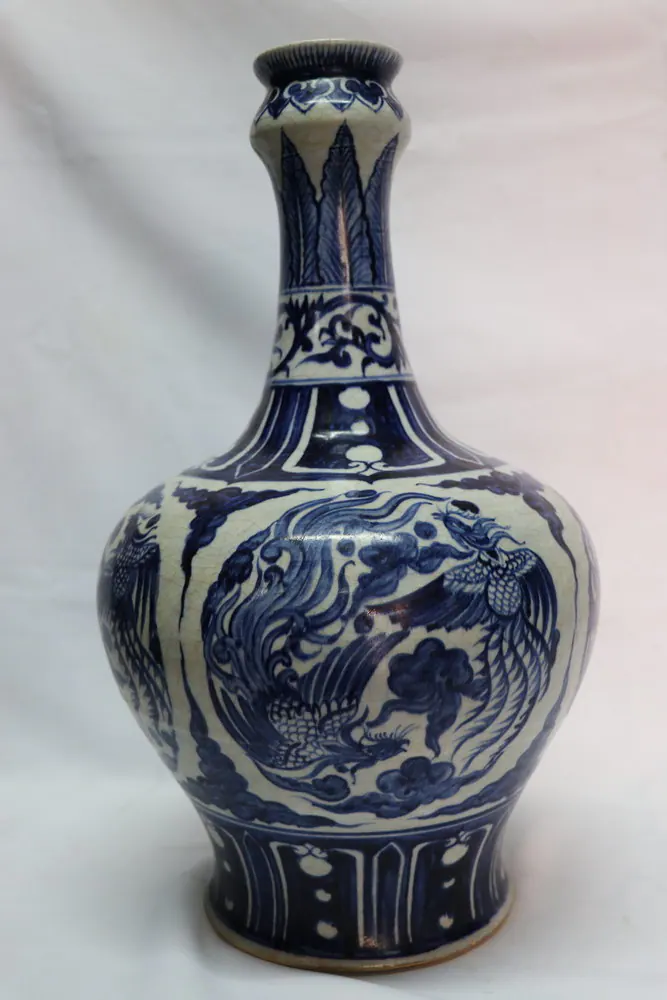
The phoenix, fenghuang, is the first of the birds, a creature of good omen said to appear only in times of peace and good government. It stands for virtue and grace, and when two are shown together they also wish for harmony in marriage. On porcelain the phoenix is drawn with a crested head, a long curving neck, spread wings and a long, streaming tail. On many Yuan and early Ming pieces the birds come in pairs that differ in their tails: one has long, serrated feathers, the other curling, tendril-like plumes, a distinction often read as male and female.
Paired phoenixes circling one another make a natural roundel, and this was a favourite design for the centre of a dish, as on a barbed-rim Yuan charger in our collection, where two phoenixes revolve around each other in the central medallion. On vases, phoenixes fly among clouds in bands around the shoulder or body.
The peony, mudan, is known as the king of flowers and stands for wealth and honour. It is one of the most frequent flowers on Chinese porcelain: large blooms in a continuous scroll made a standard band on Yuan jars and meiping, and peony scrolls stayed in the painter's repertoire for centuries. A phoenix among peonies joins the two meanings in a wish for honour, prosperity and good fortune.
The peony is one of a group of flowers that mark the seasons: peony for spring, lotus for summer, chrysanthemum for autumn and prunus for winter. Painted together, they wish for good fortune all year round. Fruit carries meanings too. The pomegranate, full of seeds, wishes for many sons; the peach is the fruit of immortality; and the finger citron, or Buddha's hand, echoes the words for blessing. Shown together, these three make the ‘three abundances’: of blessings, of years and of sons.
Qilin and other auspicious beasts
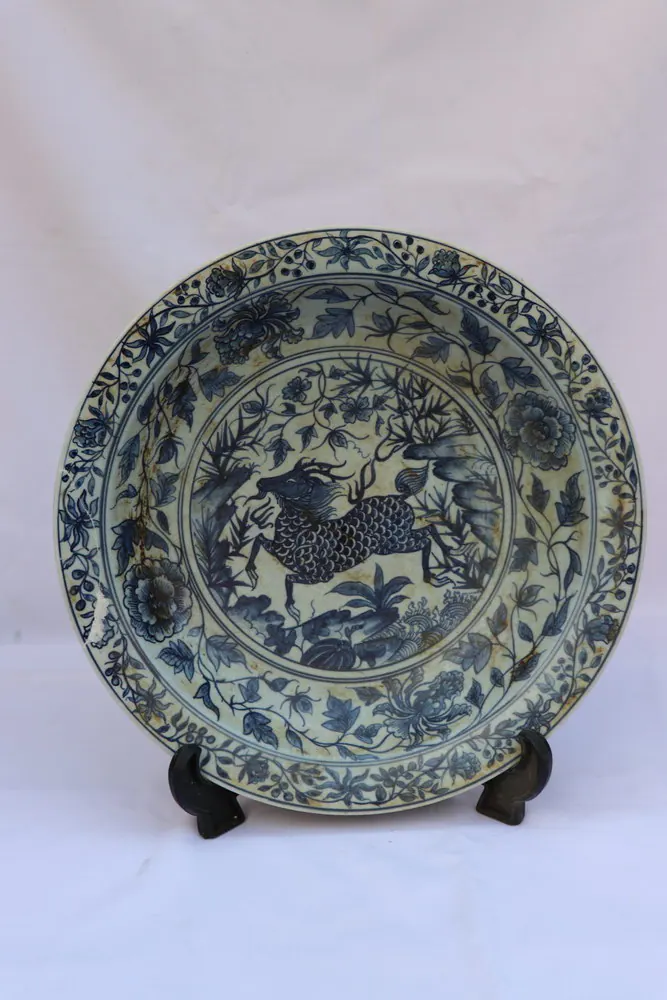
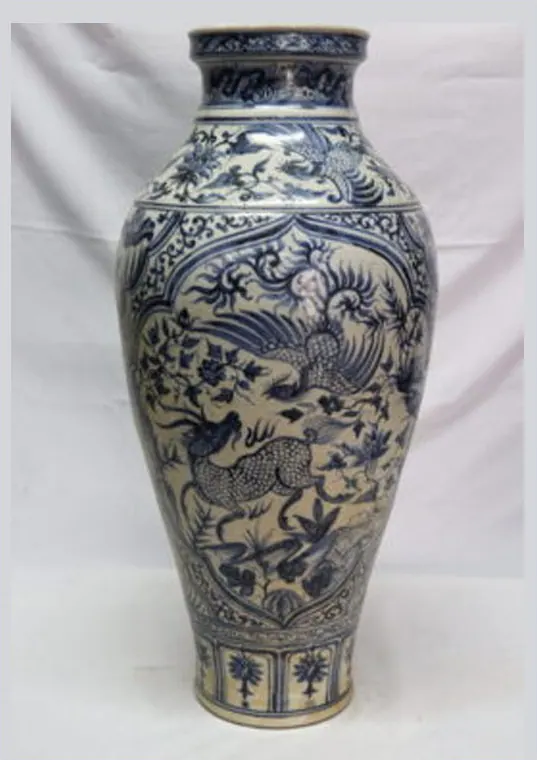
The qilin is a composite beast, usually shown with a dragon-like head, sometimes with horns, a deer's body covered in scales, cloven hooves and a bushy tail, often with flames rising from its shoulders. Western writers once called it the kylin or Chinese unicorn. It is a gentle creature of good omen: tradition holds that one appeared before the birth of Confucius, and the qilin is a symbol of wise rule and of the birth of able sons.
On blue and white of the Ming, the qilin is often shown seated or striding in a landscape of rocks and plantain, sometimes looking back over its shoulder. A Ming blue and white plate in our collection has a qilin in a landscape at its centre, framed by a double ring and a border of peonies. Our collection also includes a meiping painted with a qilin in a cartouche on each side, with foliage incised on the ground between them, which its listing places in the early Yuan.
Other beasts carry their own wishes. The Buddhist lion, often shown playing with a brocade ball, is a guardian. Deer stand for official success and long life, cranes for longevity, and horses, sometimes winged and galloping above waves, for speed and strength.
Figures and stories: warriors, scholars and scenes from plays
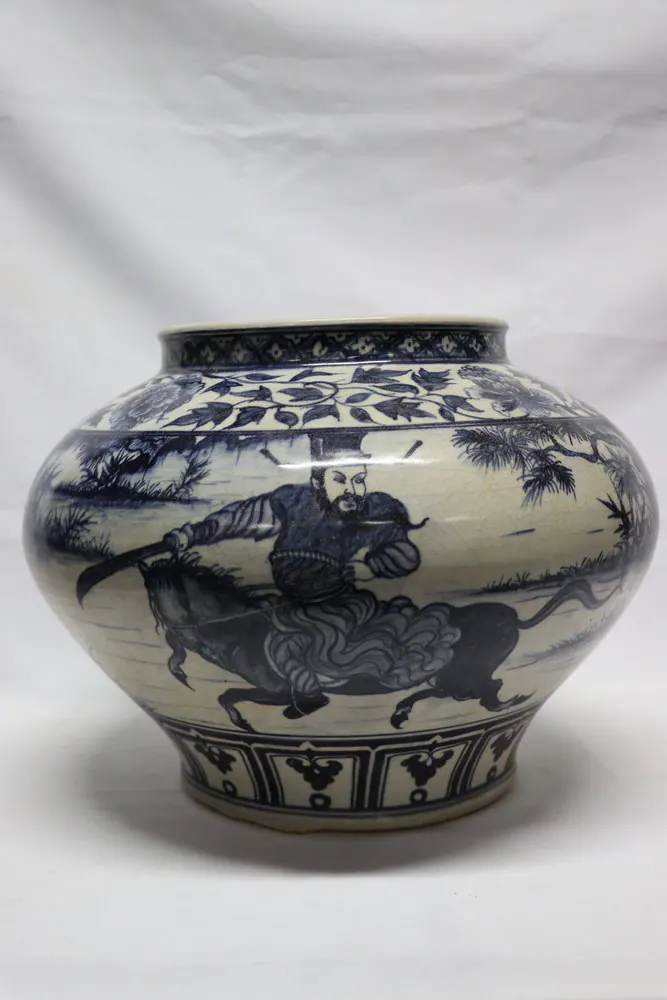
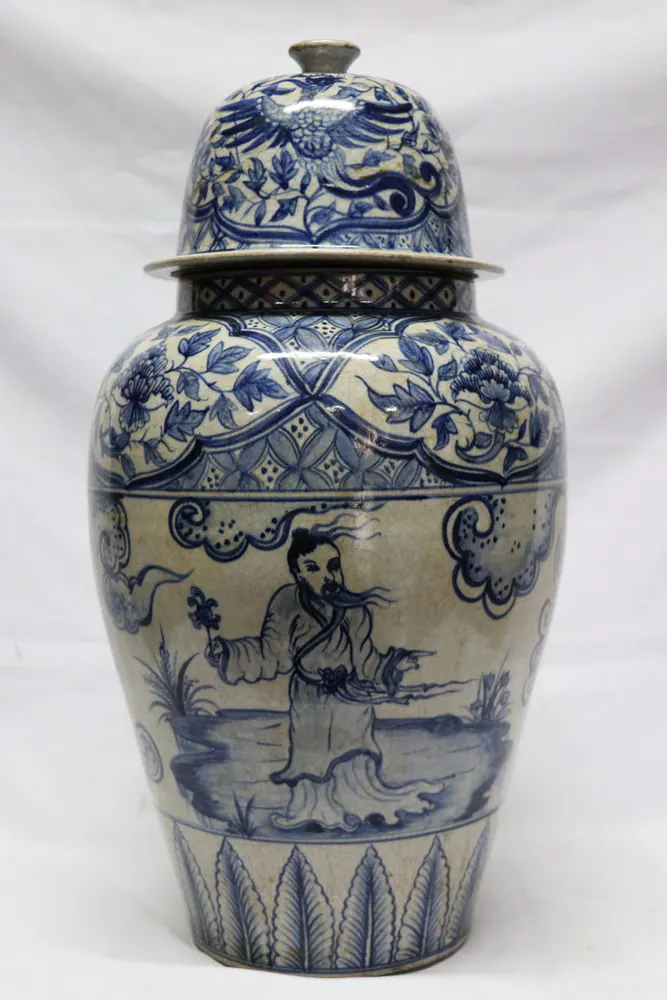
Figure scenes became a major theme in the Yuan, when potters drew on the popular drama of the period and on illustrated printed books. Among the best known Yuan pieces are a meiping showing the minister Xiao He pursuing the general Han Xin by moonlight, and a jar showing the sage Guiguzi coming down the mountain in a carriage drawn by a tiger and a leopard. These scenes were painted around the body of a jar or vase like a continuous scroll.
The warrior on horseback, sword or halberd in hand, is one of the subjects collectors ask about most. Such figures are often heroes from the Three Kingdoms period or from plays and novels, but without an inscription the particular story frequently cannot be named with confidence. A Yuan blue and white jar in our collection shows two mounted warriors, one with a sword and one with a raised spear, in a wooded landscape.
Scholars are the other great figure subject: in gardens and pavilions, playing the qin, viewing paintings, or walking among swirling clouds, a design common in the middle of the fifteenth century. The Eight Immortals, the Seven Sages of the Bamboo Grove, boys at play (a wish for many sons) and elegant ladies all appear, the last famously on Kangxi porcelain, where Dutch buyers called the slender figures lange lijzen, ‘long Elizas’. Narrative scenes returned in force in the Transitional period and under Kangxi, taken from novels such as the Romance of the Three Kingdoms and the Water Margin and from plays such as the Romance of the Western Chamber.
Borders and bands that help to date a piece
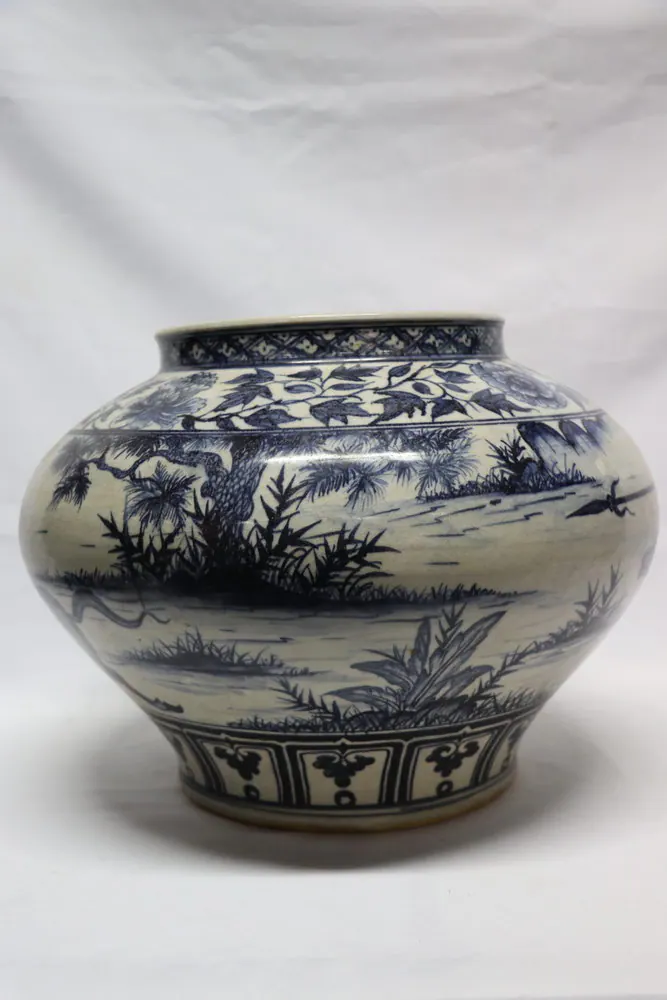
The subsidiary bands on a vase or jar are often more useful for dating than the main scene, because painters repeated them almost without thinking, in the manner of their own time.
- Lotus-petal panels. A ring of upright panels around the foot. On Yuan pieces each panel tends to be drawn separately, with a space between neighbours, and filled with an emblem or a flame-like motif; from the early Ming the panels increasingly share their outlines and become more regular.
- Cloud collars. Large lobed panels, shaped like ruyi heads, hanging from the neck over the shoulder. They are typical of Yuan blue and white and were revived later.
- Waves. Crested waves with foaming, claw-like spray are a Yuan and early Ming border; later waves are often drawn with finer, more regular lines.
- Scrolls and frets. Classic scroll, key fret and diaper borders at the rim and neck changed steadily in their proportions and in how tightly they were drawn.
- Later borders. Kraak panels mark late Ming export ware, Transitional pieces often have stylised tulip borders and lightly incised bands, and Kangxi painters favoured prunus on cracked ice and ruyi-head borders.
Later potters copied earlier borders, sometimes very well, so a border never dates a piece on its own. It is most useful when it contradicts the main design: a Yuan-style scene above a border drawn in a later manner is a warning worth taking seriously. Our page on Yuan blue and white porcelain shows how these bands fit together on fourteenth-century pieces.
Judging motifs on a piece you are considering
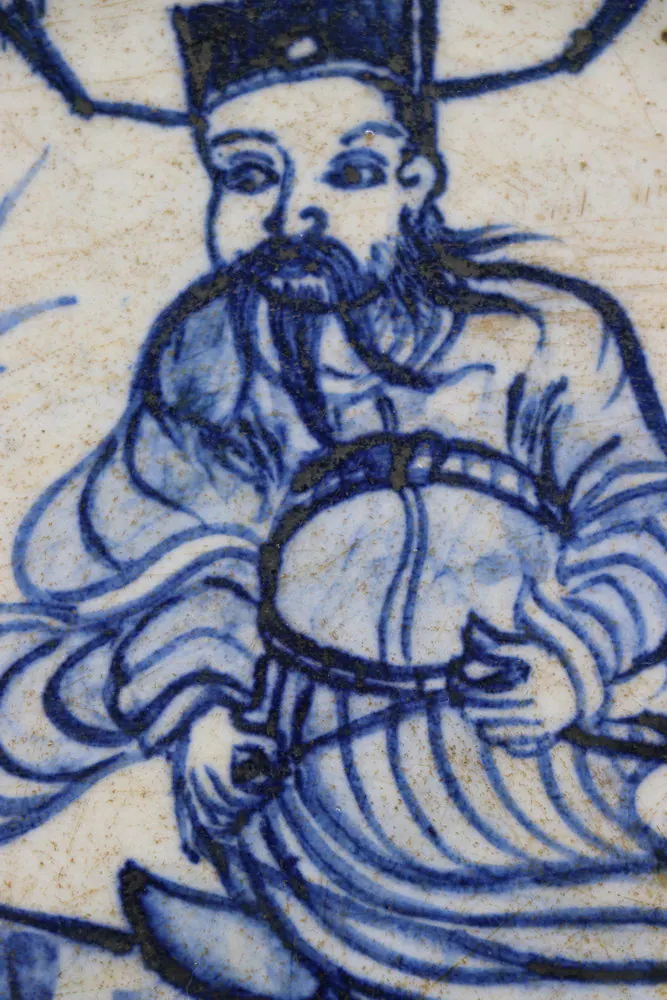
Meaning does not date a piece; drawing does. A fish, a phoenix or a qilin was painted in every century from the Yuan to the Qing, but each period drew it in its own way. Yuan painters worked with bold, fluid brushwork and dense compositions, filling the surface in zones. Fifteenth-century Ming painters generally left more of the white ground open around their subjects, many sixteenth-century painters worked more freely, and Kangxi painters outlined their subjects and filled them with washes in several tones of blue.
Copies tend to give themselves away in the line. A hesitant or overworked outline, a motif copied from a photograph of a famous piece without its natural variations, or a combination of subjects and borders from different periods should make you look harder at everything else. The right motif painted in the wrong hand is a common sign of a later piece.
For the wider story of how painting styles changed, see our history of Chinese blue and white porcelain, and for the shapes that carry these designs, our guide to Chinese porcelain shapes.