Guide
Chinese Porcelain Marks: How to Read and Date Them
Chinese porcelain marks are the characters or emblems painted, incised or stamped on a piece, usually on its base. This guide explains how to read a reign mark, which forms each period used, the other kinds of mark you will meet, and why a mark on its own never dates a piece.
What to look for
- Read the mark in columns, top to bottom, starting on the right, and check that the middle characters name a real reign.
- Check that the number of characters, the script and any border suit the reign the mark names.
- Look at the calligraphy: a period mark is written fluently in the hand of its own time, not copied stroke by stroke.
- Compare the blue of the mark with the blue of the decoration: they should look as though they were fired together, under one glaze.
- Judge the body, foot, glaze, shape and painting first, and only then ask whether the mark agrees with them.
- Describe a mark as a mark: "with a Kangxi mark" records what is written, not when the piece was made.
How to read Chinese reign marks
Most of the Chinese porcelain marks that collectors study are reign marks. A standard Ming or Qing reign mark has six characters and follows a fixed formula: the dynasty, the era name of the reigning emperor, and a phrase meaning "made in the period". The mark 大明宣德年製 reads Da Ming Xuande nian zhi, "made in the Xuande reign of the Great Ming". A Qing mark begins 大清, Da Qing, "Great Qing".
The characters are read in columns from top to bottom, beginning with the right-hand column. A six-character mark is usually written in two columns of three, sometimes in three columns of two, and occasionally in a single horizontal line, which is read from right to left. The first two characters give the dynasty, the middle two the era name, and the last two the formula nian zhi.
The era name, or nianhao, is the name given to a span of years, not the emperor's personal name. Ming and Qing emperors normally kept one era name for the whole of their reign, which is why collectors speak of "the Xuande emperor" or "a Kangxi mark". A new era usually began with the new year after an emperor came to the throne, so era dates often start a year later than the reign itself. One small variation is worth learning early: the marks of the Longqing reign end in 造 (zao) rather than 製 (zhi). Both mean "made".
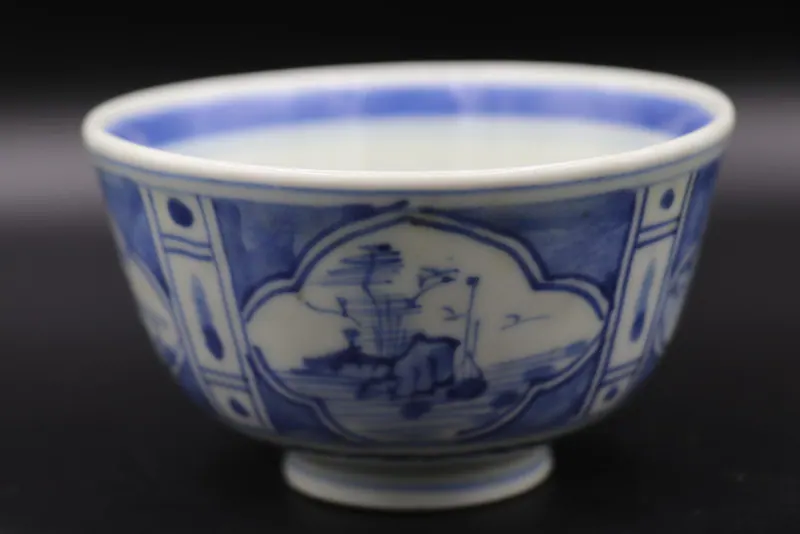
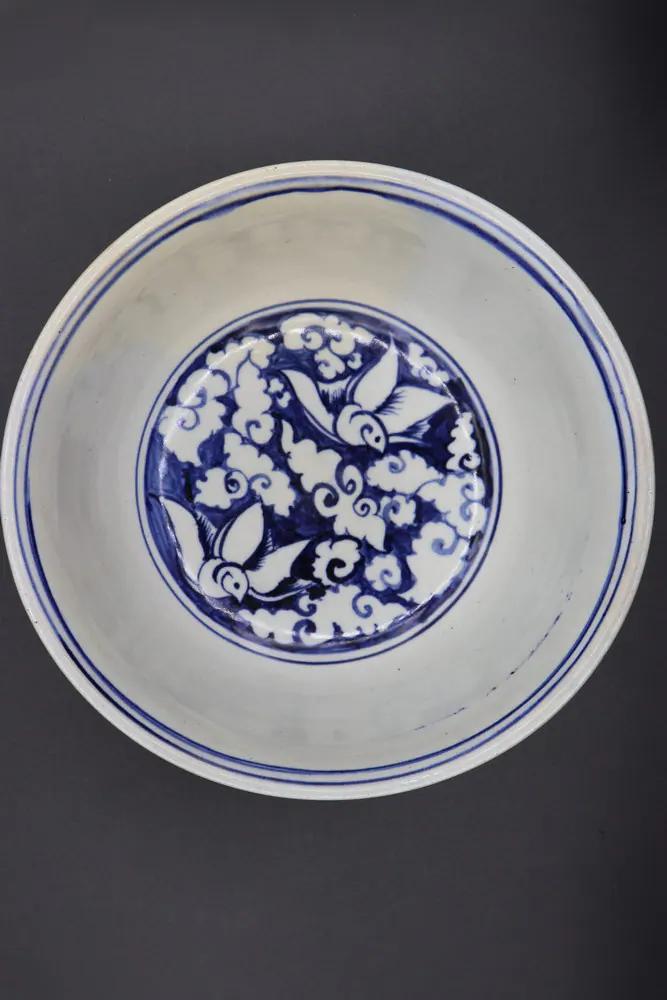
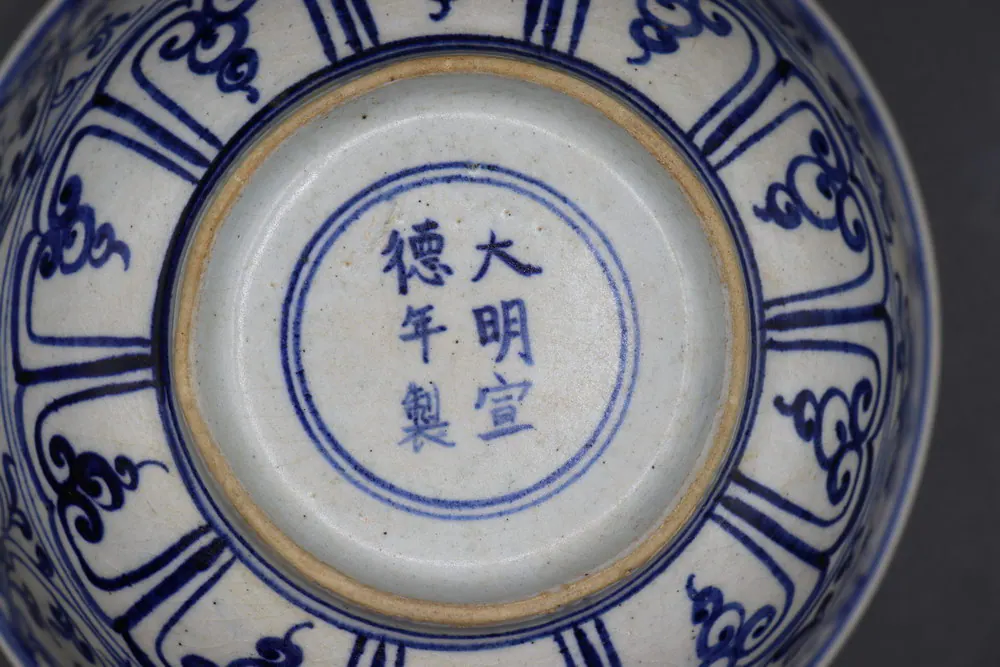
The base of a blue and white bowl in our collection with a Xuande mark, shown at the top of this page, has the standard layout: six characters in two columns of three, inside a double ring in underglaze blue.
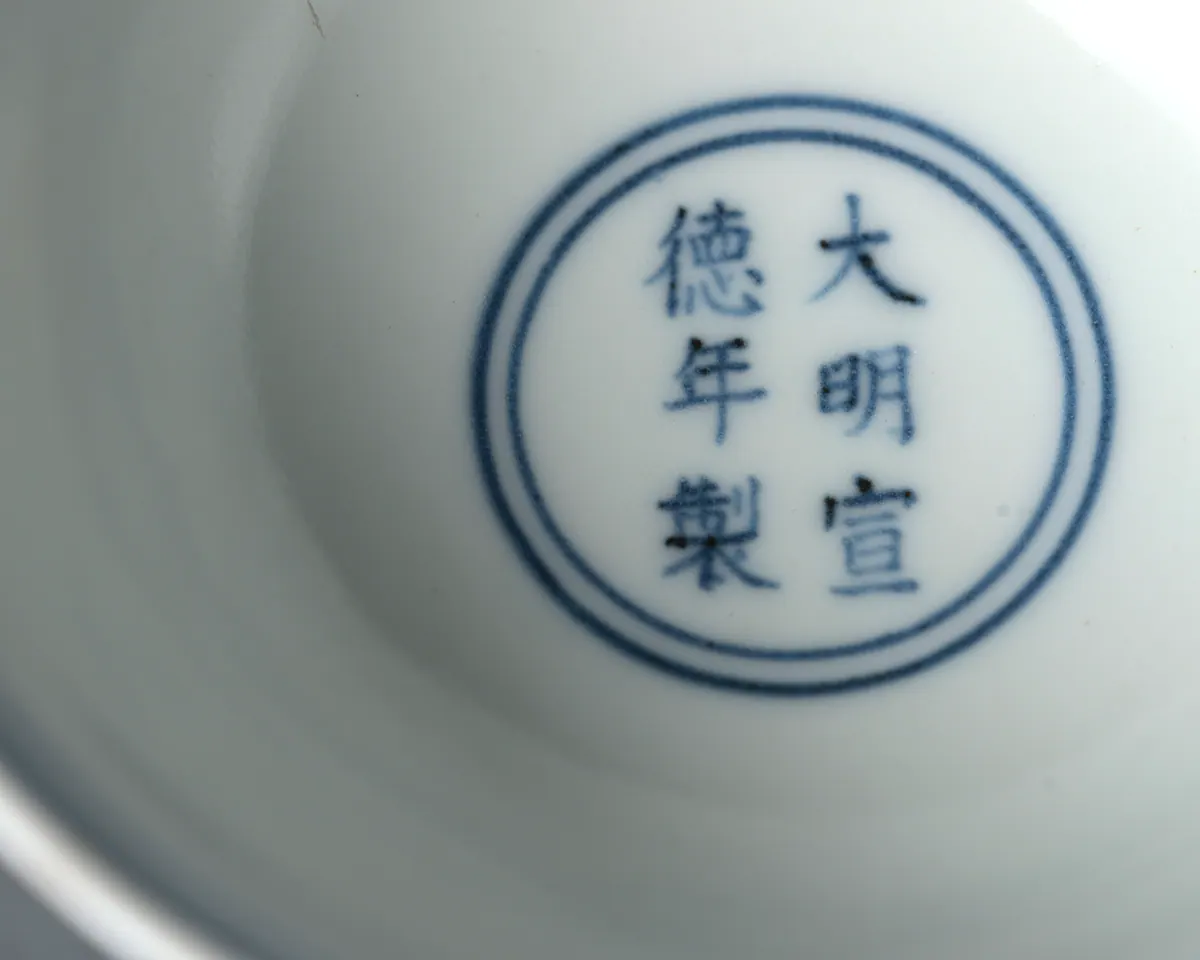
- 大 Da great, the first half of the dynasty name
- 明 Ming completing the dynasty: Da Ming, the Great Ming
- 宣 Xuan the first half of the era name
- 德 De completing the era name, Xuande
- 年 nian year, here meaning the reign period
- 製 zhi made: nian zhi, "made in the period"
Six characters or four, regular or seal script
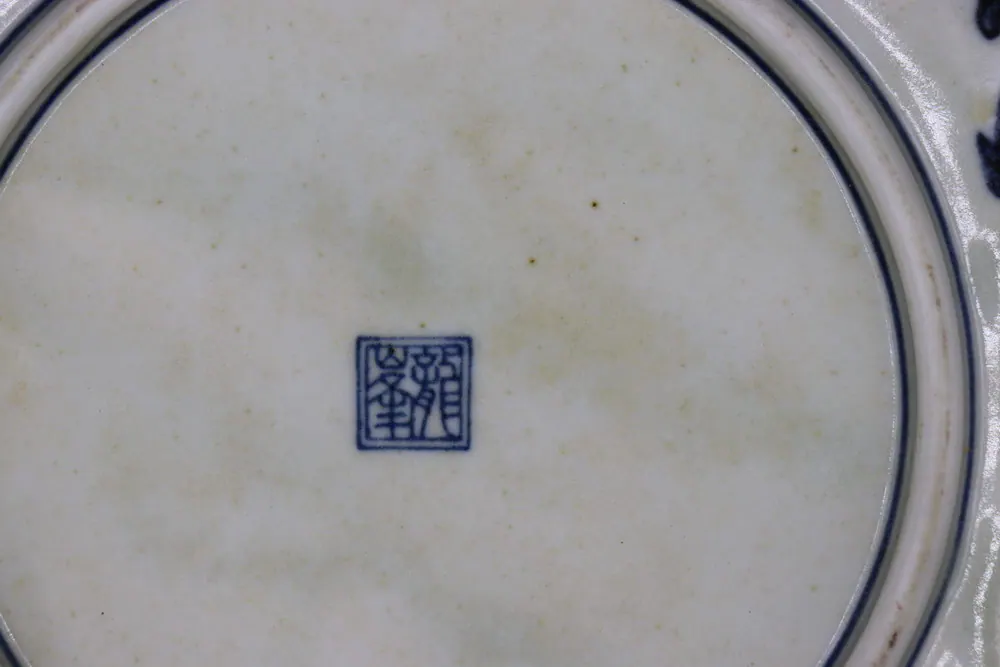
Beyond the standard six-character mark, the form of a mark varies in ways that matter.
- Four characters. A four-character mark leaves out the dynasty, as in 宣德年製, Xuande nian zhi. It is the accepted form under Yongle and appears alongside the six-character mark in some later reigns.
- Regular script. Kaishu, the standard written hand, is used for almost all Ming marks and for most Kangxi marks.
- Seal script. Zhuanshu is an archaic, angular script taken from seal carving. The six-character seal-script reign mark became the usual form on Qing imperial porcelain under Qianlong and stayed common into the nineteenth century. In the Ming it is rare; the accepted Yongle marks are its best-known use.
- Borders. A mark may sit inside a double ring, inside a double square or with no border at all. The border is part of a reign's style: Chenghua marks on small cups, for instance, are usually framed by a double square.
- Technique. Most marks are painted in underglaze blue. Others are incised or impressed in the body, written in overglaze enamel (often iron-red or blue on enamelled Qing wares), or painted faintly under the glaze in the technique called anhua, "hidden decoration".
- Placement. The recessed base inside the foot ring is usual. Xuande marks also appear in a line below the rim or on the shoulder, and some marks are written inside a bowl or cup.
Each reign had its habits. A mark whose form does not suit the reign it names is the first warning sign, however well it is written.
When reign marks began
Characters appear on Chinese ceramics long before reign marks. Some early northern white wares carry the incised character 官 (guan, "official"), and Yuan white wares of the shufu type have the characters 樞府 moulded inside. Marks like these record an office or an order. They do not name a reign.
The first Ming emperor did not mark his porcelain. No Hongwu reign mark on porcelain is accepted as genuine: court porcelain of the Hongwu reign (1368 to 1398) is unmarked, and it is dated by its style and by excavation at the imperial kiln site in Jingdezhen.
Reign marks begin under Yongle (1403 to 1424), but they are rare. Accepted Yongle marks read 永樂年製, Yongle nian zhi, in four characters of seal script. Most are incised, impressed or in anhua on white wares; a few are painted in underglaze blue inside the small cups known as press-hand cups. No accepted period piece has a six-character Yongle mark. Yongle marks were copied from the late Ming onwards.
Regular marking starts with Xuande (1426 to 1435), the first reign whose imperial porcelain was marked as a matter of course. After that the practice was not continuous. Court porcelain of the three reigns between 1436 and 1464 is unmarked, and marks of the last Ming reigns are scarce. The Qing court took up the practice again, and from the Kangxi reign onwards most imperial porcelain carries the mark of its reign. The Ming emperors page sets out who reigned when.
Private kilns, which made the great bulk of Chinese porcelain, marked their wares far less consistently. Some used the mark of the reign in progress, some wrote the mark of an admired earlier reign, and many used auspicious phrases, emblems or no mark at all. On a private-kiln piece a reign mark is a matter of custom or commerce, not a statement of origin. Our guide to Ming folk kiln porcelain covers these everyday wares.
The kinds of mark you will meet
Identifying Chinese pottery marks starts with knowing which kind of mark you are looking at.
- Reign marks name a reign. When a piece was made in the reign its mark names, the trade calls it "mark and period".
- Apocryphal marks name an earlier reign than the one in which the piece was made. They are very common, and many were written in homage rather than to deceive. Our guide to apocryphal marks explains why.
- Hall marks name a hall, studio or pavilion, and usually include 堂 (tang, "hall") or 齋 (zhai, "studio"). Some belong to imperial buildings, such as 慎德堂製, Shende tang zhi, for the Daoguang emperor's hall in the Yuanmingyuan. Others are private or commercial.
- Auspicious and dedication marks offer good wishes or praise the vessel: 福 (fu, good fortune), 壽 (shou, long life), 長命富貴 ("long life, wealth and honour") or 富貴佳器 ("a fine vessel for the rich and honoured"). They are typical of private-kiln wares of the sixteenth and seventeenth centuries.
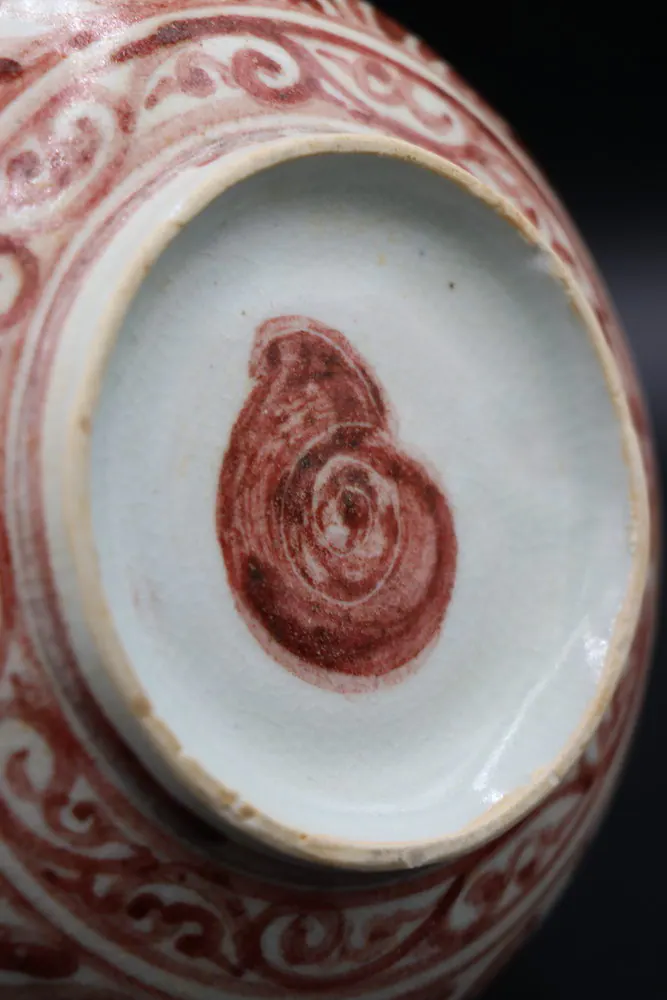
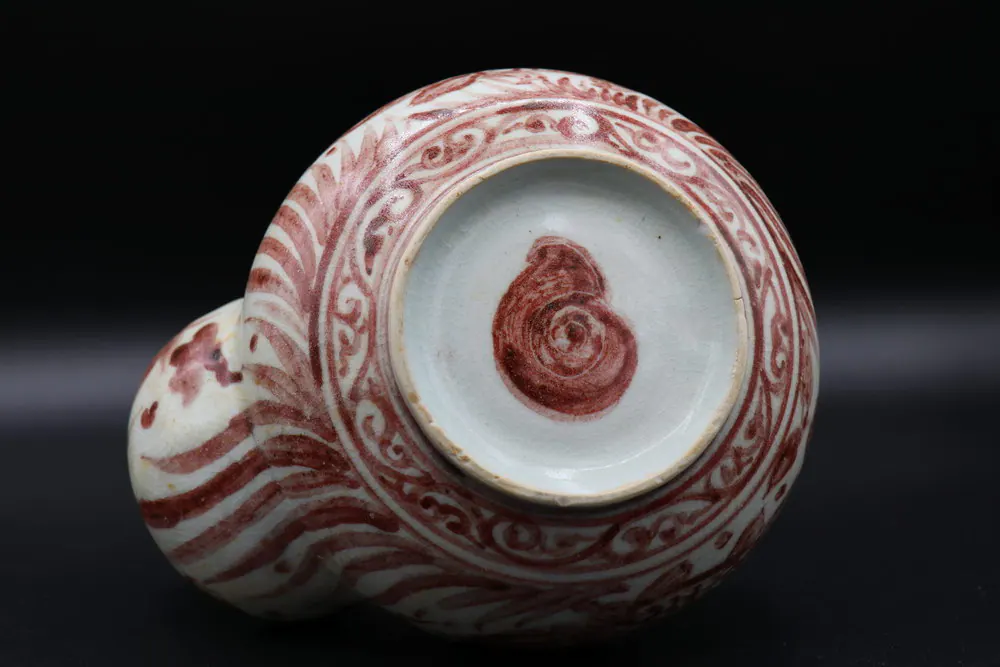
- Symbol marks use an emblem instead of words: an artemisia leaf, a lingzhi fungus, a conch shell or a pair of fish, often inside a double ring. They are especially common in the Kangxi period. The base of an underglaze red kendi in our collection is painted with a conch shell.
- Workshop and potters' marks name a maker or a shop. They become more frequent on nineteenth- and twentieth-century porcelain.
- Cyclical dates give a year in the sixty-year cycle, such as 丙寅 (bingyin). The cycle repeats, so the right sixty-year span has to be fixed by style. They appear on some late Ming and Transitional porcelain, when reign marks were scarce.
- Republic and later marks include the Hongxian mark (洪憲) of Yuan Shikai's short-lived imperial title of 1916; most porcelain bearing it was made later. Porcelain exported to the United States after 1891 may be marked "China" in English, and "Made in China" came later still.
Hall, symbol and workshop marks have a guide of their own: symbol, hall and workshop marks.
Why a mark proves little on its own
A mark records what was written on a piece, not when the piece was made. That is the most important point about Chinese porcelain base marks, and it follows directly from their history.
Potters copied the marks of admired reigns from the sixteenth century onwards. Jiajing and Wanli potters wrote Xuande and Chenghua marks. Kangxi potters wrote Chenghua, Xuande and Jiajing marks. Nineteenth- and twentieth-century workshops wrote Kangxi, Yongzheng and Qianlong marks, and modern reproductions carry every famous mark there is. Many of these later pieces are good antiques in their own right, but the mark does not date them.
The reverse is also true. A great deal of genuine early porcelain carries no mark, including most private-kiln wares and whole groups of imperial wares, so the absence of a mark says nothing against age. A genuine mark can also sit on a piece that was enamelled or redecorated long after it left the kiln, so the mark and the decoration may not be of one date.
Experienced collectors therefore read the piece before the mark. The body, the foot, the glaze, the shape and the painting come first; the mark then either agrees with them or raises a question. Our guide to reading the base covers the evidence around the mark. For the wider picture, see our page on detecting fakes.
How to judge a mark
When you do come to the mark, look at four things.
- The calligraphy. Imperial marks were written by practised hands, and each period has a recognisable style that specialists learn from documented examples. Later copies often give themselves away through stiff or hesitant strokes, uneven spacing or characters that are subtly wrong. An apocryphal mark is usually written in the style of its own time rather than of the reign it names, which makes the calligraphy itself a clue to date.
- The blue. A mark in underglaze blue should share the tone and behaviour of the blue in the decoration. Early Ming cobalt often gathers into darker spots where the pigment lay thick; later blues are usually purer and more even. A mark in a flat, inky blue on a piece painted in a soft, silvery blue needs explaining. Our guide to cobalt blue describes how the colour changed.
- The glaze over it. An underglaze mark should lie under the same glaze as the rest of the base, with the same bubbles, tint and wear. A blue mark that seems to sit on top of the glaze, or glaze that changes character around the mark, suggests work added later.
- The piece around it. The form, border and script of the mark must suit the reign, and the piece must suit the mark. A mark of the right reign on a shape that reign did not make, or on a body and foot of another period, is a later mark however well it is written.
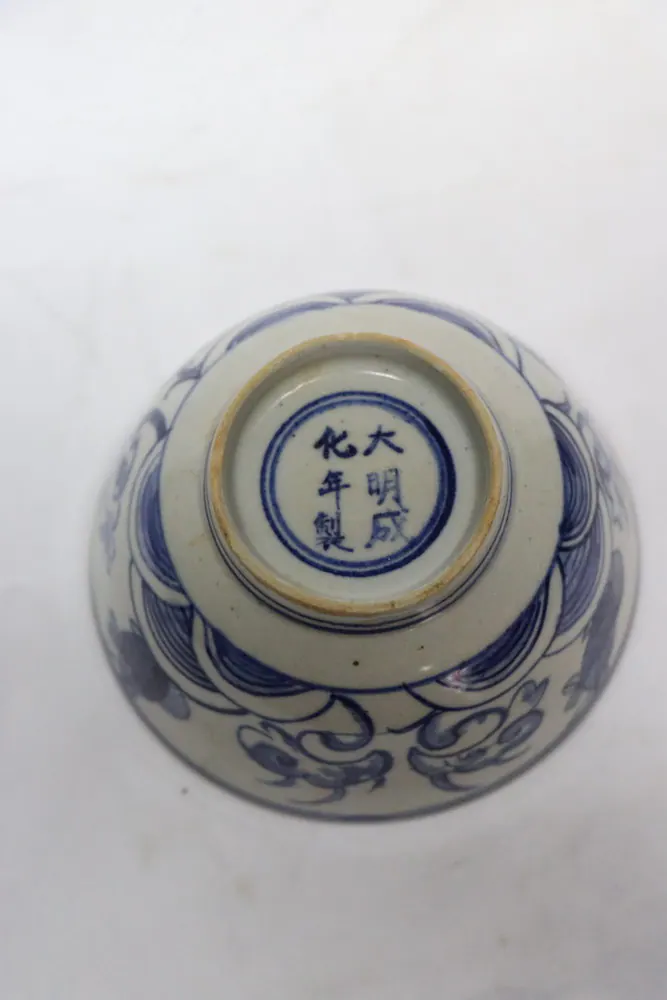
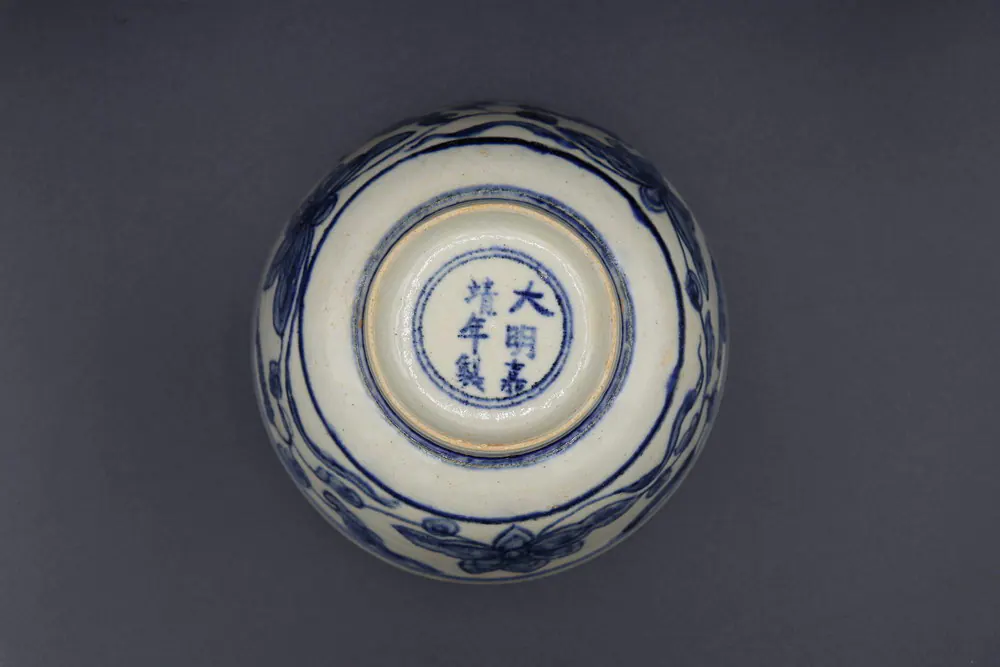
Photographs help only if they show the whole base. The base of a blue and white bowl in our collection with a Jiajing mark is photographed so that the mark, its double ring and the painting on the outside can be seen in one view, which is the view to ask for when you inquire about any marked piece.
The Ming and Qing reign mark charts
This guide covers the principles. For the marks themselves, reign by reign, use the charts.
Our chart of Ming reign marks runs from Hongwu to Chongzhen. It gives the exact characters of each mark, the years of each era name, and what collectors should know about each reign, including the reigns that left few or no marks.
The chart of Qing reign marks runs from Shunzhi to Xuantong and shows how regular and seal script alternated through the dynasty. The Qing emperors page gives the history behind each name.
In our own listings we describe marks by what they say. A title such as "bowl with a Jiajing mark" reports the inscription on the base; it is not in itself a claim about when the bowl was made. We think that is the only honest way to write about marks, and it is the habit we would encourage in any collector.