Guide
Late Qing and Republic Porcelain (1850 to 1949): Styles, Marks and Copies
A great deal of the Chinese porcelain now in family collections was made between the Taiping Rebellion and 1949: late Qing and Republic period porcelain, much of it carrying the marks of earlier reigns. This guide explains what Jingdezhen made in those decades, from Guangxu imperial wares and signed enamel painting to the Hongxian mark and Republic copies, and how to date a piece from the period.
What to look for
- Read any inscription. A painter's name and a cyclical date often place a piece in the late Qing or Republic, but the cycle repeats every sixty years, so match it to the style.
- Treat Hongxian and Jurentang marks as evidence of style, not proof of a date in 1916.
- Look at the enamels. Pale washes with ink-like outlines suggest qianjiang painting; strident pinks and lime greens usually point later.
- Set an eighteenth-century mark against the porcelain beneath it. A very white, glassy body with a Qianlong mark is often Republic.
- Look for printing: identical repeated motifs, flat even colour or a fine dot pattern show transfer or stencil work.
- Check the base for "China" or "Made in China", which usually points to a piece exported after 1891.
Jingdezhen after the Taiping destruction
The Taiping Rebellion (1850–1864) reached Jingdezhen in the 1850s, and the imperial works were destroyed in the fighting. Private kilns suffered too. When the imperial factory was rebuilt in the mid-1860s under the Tongzhi Emperor, the town had to recover its skills as well as its buildings.
It did so quickly. One of the first great commissions was porcelain for the emperor's wedding in 1872, much of it famille rose on yellow and other coloured grounds. At the same time the private kilns expanded to meet a growing domestic market and a steady export trade, and it is from these decades onwards that the bulk of surviving Qing dynasty porcelain comes.
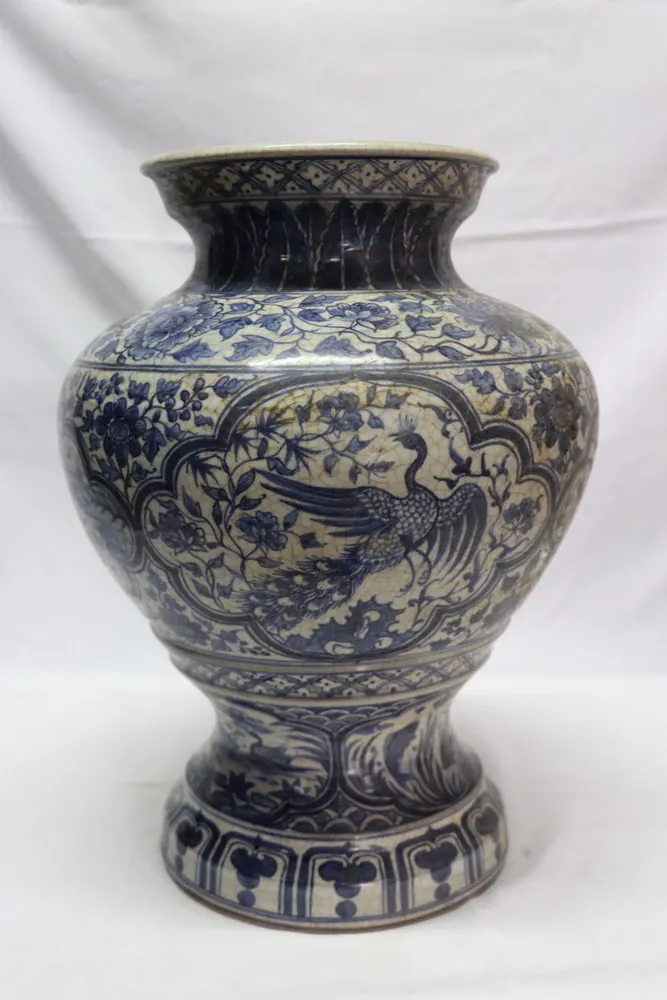
Private kilns made porcelain for every level of Chinese life: dinner and tea wares, large vases and jars for reception halls, cylindrical hat stands, and pieces painted with auspicious symbols and inscriptions for birthdays, weddings and the New Year. Late Qing porcelain of this kind is plentiful, and the quality ranges from routine to very fine.
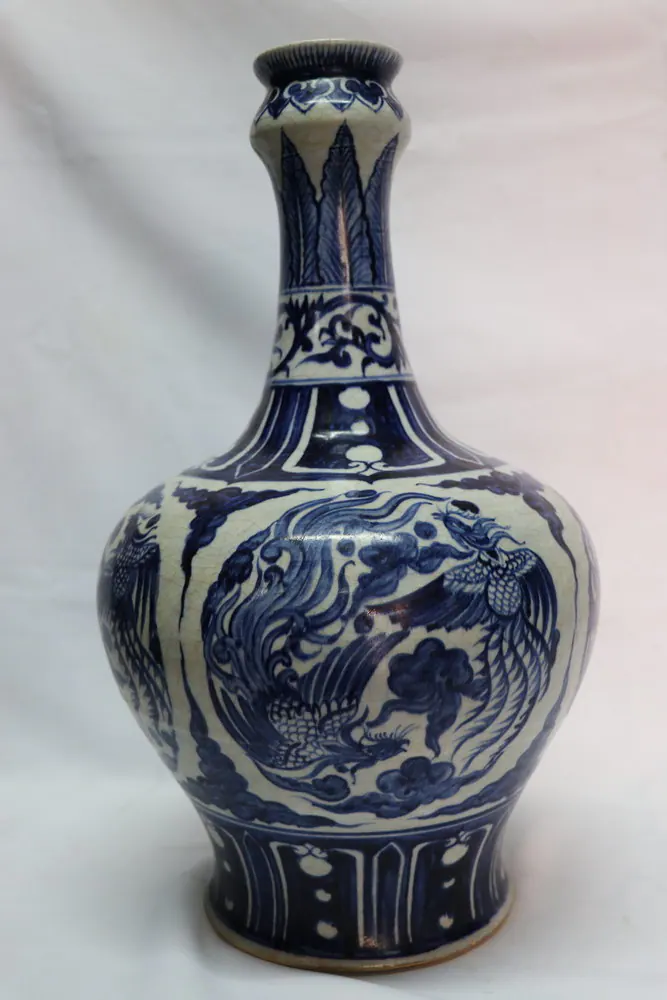
Late Qing porcelain looks back. Much of it copies or adapts the styles of Kangxi, Yongzheng and Qianlong, and much carries their marks. This is the single most important fact for anyone dating a piece from the period.
Guangxu and Xuantong imperial wares
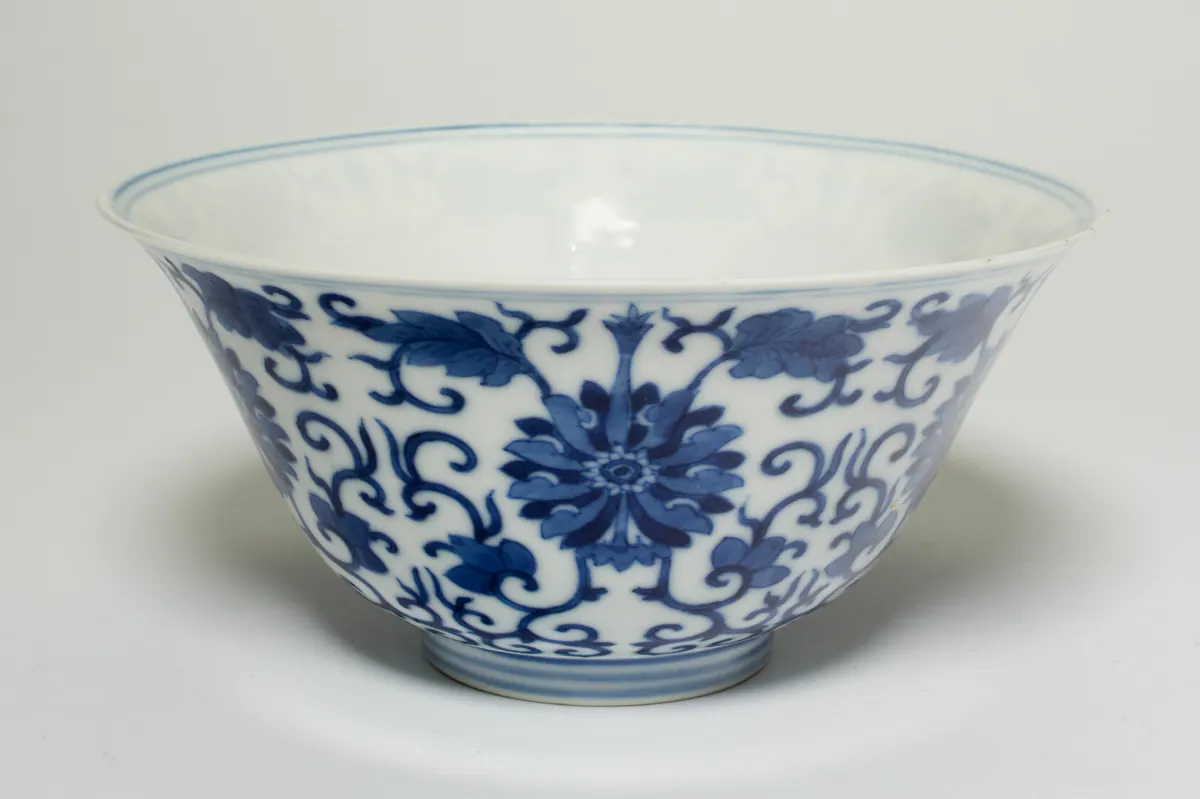
The Guangxu reign (1875–1908) was a real revival for the imperial kilns. Guangxu porcelain includes careful copies of eighteenth-century blue and white, famille rose and monochromes, often of high quality, with the Guangxu mark in six characters of regular script. Private kilns made Guangxu porcelain in the same styles, some of it with the Guangxu mark and a great deal with the marks of Kangxi and Qianlong.
The Empress Dowager Cixi, who dominated the court for most of the reign, commissioned porcelain of her own. Wares made for her residences in the 1870s, painted with flowers and birds on coloured grounds, often carry the hall name Dayazhai, and porcelain was made for her sixtieth birthday in 1894. Our guide to symbol, hall and workshop marks explains marks of this kind.
The Xuantong reign lasted only from 1909 until the revolution of 1911, and the last emperor abdicated in 1912. Xuantong-marked porcelain continues Guangxu styles and is scarcer simply because the reign was short. The chart of Qing reign marks shows the forms used from Shunzhi to Xuantong.
Qianjiang enamels and signed painters
From the 1860s and 1870s a new style of enamelling spread at Jingdezhen. Qianjiang enamel, literally "pale crimson", uses thin washes of soft colour, chiefly pale brown, green and blue, over outlines in a dark, ink-like enamel. The effect is closer to a painting on paper than to earlier Qing porcelain, and the subjects are those of the literati painter: landscapes, figures, and flowers and birds, usually with a poem.
Qianjiang painters signed their work, often with a studio name, a seal and a cyclical date. Cheng Men, Jin Pinqing and Wang Shaowei are among the best known. The fashion lasted into the early Republic, when painters working on plaques and vases, among them a circle later known as the Eight Friends of Zhushan, including Wang Qi and Deng Bishan, took signed porcelain painting further.
Qianjiang enamels are soft and wear easily, so a genuine piece that has been used usually shows it. Because the enamels are thin, the colours can also look faded next to later work, which is a feature of the style, not a defect.
Hongxian: the famous mark and why most examples were made later
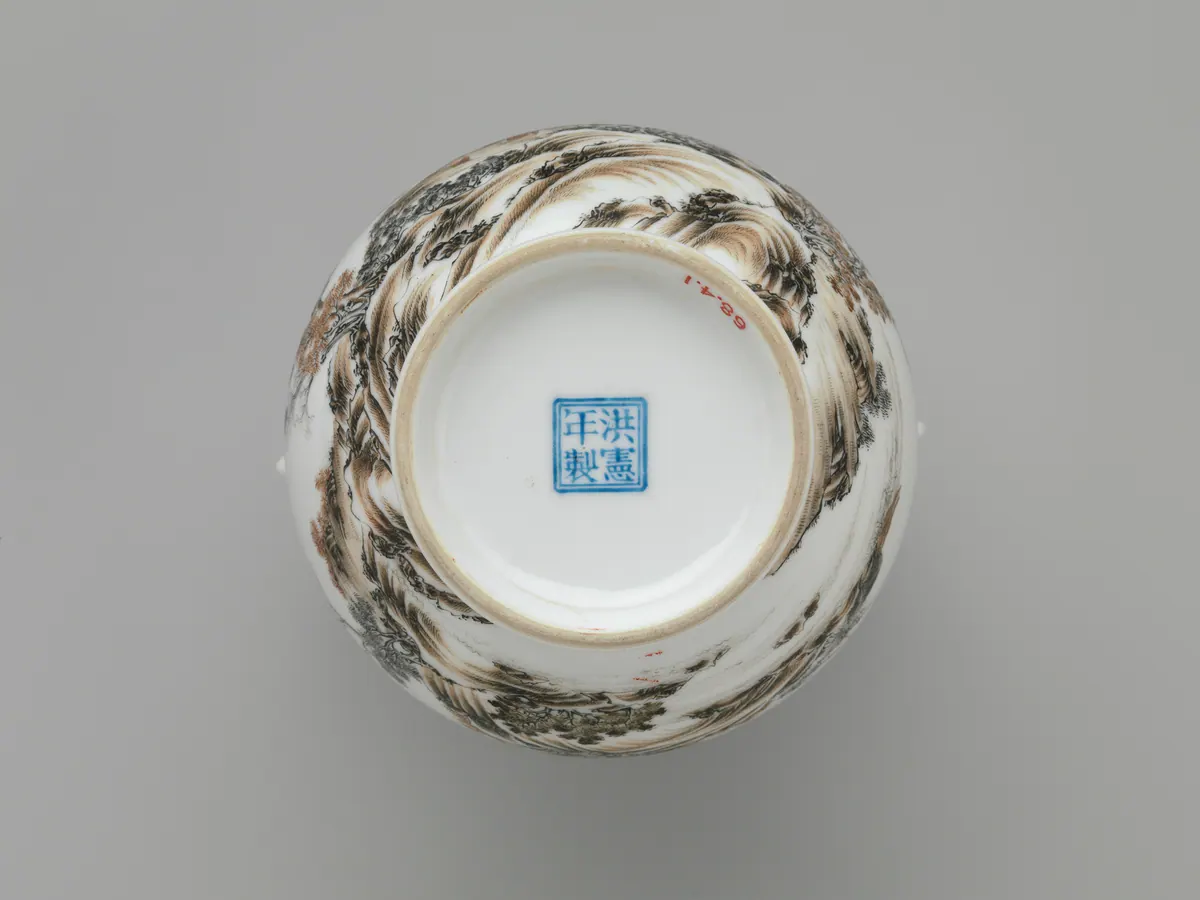
Yuan Shikai, the general who became president of the Republic in 1912, declared himself emperor in December 1915 and took Hongxian as his reign title. Opposition was immediate, and in March 1916 he abandoned the monarchy; he died that June. Hongxian marks therefore refer to Yuan Shikai's reign of 1915 to 1916.
The Hongxian mark, usually Hongxian nian zhi ("made in the Hongxian reign"), usually written in iron red, is among the best known on Chinese porcelain. It appears most often on fine famille rose in the style of Yongzheng and Qianlong palace enamels. So does the Jurentang mark, Jurentang zhi, which names a hall in the Zhongnanhai compound in Beijing that Yuan used as his office.
Very little porcelain could have been made in the few months of the reign, and most Hongxian-marked porcelain is regarded as made later in the Republic period, when the name had gained a reputation of its own among collectors. The same caution applies to Jurentang marks.
None of this makes a Hongxian-marked piece worthless. Some are finely potted and painted, and they are collected as Republic porcelain. The mark simply cannot be taken as a date, and a piece should be judged, like any other, on the quality of its body, enamels and painting.
Republic period porcelain: copies of Qing marks and styles
The Republic, from 1912 to 1949, was a busy period at Jingdezhen. Without an imperial factory, the best potters and painters worked for private workshops and companies, and for dealers and collectors in China and abroad who wanted porcelain in the style of the great eighteenth-century reigns.
The results range from crude to superb. The finest Republic famille rose, with delicate painting on thin white porcelain, can be very close to its Yongzheng and Qianlong models. Qianlong seal marks in iron red or blue are common on it, as are Kangxi and Yongzheng marks on blue and white and famille verte. Some workshops used their own names, and the Jiangxi Porcelain Company, founded in the last years of the Qing, marked some wares with its name.
Republic period porcelain also has a character of its own. Painted plaques and vases with landscapes and figures by named artists, often dated, are now collected for themselves, and bowls and vases painted in the manner of palace enamels, with a poem and small seals beside the picture, were a speciality of the best workshops.
Our guide to famille verte and famille rose explains how enamel colours help separate eighteenth-century work from these later copies.
Printing and export marks
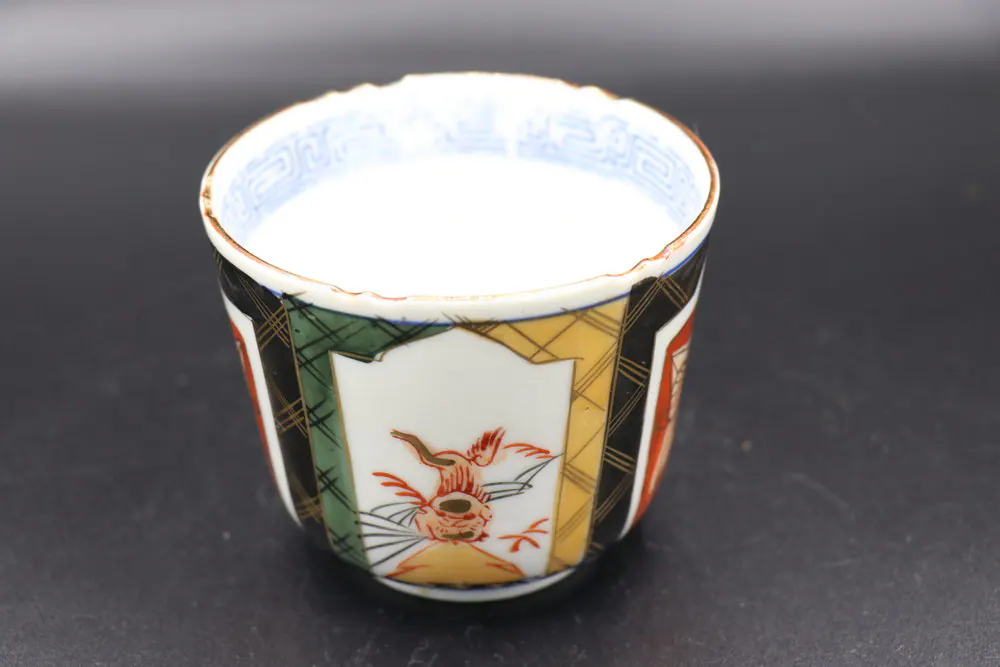
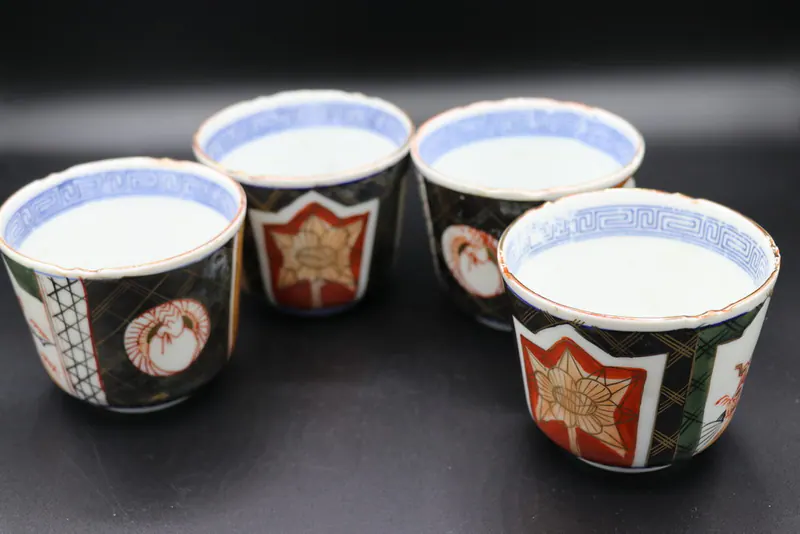
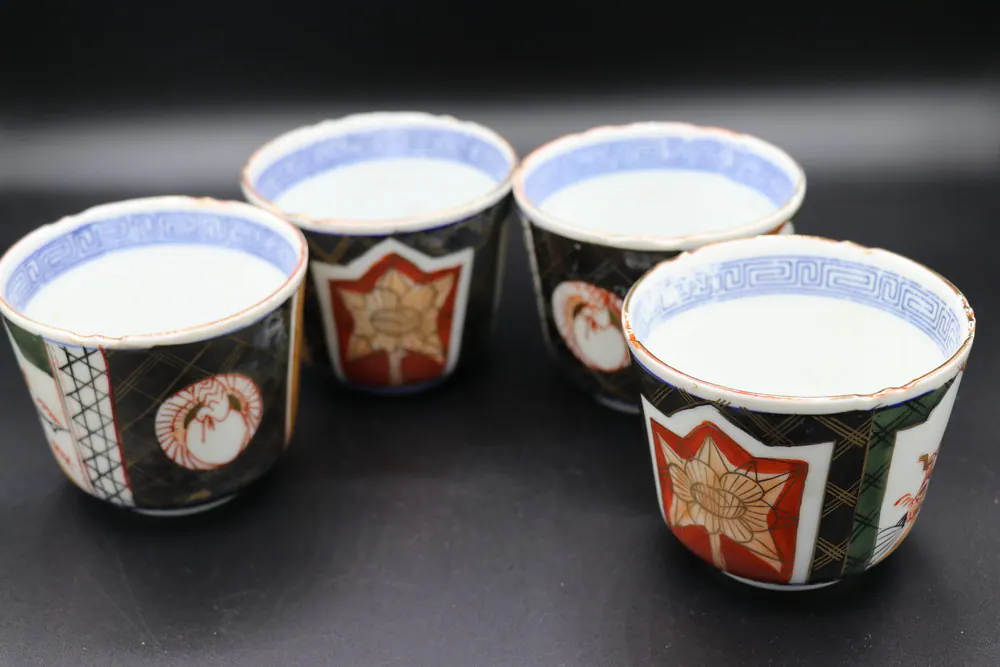
Around the turn of the twentieth century decoration began to be printed, by transfer or stencil, sometimes with hand-painted enamels added over the print. Printed work is recognisable by motifs that repeat exactly, flat and even areas of colour and, under magnification, a fine dot or line pattern. A set of four enamelled cups in our collection, printed and hand painted, which we date to about 1870 to 1920, shows the two methods together.
Export marks help too. From 1891, under the McKinley Tariff Act, goods imported into the United States had to be marked with their country of origin, so porcelain made for that market may carry "China" on the base in English, and later "Made in China". Such a mark usually places a piece after 1891, whatever reign mark accompanies it.
How to date late Qing and Republic porcelain
Dating porcelain from these decades means reading the whole piece, not the mark. Start with the body and glaze, and with the base, where the trimming of the foot and the colour of the exposed body can be telling; see our guide to reading the base. Late Qing porcelain often has a slightly bluish, glassy glaze; much Republic porcelain is very white and smooth, with thin, precise potting.
Then look at the enamels. Late nineteenth-century famille rose is brighter and flatter than its eighteenth-century models; Republic enamels include soft pastels but also strident pinks and lime greens. The painting tells you more still: faces, hands and the edges of leaves show whether a painter was working in his own idiom or copying an older one.
Read the mark last, and read it for its calligraphy as well as its words. Marks of Kangxi, Yongzheng and Qianlong appear on a great deal of late Qing and Republic porcelain, and our guide to reading Chinese porcelain marks explains what they can tell you. Signed and dated pieces are the easiest to place, provided the cyclical date is matched to the right sixty-year cycle.
None of this makes later porcelain less worth owning. Good late Qing and Republic pieces are sought after in their own right, and their value depends, like that of earlier wares, on quality, condition, rarity and provenance rather than on the mark alone.