Guide
Yuan Dynasty Blue and White Porcelain: How to Recognise It
Yuan blue and white porcelain, made at Jingdezhen in the middle decades of the fourteenth century, was the first mature Chinese porcelain painted in underglaze cobalt, and it set the pattern for the Chinese blue and white that followed. This guide explains how Yuan dynasty porcelain of this kind came to be identified, sets out its characteristics (forms, decoration, body, base and blue), and shows how later imitations differ, so that you can judge a piece offered as Yuan with a clear idea of what to expect.
What to look for
- Look for dense decoration in horizontal bands: lotus panels at the foot, a main scene on the body, and scrolls or cloud collars on the shoulder.
- Check the blue: deep and inky where thickly painted, with blackish spots that sink into the glaze and follow the brushstrokes.
- Turn it over: jars and vases usually have a flat, unglazed base, often flushed orange and flecked with grit from the kiln.
- Look inside jars and vases for the horizontal joins where separately thrown sections were luted together.
- Judge the drawing: Yuan painters worked quickly and surely, so stiff, traced or fussy lines are a warning.
- Treat evenly spaced dark dots, a glassy or acid-dulled glaze and a stained base as signs of a modern copy.
The David Vases and the recognition of Yuan blue and white porcelain
For centuries it was assumed that fine blue and white began with the Ming. Pieces now recognised as Yuan were catalogued as early Ming, or as provincial work. What changed that view was a pair of tall temple vases in the Sir Percival David Collection, now shown at the British Museum in London. Each carries a painted dedicatory inscription recording its gift to a temple, with a date corresponding to 1351, the eleventh year of the Zhizheng era of the last Yuan emperor, Toghon Temür.
The vases were published in 1929, but they were first put to systematic use in the 1950s. The American scholar John Pope compared their painting, their bands of ornament and their blue with large groups of porcelain in the Topkapı Palace in Istanbul and the Ardebil Shrine in north-western Iran, and showed that a coherent body of fourteenth-century blue and white survived there. Because of the date on the vases, collectors still call the mature Yuan style the Zhizheng type.
Since then, pieces from dated tombs, hoards and kiln sites in China have filled out the picture. Yuan blue and white is no longer a puzzle, but it remains a small field, and the name is attached to a great many later pieces. Knowing what the genuine wares look like is the best protection.
Jingdezhen under the Mongols
Jingdezhen, in Jiangxi province, was already a large porcelain centre under the Song, known for the pale bluish-white ware called qingbai. In 1278, soon after the Mongol conquest of southern China, the government of Kublai Khan set up the Fuliang Porcelain Bureau there, named after the county in which Jingdezhen lies, to oversee production. The surviving records say little about what the bureau made, and its connection with blue and white is uncertain. Our page on the Yuan dynasty gives the wider history.
Two technical changes made large, well-fired porcelain possible. Potters added kaolin, a refractory white clay, to the local porcelain stone, which gave a stronger body that could be thrown into big dishes and jars without slumping in the kiln. And they had a cobalt that fired to a deep, strong blue. Analysis shows that the finest Yuan blue is low in manganese and relatively high in iron, unlike Chinese cobalt ores, and it is generally accepted that it was imported from the Middle East, most probably from Persia. Our guide to cobalt blue on Chinese porcelain explains the difference.
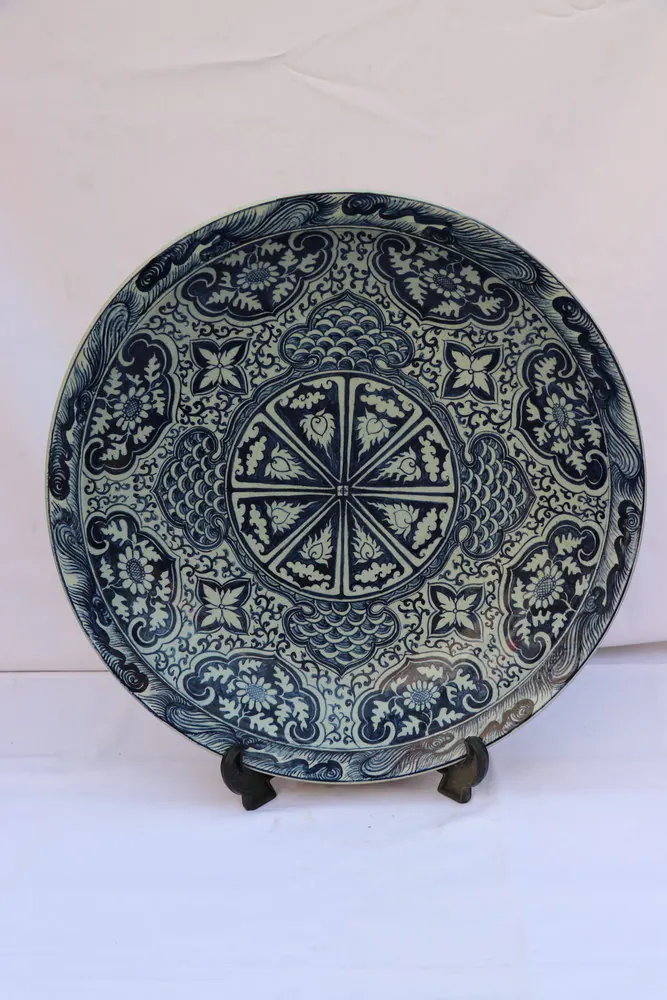
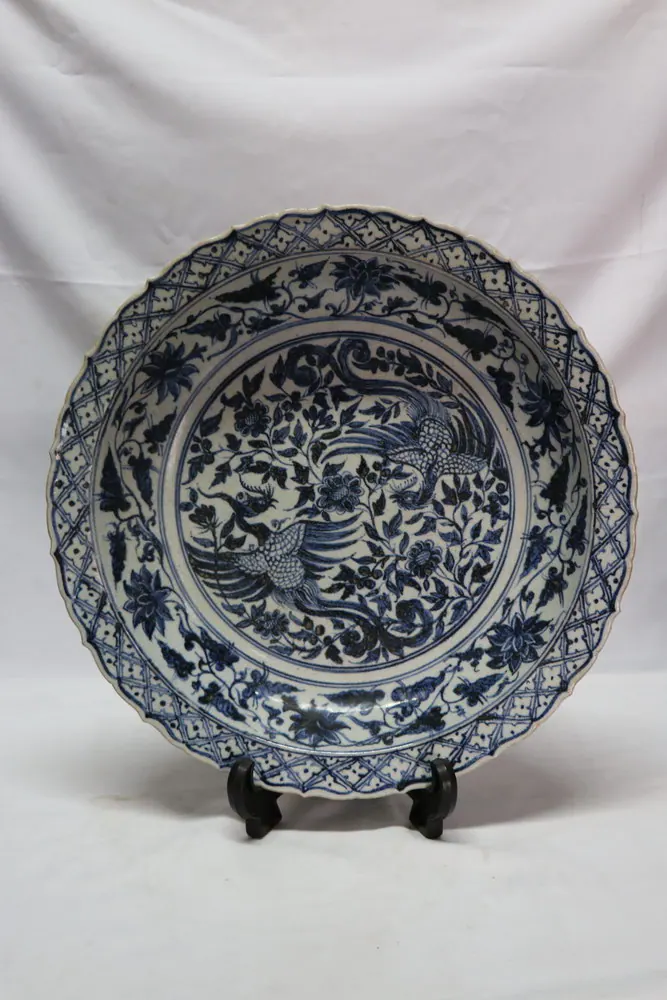
The Middle Eastern connection ran both ways. Mongol rule linked China with Iran and Central Asia, and much of the finest Yuan blue and white was made for buyers in the Islamic world. Very large dishes suited shared meals there. The greatest surviving groups are in the Topkapı Palace and at Ardebil, where Shah Abbas I gave his collection of Chinese porcelain to the family shrine of the Safavid dynasty in the early seventeenth century. Smaller jars, bowls and ewers went to Southeast Asia, and a good deal was used within China itself. A barbed-rim charger in our collection, catalogued as Yuan, is a broad dish of this kind, with a moulded edge and a pair of phoenixes at the centre.
Forms: the Yuan dynasty vase, jar and dish
Yuan potters made a limited range of shapes, and most of them are large and heavy. The principal forms are these:
- Large dishes, commonly 40 cm or more across, with a flat or barbed (lobed) rim.
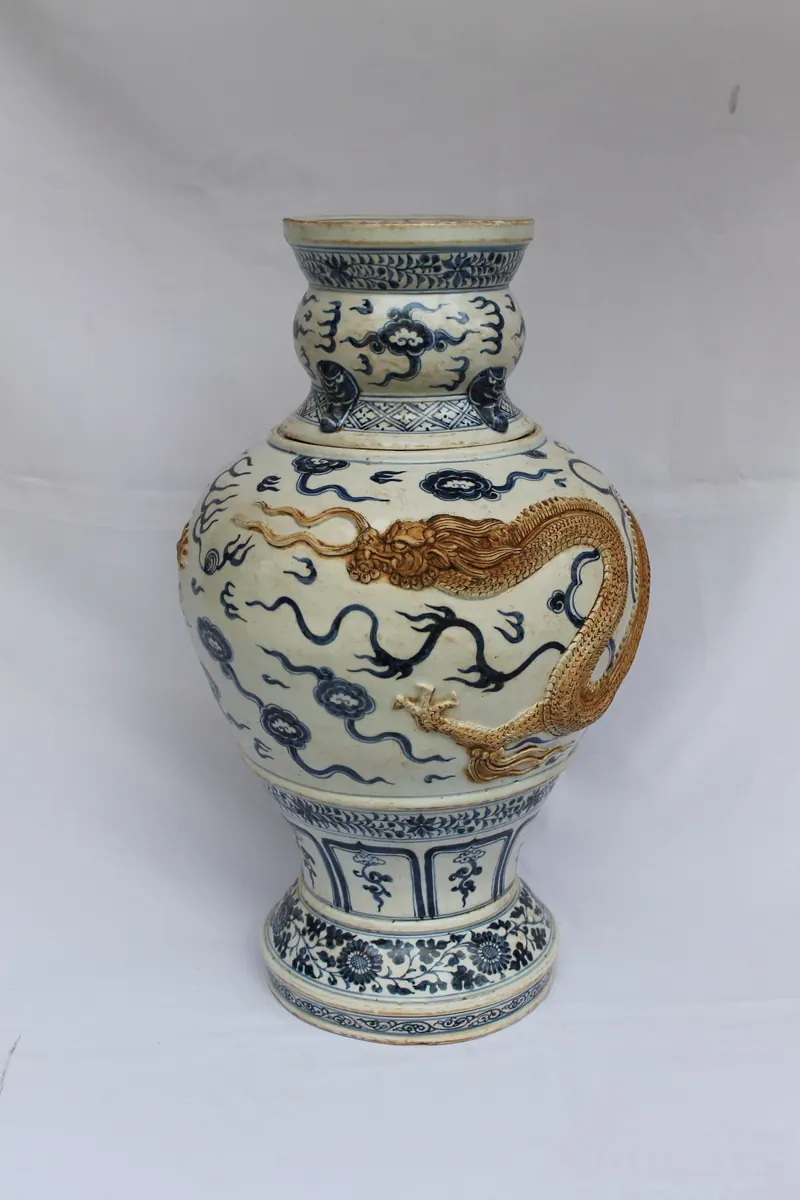
- Guan jars: broad-shouldered storage jars with a short neck, sometimes with a cover, often painted with the most ambitious scenes.
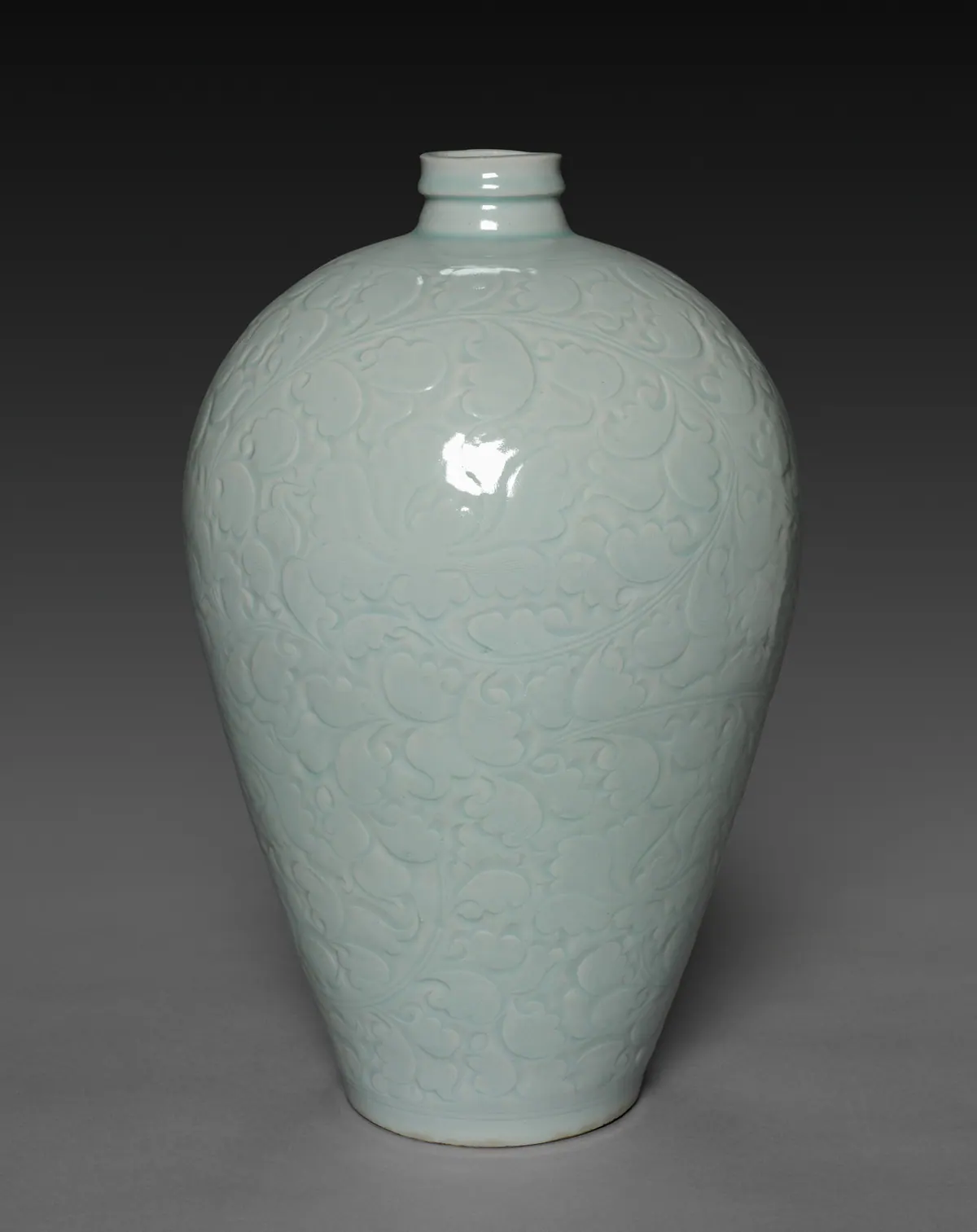
- Meiping: tall vases with a small mouth, a full shoulder and a narrow base. The name means "plum vase".
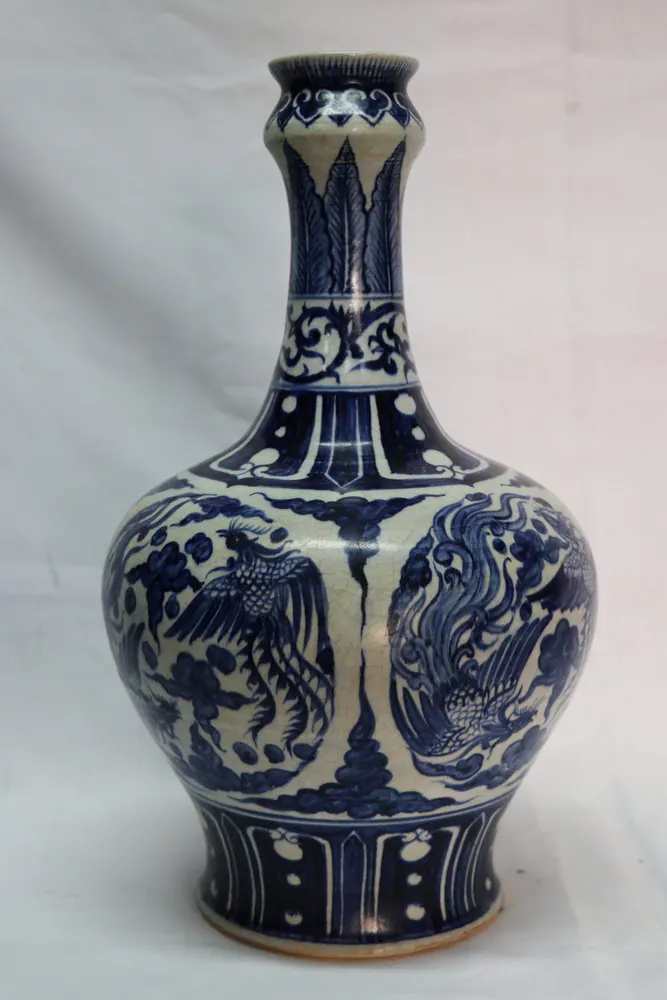
- Yuhuchunping: pear-shaped bottles with a slender neck and flared mouth, a form also made in qingbai and in metal.
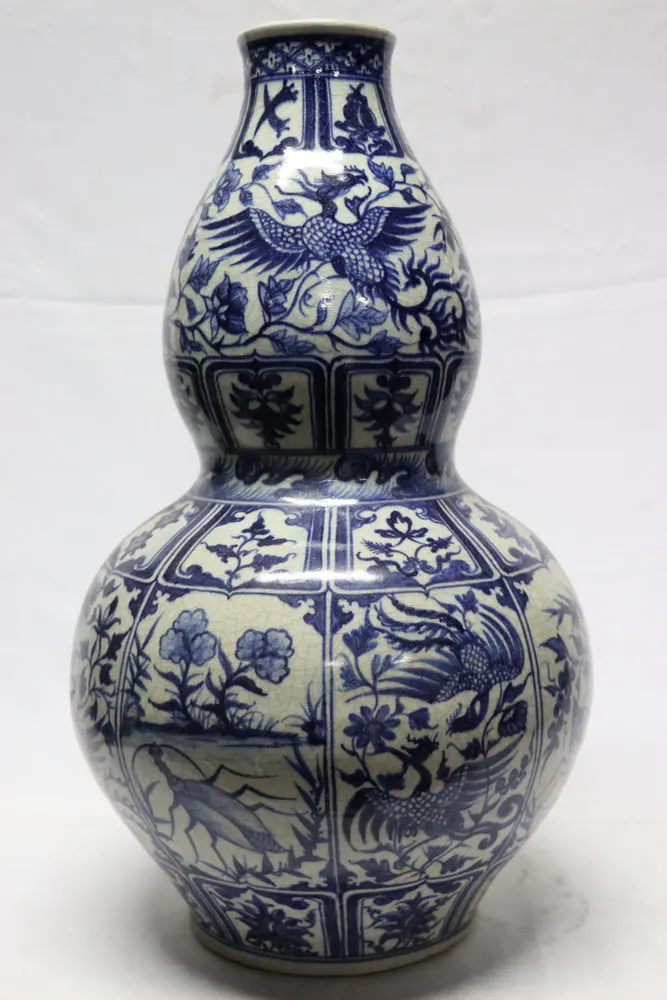
- Double gourd vases, flasks, ewers, stem cups and bowls in a range of sizes.
Proportions matter as much as the shape itself. Yuan jars and meiping have full, confident shoulders and a firm, heavy stance. Many later copies look slightly pinched or overly tall, or are too tidily finished at the foot. The same shapes were made in underglaze copper red, which our guide to underglaze red porcelain describes.
Decoration: bands, panels and scenes
The most recognisable feature of Yuan blue and white is its layout. The surface is divided into horizontal bands, each with its own pattern, and little of the white is left empty. A typical jar or meiping has a band of upright lotus panels at the foot, often filled with scrolls or small emblems; a main field on the body; a band of cloud-collar lappets or scrolls on the shoulder; and waves, classic scroll or small flower heads at the neck. Dishes follow the same logic in rings: a border at the rim, a scroll in the cavetto and a scene in the centre.
The main subjects come from a fairly small repertoire:
- Fish among water plants, and ducks or egrets in lotus ponds.
- Peony and lotus scrolls with large, fleshy leaves.
- Dragons, phoenixes and qilin among clouds or flowers.
- Figure scenes, many thought to derive from the plays and illustrated books popular in the Yuan period.
The painting itself is as telling as the layout. Yuan painters built up the blue in brushstrokes, shading a leaf or a wing with overlapping strokes rather than filling a drawn outline with an even wash, a technique that became usual only in the later fifteenth century. Lines are quick and sure, scrolls run on without hesitation, and the same motif is seldom drawn exactly alike twice. Crowded as the designs are, they are rarely confused: each band is separated from the next by one or two plain lines.
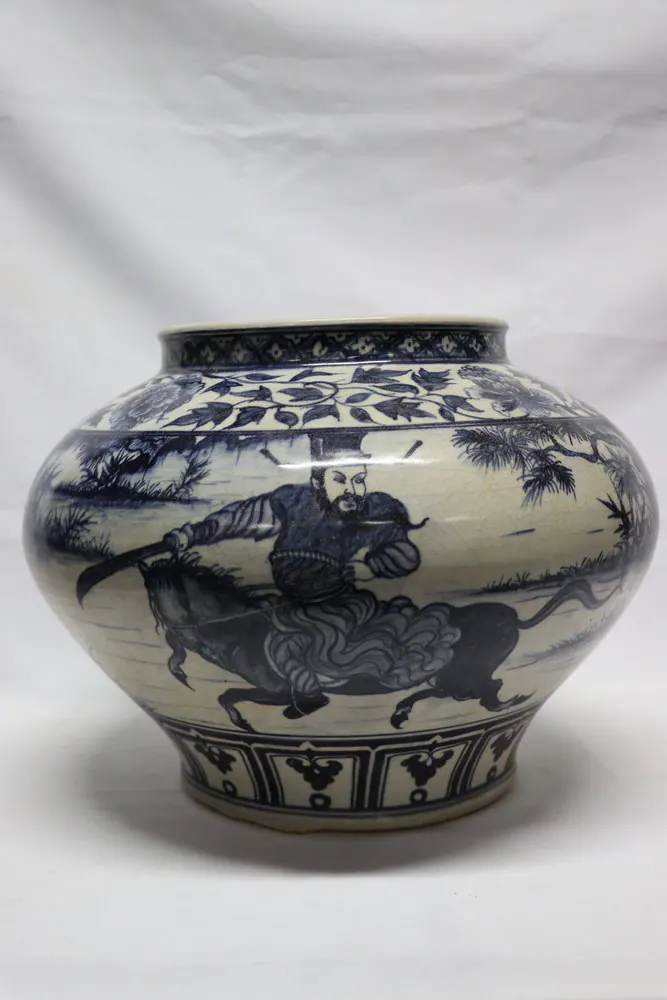
Some pieces reverse the scheme, leaving the design in white against a blue ground, and a few combine painting with moulded or incised decoration. A jar in our collection catalogued as Yuan is painted with two mounted warriors in a landscape, one with a sword and one with a lance. Our guide to symbols on Chinese porcelain explains what the fish, lotus, phoenix and qilin meant to the people who bought these wares.
Body, joins and bases
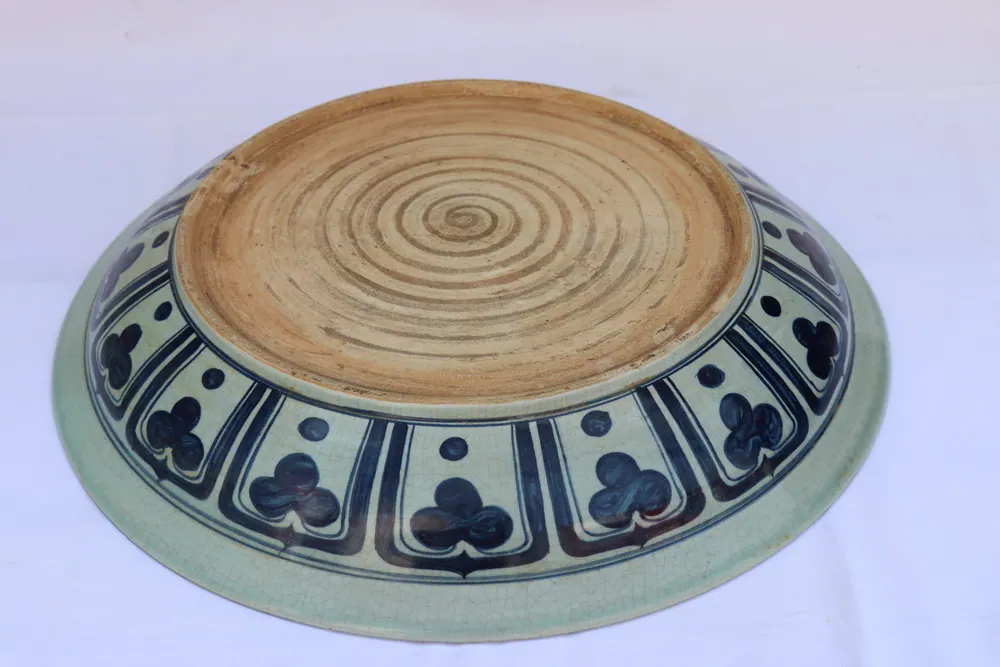
Yuan porcelain is thickly potted. Large pieces feel heavy in the hand, and the walls of jars and dishes are substantial. Where the body is exposed it is usually fine-grained and white or faintly grey. The glaze tends to have a slight blue or green tint, especially where it pools, and is often full of tiny bubbles.
Big vessels could not be thrown in one piece. Jars, meiping and vases were made in two or more sections joined with slip before glazing, a process called luting. The joins can often be seen or felt inside as a horizontal ridge; outside they sometimes show as a slight change in the profile or a line in the glaze. A small torch shone through the mouth will usually reveal them.
The base is one of the best guides. Jars and meiping usually have a flat, unglazed base, often slightly concave, with spiral or concentric marks from the wheel and specks of grit from the kiln floor. Large dishes generally have a broad foot ring and an unglazed base. Where the bare body met the heat of the kiln, it commonly fired to an orange or reddish-brown flush. Our guide to foot rings and bases explains how to read these features. They are also easy to imitate: a base stained or painted orange, or grit glued in place, is common on copies. On a genuine piece the flush shades naturally into the body and the grit is fused to it.
The blue: depth, blackish concentrations and iron spots
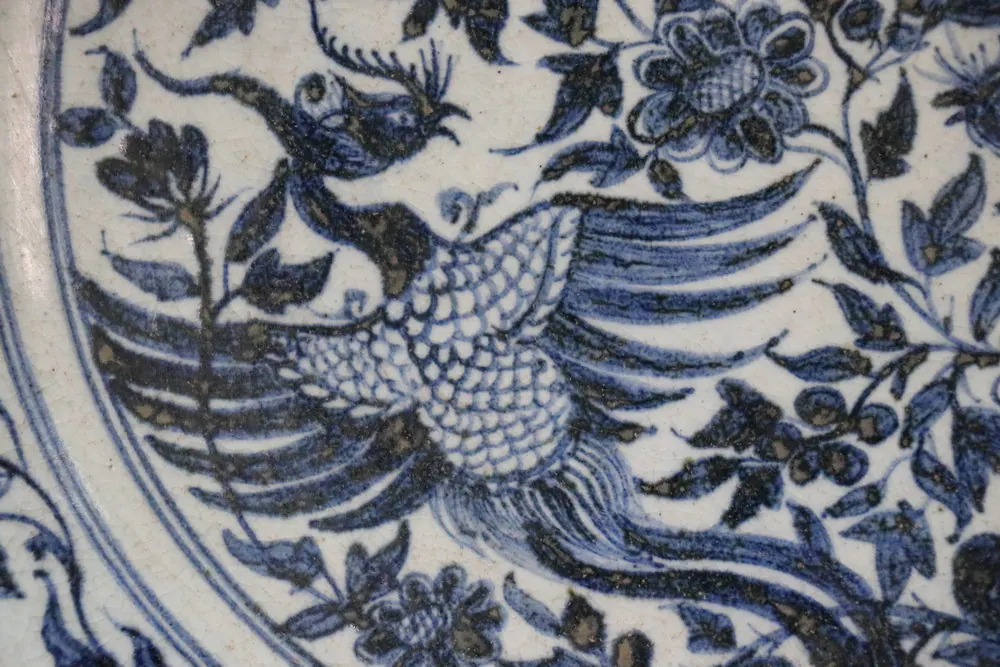
Imported cobalt gives Yuan blue and white its colour: a deep, intense blue, sometimes with a violet tinge, laid on in brushstrokes of varying strength. Where the painter loaded the brush, iron in the pigment crystallised during the firing into blackish or brownish spots, often with a slightly metallic sheen. The glaze over them frequently dips into small hollows, and the dark spots seem to lie within the glaze rather than on top of it. Chinese connoisseurs call this effect "heaped and piled"; collectors also speak of iron spots or rust spots.
These spots follow the brushwork. They gather at the ends of strokes, in heavily shaded areas and where lines overlap, because that is where the pigment lay thickest. On later copies the dots are often too regular, set along outlines at even intervals, or sitting on the surface like ink.
Not every Yuan piece shows this. Some smaller wares, many of them made for Southeast Asian markets, were painted in a greyer, softer blue that is generally attributed to Chinese cobalt, and a lightly painted area of a fine piece can look quite pale. The blue is an important test, but never the only one.
Later imitations, from Ming folk kilns to modern Jingdezhen
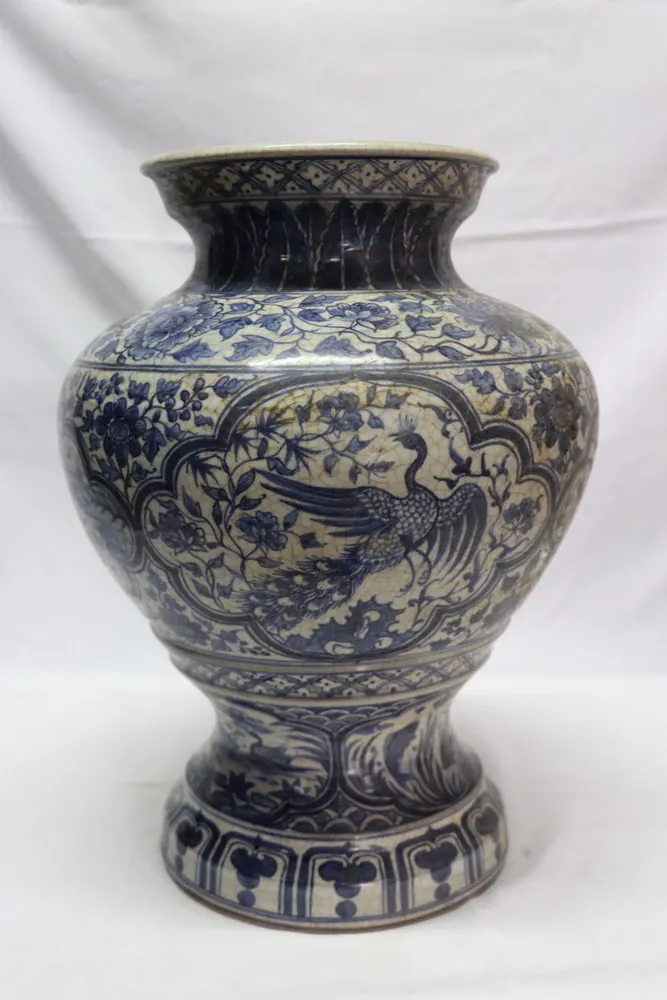
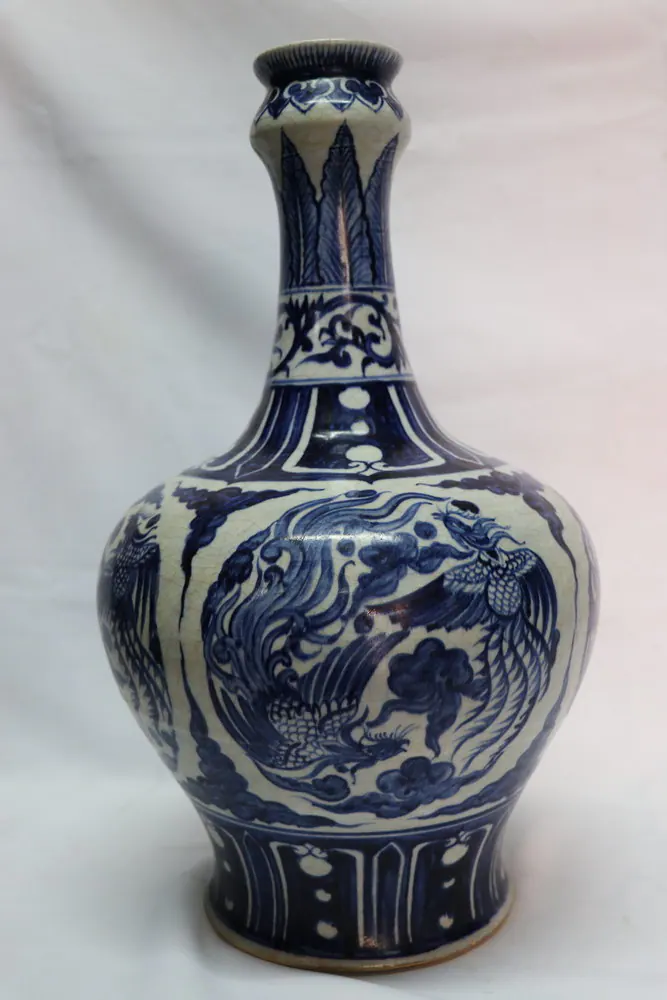
Yuan blue and white has been imitated for centuries, and not always to deceive. From the Ming onwards, private kilns sometimes painted in a manner that recalls the Yuan, with panelled designs and dense bands. A vase in our collection catalogued as late Ming to early Qing is an example: its listing describes it as a folk kiln piece with a shell mark, painted in imitation of the Yuan style, with animals and birds in shaped panels. In the eighteenth century, imperial potters imitating early Ming blue and white added dark dots with the tip of the brush to suggest the iron spots of imported cobalt, a device that copyists still use.
By far the largest group of imitations is modern. As Yuan blue and white became famous and costly in the late twentieth century, workshops in and around Jingdezhen began to make copies in great numbers, some of real technical skill. The usual faults are these:
- Drawing that is careful but lifeless, with outlines traced rather than painted, and motifs lifted from well-known museum pieces.
- A blue that is flat and even, or dotted with dark spots applied on purpose rather than formed in the firing.
- A glaze that is too glassy, or dulled with acid to hide the fact.
- Bases stained orange, rubbed with dirt, or given glued-on grit.
- Shapes that are slightly wrong: shoulders too narrow, feet too neat, proportions taken from photographs.
Our page on detecting fakes covers the general methods.
How to tell Yuan blue and white: how we attribute a piece
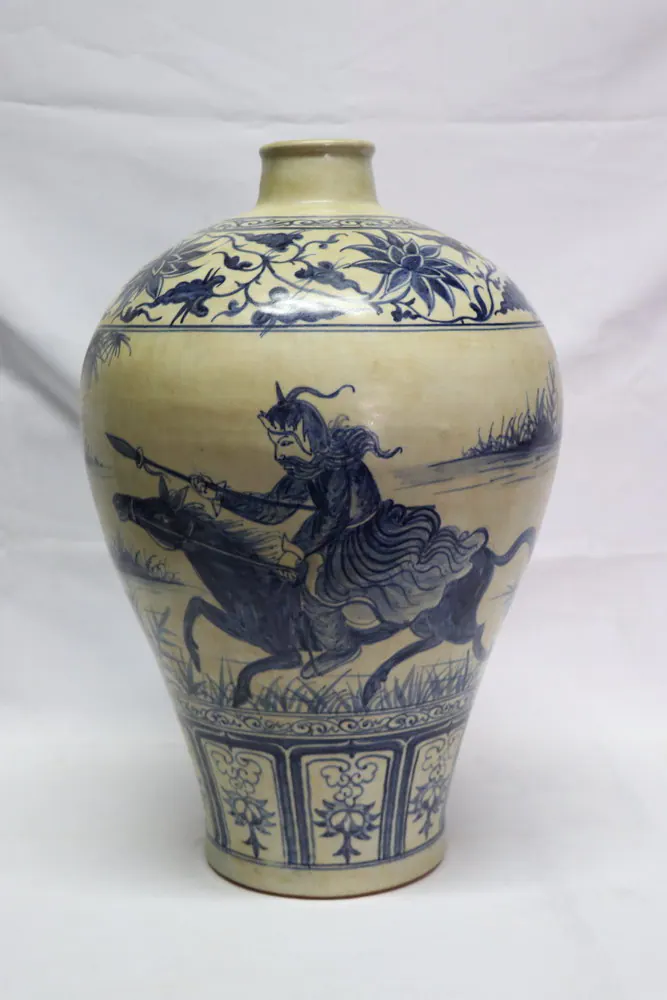
No single feature makes a piece Yuan. When we catalogue blue and white as Yuan we look for agreement across everything described on this page: a form known from the period, potted with the right weight; a layout of bands and a painting style that match dated and excavated pieces; a body, glaze and base consistent with fourteenth-century Jingdezhen; a blue whose depth and spotting follow the brush; and wear in the places that use would produce.
Wear deserves a word of its own. A jar or dish that has been in use for centuries shows it in particular places: the foot ring, the rim, the high points of the shoulder, and the inside of bowls and dishes where utensils touched them. The wear is uneven, with fine scratches running in many directions. Uniform dulling over the whole surface, or scratches that all run the same way, suggest abrasion applied to make a new piece look old. Our guide to signs of age in antique porcelain explains what wear can and cannot prove.
The line between late Yuan and early Ming is not sharp. The kilns, painters and cobalt did not change overnight in 1368, and many pieces are best described as late Yuan to early Ming. Our page on early Ming porcelain covers what followed. We photograph each piece from several angles, including the base wherever we can, so that you can apply these tests yourself.
What makes one Yuan piece more desirable than another is the same as for any Chinese porcelain: the quality of the potting and painting, the rarity of the form and subject, condition, provenance and the state of the market. You can see the pieces we currently offer in our Yuan dynasty porcelain collection. Each is sold by private inquiry through the Request price form on its page; shipping is fully insured, and all sales are final.