Song and Yuan dynasties
Qingbai: Jingdezhen's Shadow-Blue Porcelain of the Song and Yuan
Qingbai, meaning "bluish white", is the translucent porcelain that made Jingdezhen's name long before blue and white. This guide explains why the glaze looks blue, the forms and decoration of Song and Yuan qingbai ware, and how to tell period pieces from later copies.
- Dates
- Northern Song to Yuan, about the 10th to 14th century
- Main kilns
- Jingdezhen, Jiangxi; also kilns in Fujian, Guangdong and elsewhere
- Body
- Porcelain stone; kaolin added in the Yuan
- Glaze
- Clear with a trace of iron, pale blue where it pools
- Also called
- Yingqing, "shadow blue"
What qingbai is and why it looks blue
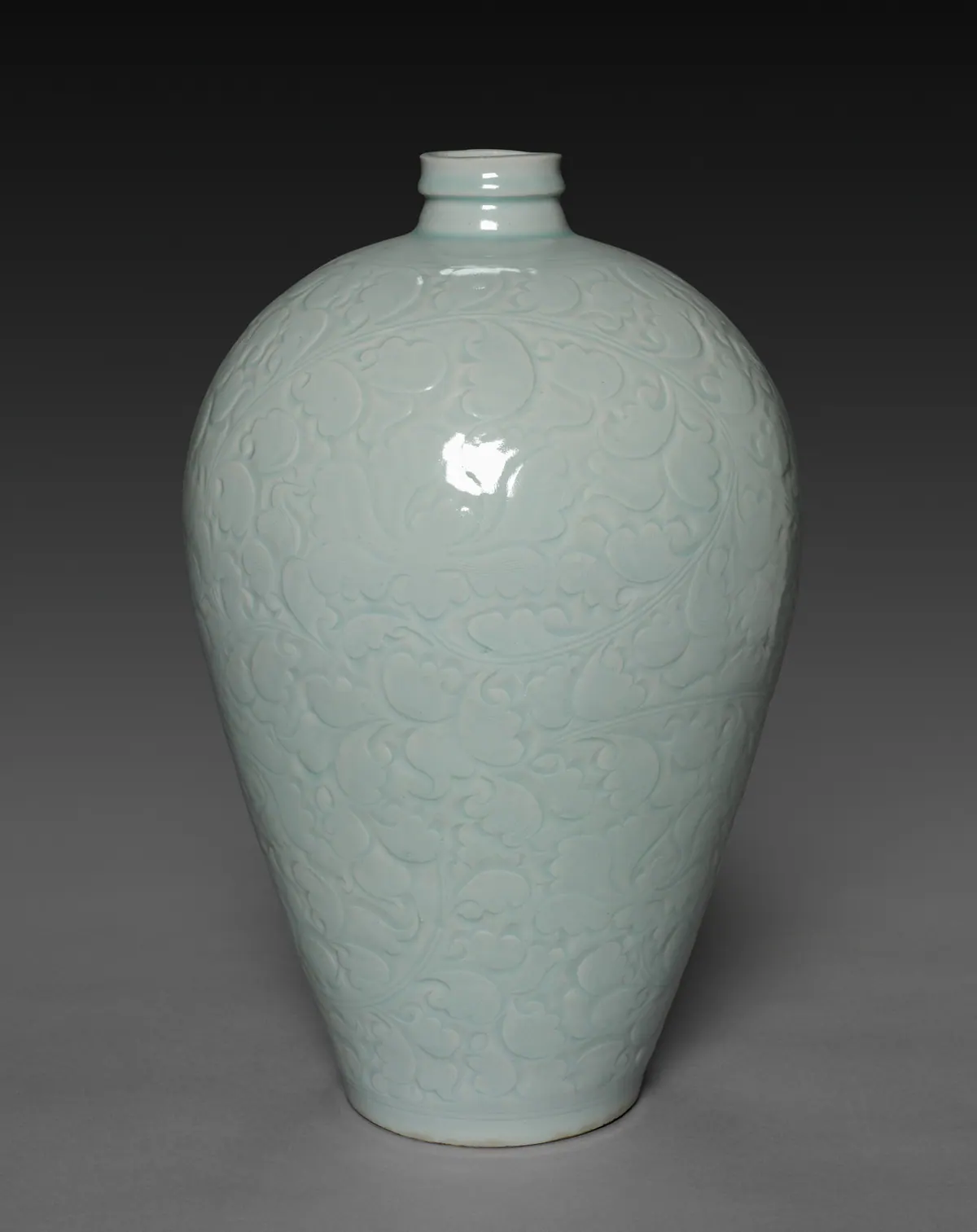
Qingbai means "bluish white" or "greenish white", and the name describes the effect exactly: a white porcelain under a glaze with a faint blue tint, strongest where the glaze gathers. Collectors also call it yingqing, "shadow blue", a later collectors' name that captures the way the colour deepens in the shadows of carved lines. Most specialists today prefer qingbai.
The colour comes from a small amount of iron in a clear glaze, fired in a reducing atmosphere that turns the iron bluish, as in celadon but in much smaller quantity. Where the glaze is thin it looks almost clear over the white body; where it pools, in carved grooves or around the foot, it deepens to aquamarine. If the kiln let in too much oxygen, the same glaze fired ivory or pale straw, which is why qingbai varies in tone from icy blue to warm cream.
At Jingdezhen the body was made from porcelain stone, a rock found in the nearby hills that could be crushed, refined and used on its own. It fired white and translucent, but it was prone to warp at high temperatures, which limited the size of pieces and is one reason Song qingbai is so thinly and delicately potted.
Jingdezhen before blue and white
Jingdezhen, in north-eastern Jiangxi, had porcelain stone in the surrounding hills, forests for fuel and rivers to carry its wares to market. By the early eleventh century its kilns were producing fine qingbai. Tradition holds that the town took its name from the Jingde era (1004–1007) of Emperor Zhenzong, when its wares were ordered for the palace. The kilns at Hutian, on the edge of the town, are the best known of the Song sites and have been excavated extensively.
Qingbai was not only a Jingdezhen ware. Its success led kilns across southern China to make it too, especially in Fujian and Guangdong, where the coastal ports made export easy. Qingbai has been found at sites across South-East Asia and beyond, and the Southern Song merchant ship known as Nanhai No. 1, raised off the Guangdong coast in 2007, carried large quantities. Pieces from the provincial kilns are often heavier, with a greyer body and a less even glaze. Our guide to Song dynasty porcelain and ceramics sets qingbai beside the other wares of the period.
Forms: ewers, bowls, boxes, vases and figures
Qingbai was made for the table, the dressing table, the altar and the tomb. Among the most characteristic forms are:
- Ewers, often with a tall neck, curved spout and strap handle, and in fine sets standing in a deep bowl that held hot water to keep wine warm.
- Bowls and dishes, from conical tea bowls to lobed and foliate dishes, some potted remarkably thin.
- Covered boxes for cosmetics, incense or medicine, many with moulded lids, and some marked on the base with the name of the family workshop that made them.
- Vases, including the meiping and slender vases for flowers.
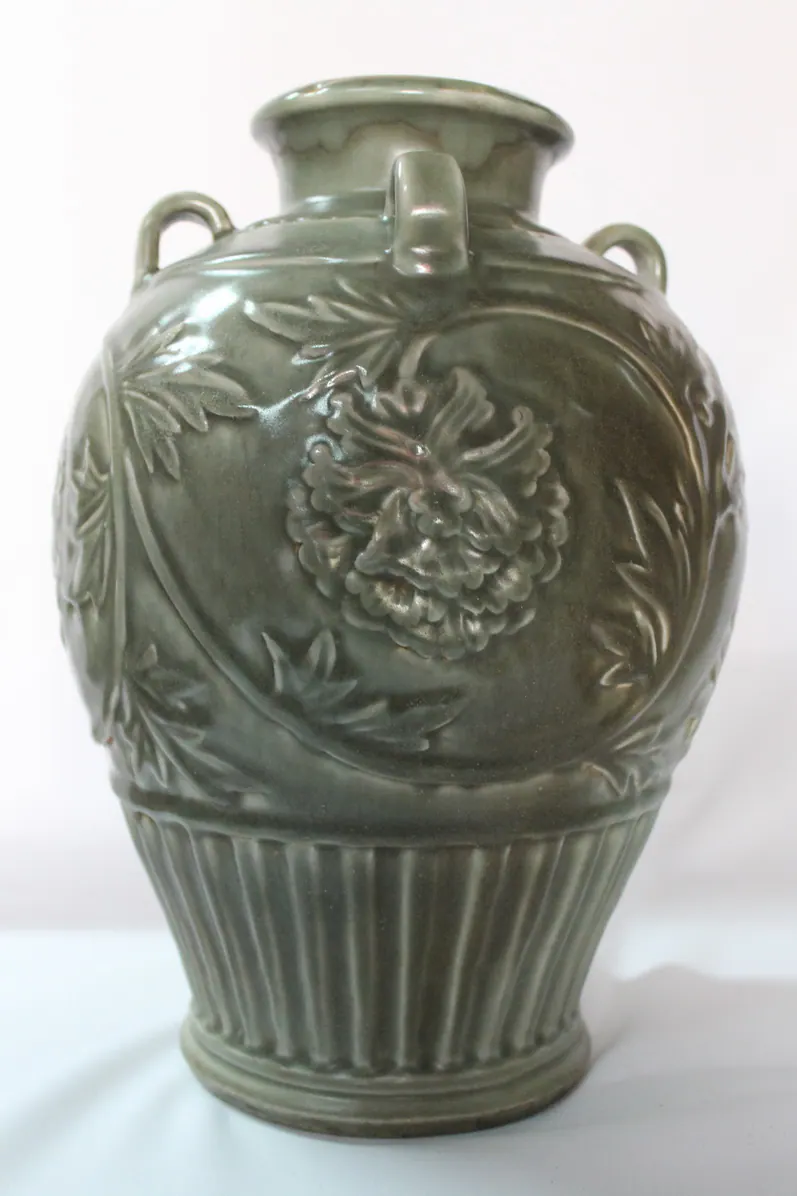
- Funerary jars, tall covered jars with figures, dragons and clouds modelled around the shoulder, often made in pairs for burial.
- Pillows and figures, among them Buddhist figures of the Yuan and pillows modelled with figures in architectural settings.
For the names of the shapes, see our guide to Chinese porcelain shapes.
Carved, combed and moulded decoration
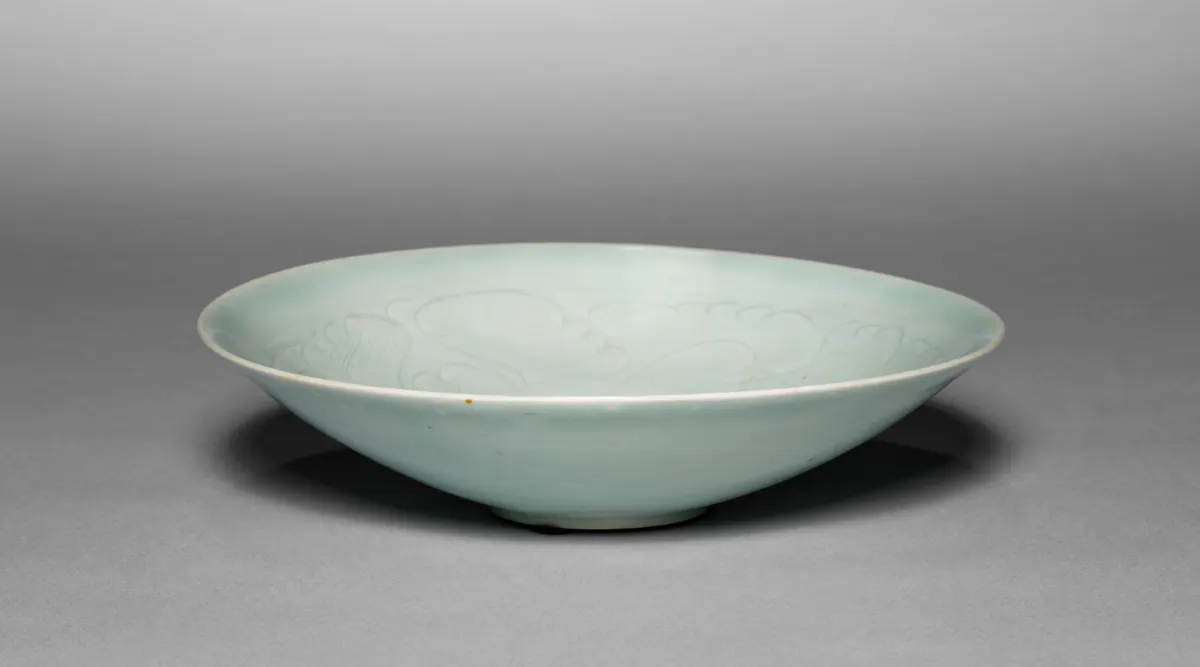
The finest Song qingbai is decorated by carving, and the glaze does the rest. The potter cut the design into the leather-hard body with a slanting blade, making one side of each line deep and the other shallow, so that the glaze pooled blue in the deep side and thinned over the shallow. Details were then added with a comb, which drew several fine parallel lines at once to suggest the veins of a leaf, the movement of water or the ruffles of a petal. Favourite subjects were lotus and peony scrolls, flowers among waves, ducks, fish and small boys playing among flowers.
Moulding became common from the later Southern Song. Bowls were pressed over a carved mould, which gave dense, detailed designs quickly and uniformly, often in the manner of Ding ware. Moulded designs tend to be crisper but shallower, and sometimes a little blurred where the mould was worn.
The way bowls were fired changed at the same time. Early pieces were fired upright, each in its own saggar on a small pad. Later, following the example of Ding, many bowls were fired upside down on their rims in stepped supports, and the bare rims were sometimes bound with metal. An unglazed rim on a qingbai bowl is therefore a clue to its date and making, not a defect.
Qingbai in the Yuan and the step to blue and white
Under the Yuan, Jingdezhen came under closer official control. The Fuliang Porcelain Bureau was set up in 1278 to oversee production, and the kilns began to use a new body: porcelain stone mixed with kaolin, a clay that raised the firing temperature and made the body stronger. Larger, heavier vessels became possible.
Yuan qingbai looks different from Song. Potting is heavier, and decoration is often applied rather than carved: strings of tiny clay beads, moulded medallions and relief panels, and openwork. Buddhist figures were made with great skill. The same potters produced shufu ware, with a thicker, opaque, egg-white glaze; some pieces are moulded inside with the characters shu fu, generally linked to the Privy Council of the Yuan government.
In the fourteenth century Jingdezhen began painting in cobalt blue under a clear, faintly bluish glaze very like qingbai. The porcelain body, the glaze and many of the forms of early blue and white came straight out of the qingbai tradition. Our guide to Chinese blue and white porcelain takes the story on from there.
Dating qingbai and spotting later copies
Qingbai ware is dated by the same evidence as other Song ceramics: dated tombs, shipwrecks and kiln sites. On the piece itself, look at:
- The body. Song Jingdezhen qingbai is fine, white and slightly sugary where exposed, translucent where thin, and often shows an orange or reddish flush on the bare foot, where iron in the body re-oxidised as the kiln cooled.
- The glaze. It should be thin and glassy, pooling blue in the hollows, and under a lens it is full of small bubbles. Pieces from burials often have a dulled or slightly iridescent surface.
- The potting. Song pieces are light for their size, with neat, shallow feet. Heavy, thick-walled pieces are more likely to be Yuan or later, or from a provincial kiln.
- The decoration. Genuine carving is fluid and quick, with lines that vary in depth. Copies tend to be stiff, uniform and over-careful.
Qingbai was imitated at Jingdezhen in later centuries, and modern copies are plentiful, often artificially aged with stains and acid to suggest burial. Many are too heavy, too evenly blue or too chalky white in the body. Condition also matters a great deal to value: thin qingbai chips and cracks easily, and restoration on a pale glaze can be hard to see without ultraviolet light.