Guide
Detecting Fake Chinese Porcelain
Most fake Chinese porcelain gives itself away somewhere: in the clay of the foot, the surface of the glaze, the hand that painted the blue, the mark or the pattern of its wear. This guide explains how to spot fake Chinese porcelain at each of those points, how artificial ageing is done and how to see through it, and when a piece needs a specialist's eye.
What to look for
- Check that shape, body, glaze, painting, mark and wear all point to the same period; one feature out of place outweighs several that fit.
- Turn the piece over: an evenly cast body, a foot stained or painted orange, or grit stuck on rather than fired in all point to a copy.
- Look at the glaze with a lens: an evenly dull, dry sheen, or crackle stained to one uniform colour, is a warning.
- Watch the brushwork: slow, careful lines and dark dots set evenly along the outlines suggest a copyist working from a picture.
- Read a mark as a record of what was written, and date the piece by everything else.
- Expect wear only where a piece was touched in use; scratches in neat parallel lines, or inside protected hollows, were put there on purpose.
Fakes, later copies and reproductions
Chinese potters have copied earlier porcelain for centuries, and not always to deceive. Potters of the Kangxi, Yongzheng and Qianlong reigns made careful versions of Xuande and Chenghua wares out of admiration for them, often with the earlier reign's mark. Late Qing and Republic workshops copied the great Qing reigns in turn, as our guide to late Qing and Republic porcelain explains. Since the late 20th century, kilns in Jingdezhen and elsewhere have made reproductions of every period, some sold honestly as new and later passed on as old.
So the useful question is rarely whether a piece is a copy, but when it was made. A Yongzheng copy of a Chenghua cup is a genuine 18th-century piece, admired in its own right. It becomes a fake only when it is offered as Chenghua. A modern reproduction becomes a fake when someone ages it and gives it a period.
The best fakes imitate exactly the signs of age that collectors are taught to look for, so no single feature proves anything. What exposes a fake is disagreement: a 15th-century shape on a modern body, a convincing mark in the wrong hand, wear where nothing could have touched it. Our guide to identifying antique Chinese porcelain sets out the method: examine each part in turn and ask whether it agrees with the rest. The sections below follow the same order and show where copies most often fail.
Shape, body and foot
Begin with the shape and the weight. Copyists often work from photographs, which do not show a form in the round, so the profile can be slightly wrong: a shoulder set too high, a neck too thick, a foot too narrow for the body. Weight is hard to describe but quickly learned by handling. Many reproductions feel too heavy for their size; some feel too light.
Then ask how the piece was made. Ming and Qing porcelain was thrown on the wheel or pressed in moulds, and trimmed by hand with a knife. Large pieces were often made in sections and joined, so a join line is normal. Many modern copies are slip-cast, by pouring liquid clay into a plaster mould. That gives a wall of perfectly even thickness and a smooth interior with no throwing rings or trace of the potter's hand.
Turn the piece over. The foot and base are the hardest parts to fake, because they show the clay, the trimming and the kiln all at once. Where the body of many Ming and early Qing pieces was left bare, it fired to an orange or reddish flush that fades softly into the white clay. Copyists imitate it with a brown or orange wash that sits on the surface and stops abruptly. Kiln grit and sand on a genuine foot are fused into the body and glaze; on a fake they may be glued on or packed in with dirt. Knife cuts and the line where the glaze stops should look quick and practised, not careful. Our guide to foot rings and bases shows what each period's base should look like.
Be cautious of a foot rim that has been freshly ground smooth all round, which can hide damage or a telling profile, and of a base that is evenly dirty. Dirt hides almost anything.
Glaze, bubbles and surface
Each period and kiln had its own glaze. Early Ming glazes are often thick and softly glossy, with a faint bluish or greenish tint and a gently uneven surface sometimes compared to orange peel. Kangxi glazes tend to be thinner, harder and more glassy. A glaze that is chalky white, perfectly flat or glassy in a way that does not suit the claimed period is often the first sign that something is wrong.
Under a ten-times lens, an old glaze is usually full of bubbles of different sizes at different depths, some opened at the surface by wear. Many modern glazes hold fewer bubbles, or a more uniform layer of them. Bubbles are not a test on their own, because glazes varied widely, but they are worth comparing with documented pieces of the same type.
The commonest trick with glaze is to kill its shine. A new glaze can be dulled with acid or abrasives to imitate the soft lustre of age. The result tends to be the same everywhere: an even, dry, slightly matt sheen that reaches into hollows and under rims where no hand or cloth could have reached. Genuine dulling follows the history of a piece, as our guide to discolouration and glaze deterioration explains.
Crackle can be induced in the kiln and then stained with tea, ink or chemicals to look old. Stained crackle is often too even in colour, as if every line had been filled at once, while natural crackle and crazing darkens unevenly over time. Kiln faults are judged the same way. Pinholes, small blisters, slight warping and bare patches where the glaze shrank back are common on wares made before the Qing, whose kilns achieved more consistent results. A piece that is too perfect for its claimed period deserves as much suspicion as one flawed in the wrong way. See our guides to kiln firing faults and glaze contractions.
Cobalt, colour and painting
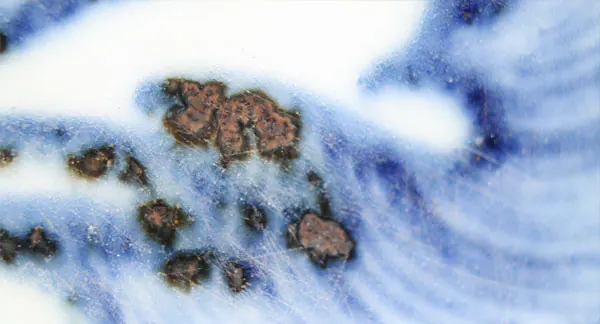
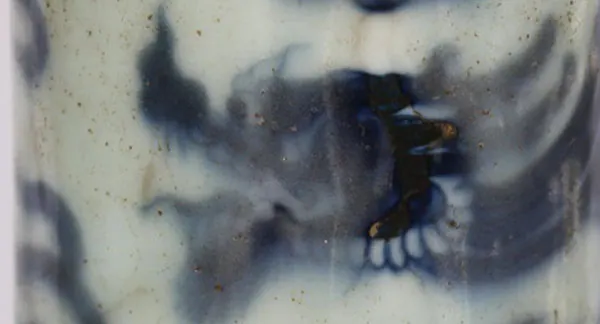
The tone of underglaze blue changed as the sources of cobalt changed: dark and heavily spotted in the Yuan and early Ming, soft and pale under Chenghua, strong and purplish under Jiajing, a clear sapphire under Kangxi. Our guide to cobalt blue on Chinese porcelain describes each. Modern copies are usually painted with refined cobalt, which gives a flat, even, inky blue with little variation in depth.
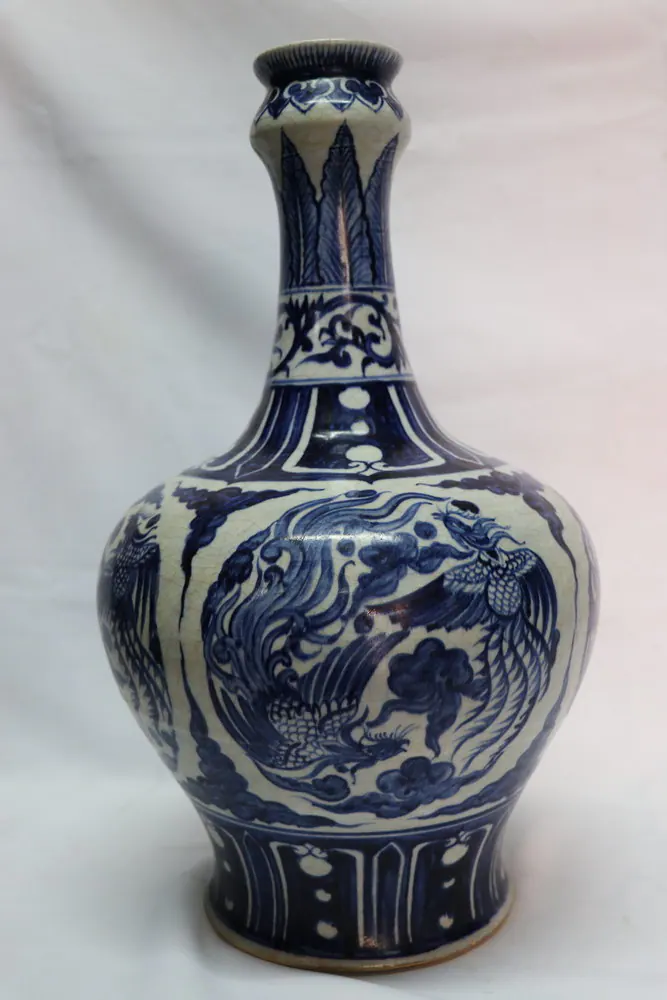
The dark spots of "heaped and piled" cobalt on Yuan and early Ming blue and white are among the most imitated features of all. On genuine pieces they formed where iron-rich cobalt gathered thickly, so they follow the brush: at the end of a stroke, in a patch of dense shading. They lie within the glaze and can glint like metal. Fakes often add them as dark dots spaced evenly along the outlines, sitting flat and dead. Brown rust spots from iron in the body are imitated in the same way, and imitations tend to be too large, too red or too black.
Enamel colours carry dates too. The opaque pink of the famille rose palette came into use only around 1720, at the end of the Kangxi reign, so a piece decorated in famille rose enamels cannot be Ming, whatever its mark says. Our guide to the colours used in each period covers other examples.
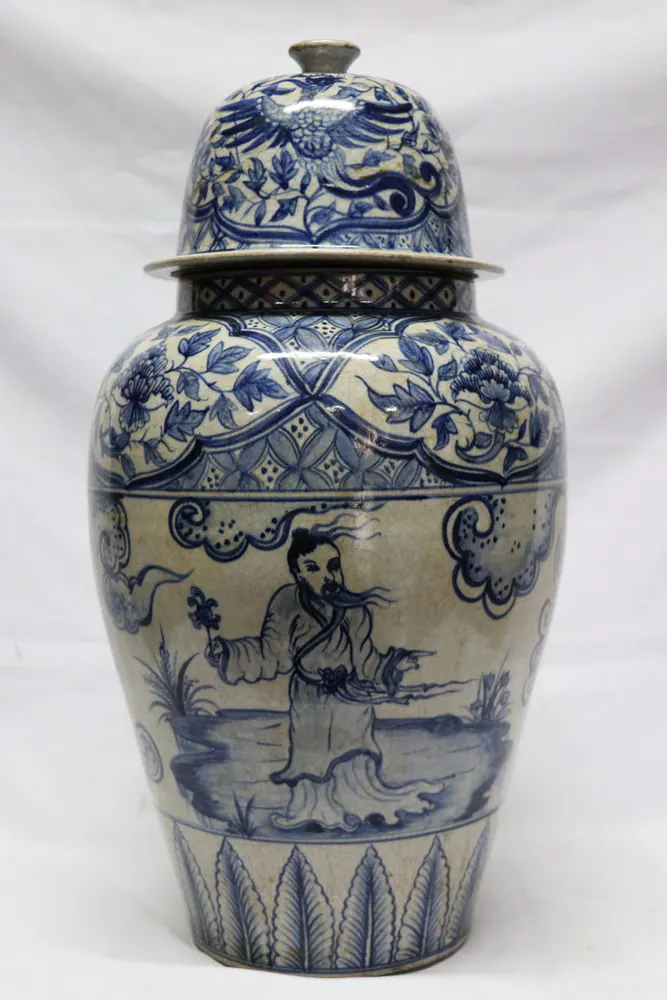
Finally, watch the brush. A painter in a Ming or Qing workshop drew the same design hundreds of times, often as one of several hands each with a set task, and the line shows it: quick, confident, varying in pressure, sometimes careless. A copyist working from a photograph draws slowly. The line is even and hesitant, with small breaks where the brush was lifted to check the model, and washes are filled in neatly where the original painter flooded them. Copies also tend to mix borders and details from different periods, so look closely at the secondary decoration as well as the main design.
Marks: a record of what was written, not when
A mark records what was written on a piece, not when it was made. That is as true of genuine porcelain as of fakes. Kangxi potters often wrote Xuande and Chenghua marks, late Qing and Republic workshops wrote Kangxi, Yongzheng and Qianlong marks in large numbers, and modern fakes carry whichever mark promises most. Our guide to apocryphal marks explains why earlier reigns were named so often.
Read the mark last, after the body, glaze, painting and wear, and then ask:
- Is the calligraphy fluent, in the hand of the reign it names, or copied stroke by stroke?
- Is the blue of the mark the same blue as the decoration, fired under the same glaze?
- Do the script, the number of characters and any ring or square around them suit that reign? Our Qing reign mark chart and its Ming companion show the forms each reign used.
- Did the reign named ever make this shape, in this palette, with this decoration?
A convincing mark on a wrong piece is still a wrong piece. Equally, a mark that names the wrong reign does not make a piece a fake: it may be an honest later piece with an apocryphal mark, to be dated by everything else. Catalogue wording matters. "Mark and period" is a claim about date; "with a Kangxi mark" records only what is written, and it is how we describe marks on pieces in our own collection. Our guide to Chinese porcelain marks explains how to read them.
Wear and artificial ageing
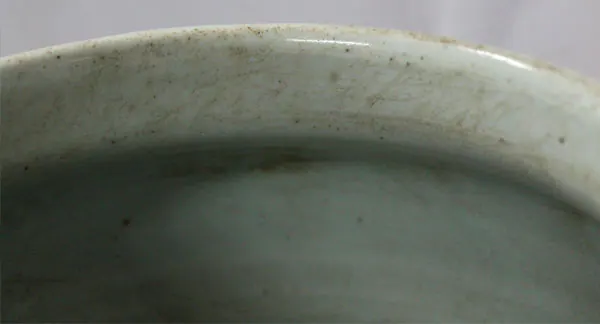
A piece that has existed for several centuries has usually been used, moved and cleaned. Genuine wear sits where that happened: on the foot rim, which slid across tables and shelves; on the rim of a bowl or dish; on the high points of moulded decoration; inside a bowl where spoons and stacked dishes rubbed. The scratches run in every direction and vary in depth, and some are dulled and dirty while others are fresher. Our guide to signs of wear shows typical examples.
Artificial wear is made in a hurry and tends to be uniform. Fakers rub pieces with abrasive paper, wire wool or paste, or tumble them with grit. Under a lens the scratches are often parallel, of similar depth and equally fresh, and they reach places nothing would have touched: the inside of a foot, the hollow of a neck, the recess under a rim.
Other ageing tricks include:
- staining the body, foot and crackle with tea, coffee or chemicals;
- burying pieces in soil, or coating them with mud, shell or coral fixed with glue, to imitate excavated or shipwreck wares (genuine deposits are bonded to the glaze, while added ones often soften in warm water or show glue under a lens);
- painting brown spots on the surface instead of letting them form in the firing;
- adding old-looking stands, boxes and labels to support a story.
None of this means that a clean, unworn piece must be new. Porcelain kept wrapped in a cupboard can survive centuries almost untouched. Wear is evidence to weigh with everything else, never proof on its own.
Restoration and altered pieces
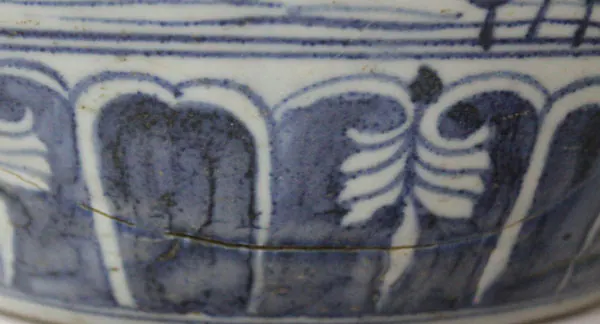
Not every misleading piece is a fake. More often a genuine piece has been made to look better than it is. Restorers fill chips and cracks with resin, then spray and paint over them, sometimes across a large part of the surface. A neck may be cut down and polished to remove damage, a drilled base from a lamp conversion filled, or a lost cover replaced with one from another piece, which the trade calls a marriage.
The signs are a change in gloss where the glaze has been sprayed, crackle that stops abruptly, blue that looks soft or slightly blurred, an area that feels warmer to the touch than the porcelain around it, and patches that glow differently under a longwave ultraviolet lamp. A strong light held behind a piece shows hairlines and cracks that run through the body. Our guide to condition and restoration explains how to check a piece thoroughly before you buy.
When to ask a specialist
Most fakes are found by patient looking, but some are good enough to deceive experienced collectors. Ask for a second opinion when:
- a piece is described as from an important period, and is offered for far less than such a piece would normally fetch;
- the evidence disagrees with itself and you cannot explain why;
- the attribution rests on a story, a family history or a previous owner's name rather than on the piece itself;
- you are buying from photographs alone.
The most useful opinion comes from an independent specialist who handles Chinese porcelain every day and can examine the piece in person. Scientific tests can help but have limits. Thermoluminescence testing estimates when a sample of ceramic was last heated; it needs a small sample drilled from the body, and the result dates only the spot that was sampled. The best long-term protection is your own eye, trained by handling documented pieces and studying museum collections.
Before you buy, ask the seller for clear daylight photographs of the base, the mark, the interior and the rim, and for a written description that states the period, the condition and any restoration. Our guide to buying antique Chinese porcelain lists the questions worth asking. We do not offer an identification or valuation service, but every piece in our collection is described as cautiously as the evidence allows, and the Request price form on each piece page is the place to ask for extra photographs.