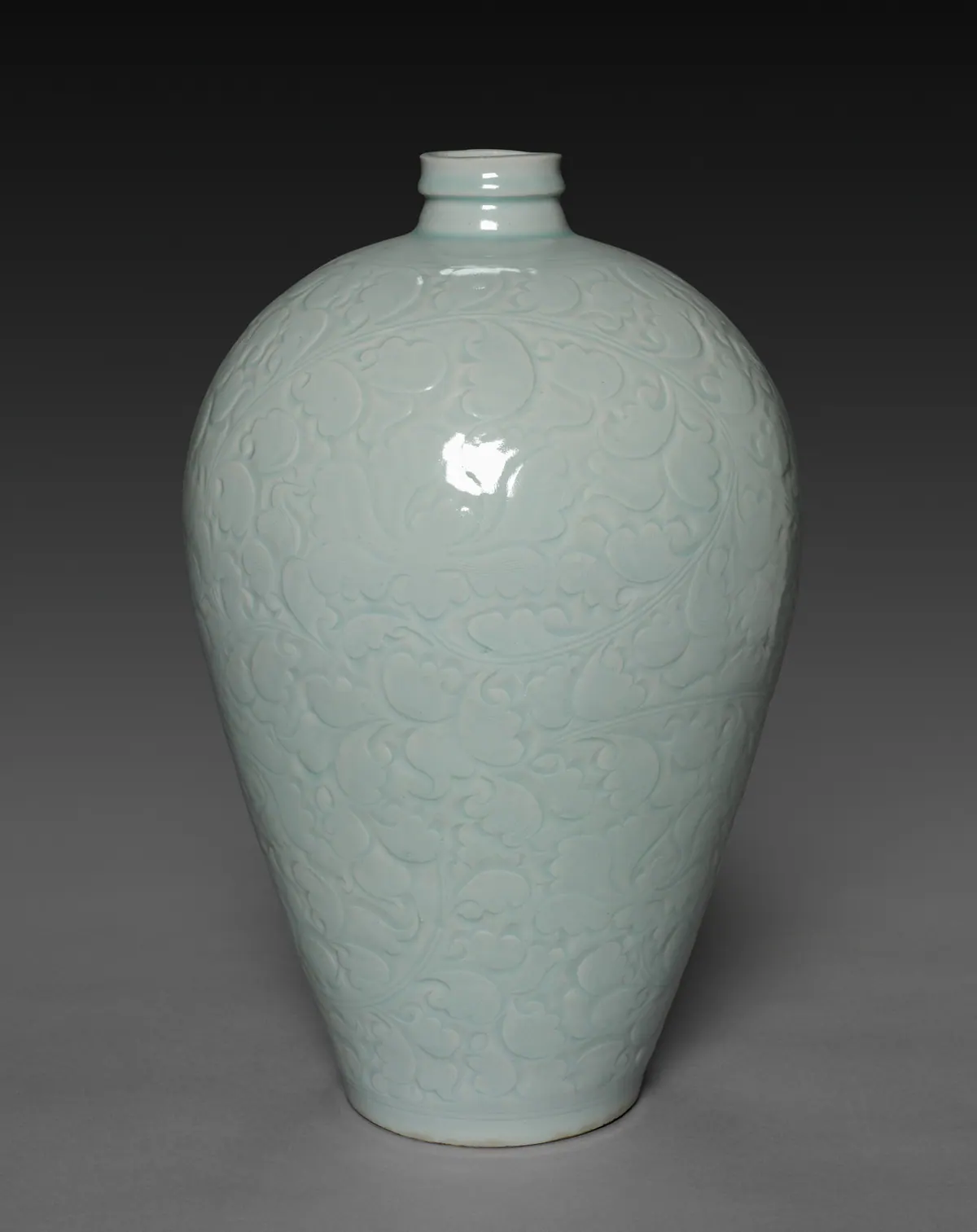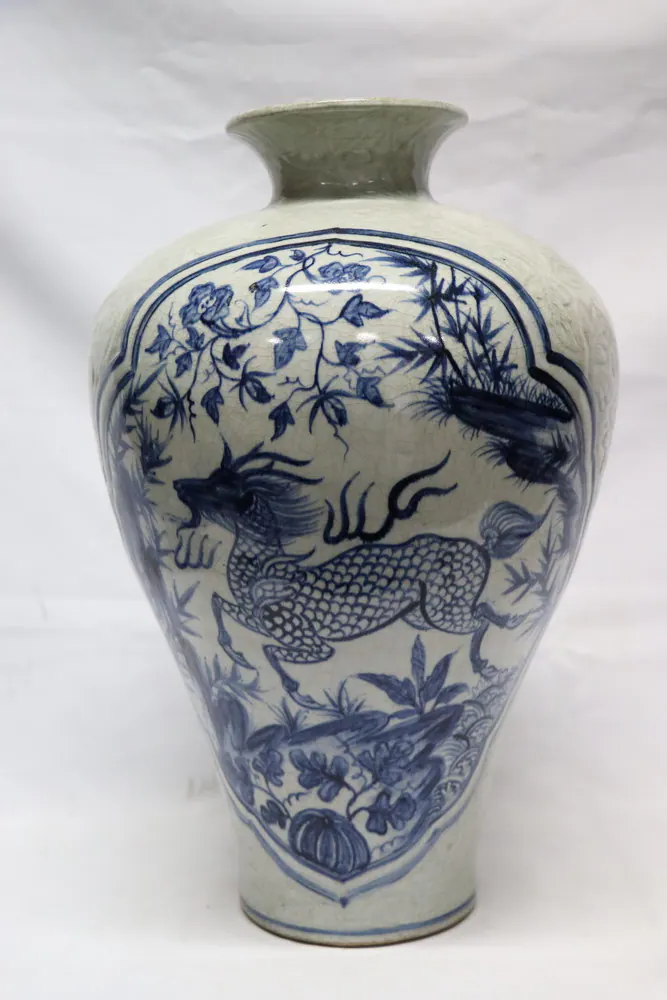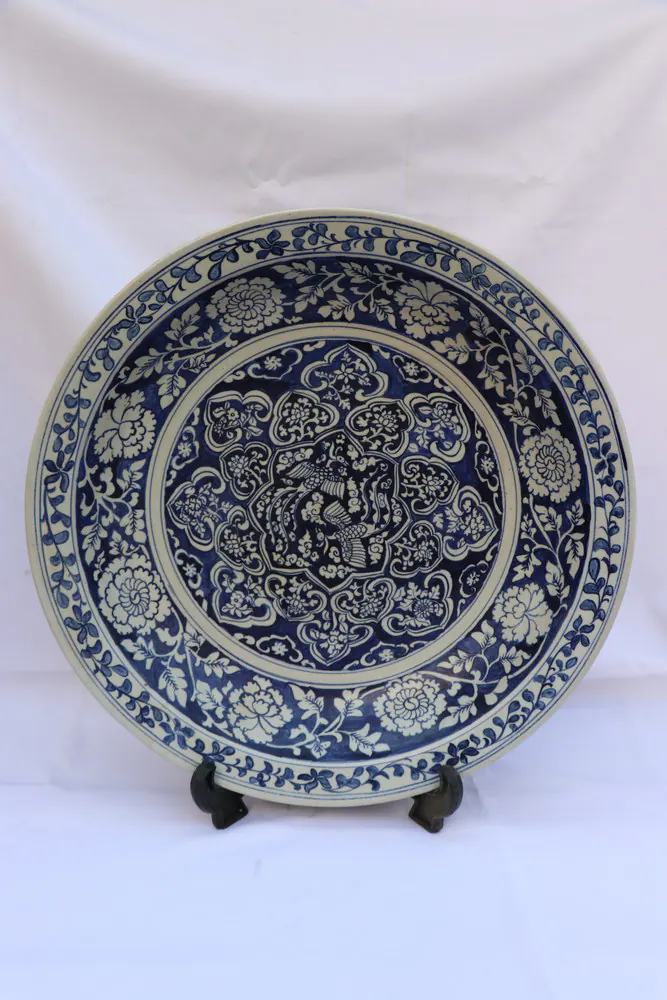
14th to 19th century
Chinese Blue and White Porcelain: A Collector's History from the Yuan to the Qing
Chinese blue and white porcelain is painted in cobalt on the raw body, covered with a clear glaze and fired once at high temperature. Made in vast numbers at Jingdezhen from the fourteenth century onwards, it was traded from Japan to Europe and copied wherever it went. This page follows it from the Yuan to the Qing, shows how the blue, the body and the painting changed from period to period, and ends with five questions for dating a piece of antique blue and white yourself.
- Where made
- Mainly Jingdezhen, Jiangxi province; also provincial kilns, notably in Fujian
- Pigment
- Cobalt oxide, painted on the unfired body under a clear glaze
- Firing
- A single high firing, roughly 1,250 to 1,300°C
- Key periods
- Yuan; Yongle and Xuande; Chenghua; Jiajing to Wanli; Transitional; Kangxi
- Main markets
- China, the Islamic world, Southeast Asia, Japan and Europe
Before the Yuan: early experiments with cobalt
Cobalt was known to Chinese potters long before blue and white became a lasting tradition. Tang dynasty potters used it to colour lead glazes blue on some sancai wares, and in the ninth century the Gongxian kilns in Henan painted cobalt designs on white wares. A few of these were recovered from the Belitung shipwreck, a ship that sank off Indonesia while carrying Chinese ceramics westwards.
These early pieces had no direct successors. Song taste favoured monochrome glazes such as celadon, Ding ware and the pale blue-tinged qingbai of Jingdezhen itself, and painted cobalt was hardly used. The continuous history of blue and white begins at Jingdezhen under the Yuan, when a stronger porcelain body, a reliable supply of cobalt and a demand from foreign buyers came together. Potters in the Islamic world had painted cobalt on white-glazed earthenware since the ninth century, and that familiar taste helped the new Chinese ware find buyers in the Islamic world so quickly.
The Yuan: Jingdezhen, imported cobalt and the Islamic world
By the second quarter of the fourteenth century, potters at Jingdezhen were making blue and white of remarkable quality. Two changes made it possible. Adding kaolin to the local porcelain stone gave a stronger body that could be thrown into large dishes and jars, and cobalt of high quality arrived from Persia along trade routes that Mongol rule had opened.
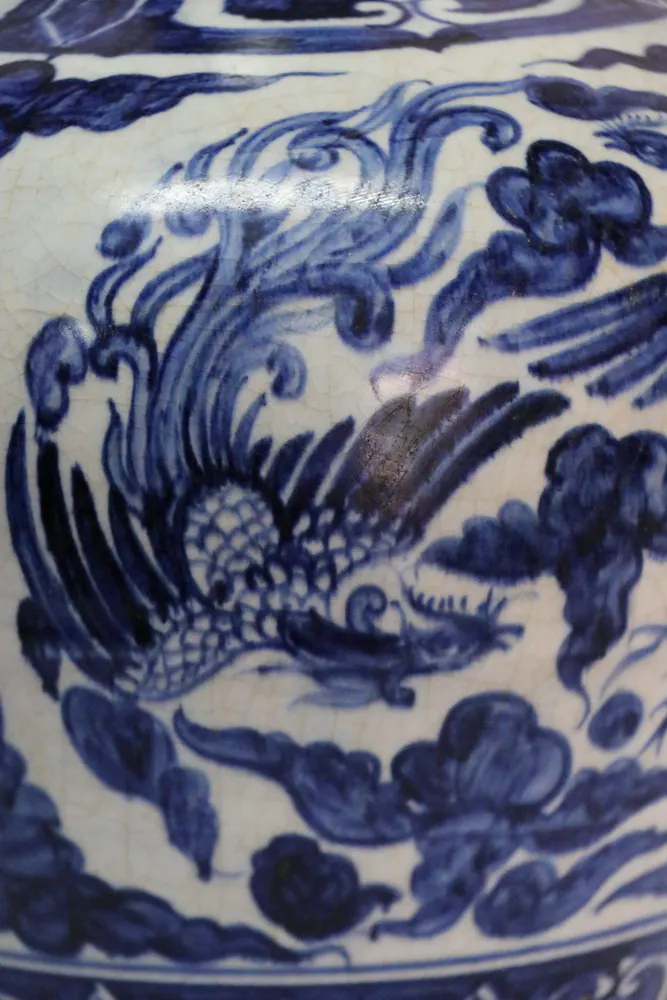
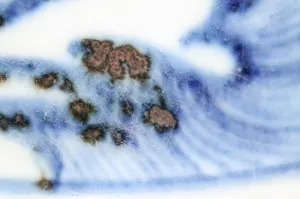
The imported cobalt was rich in iron and low in manganese. Where the painter loaded the brush, it fired to a deep, inky blue with dark, almost black spots that sink into the glaze, an effect collectors call heaping and piling. The best-known dated examples are a pair of temple vases from the Sir Percival David Collection, now shown at the British Museum, inscribed with a date corresponding to 1351.
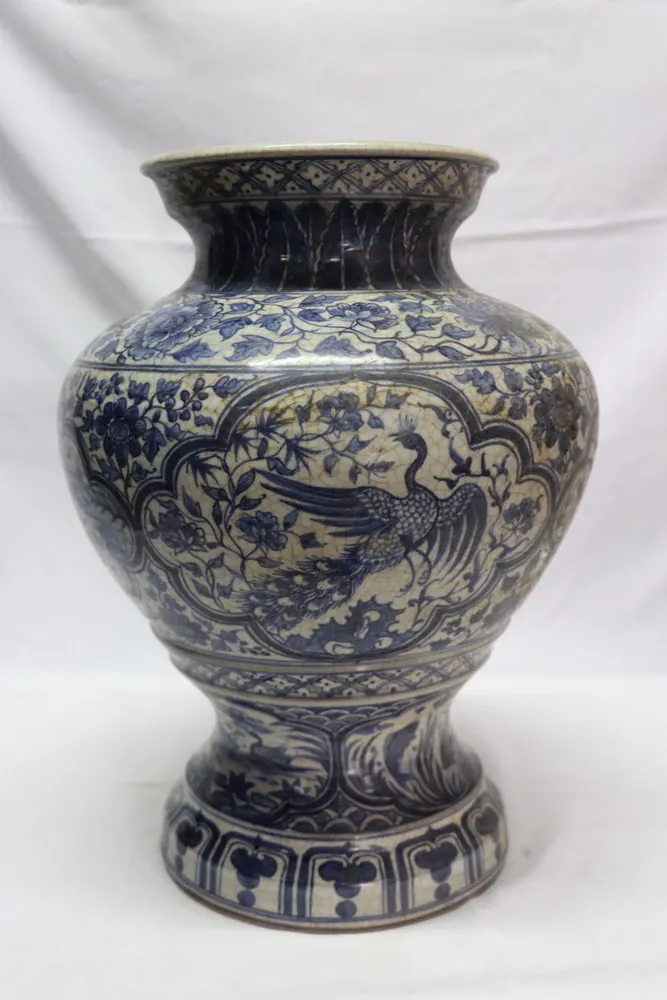
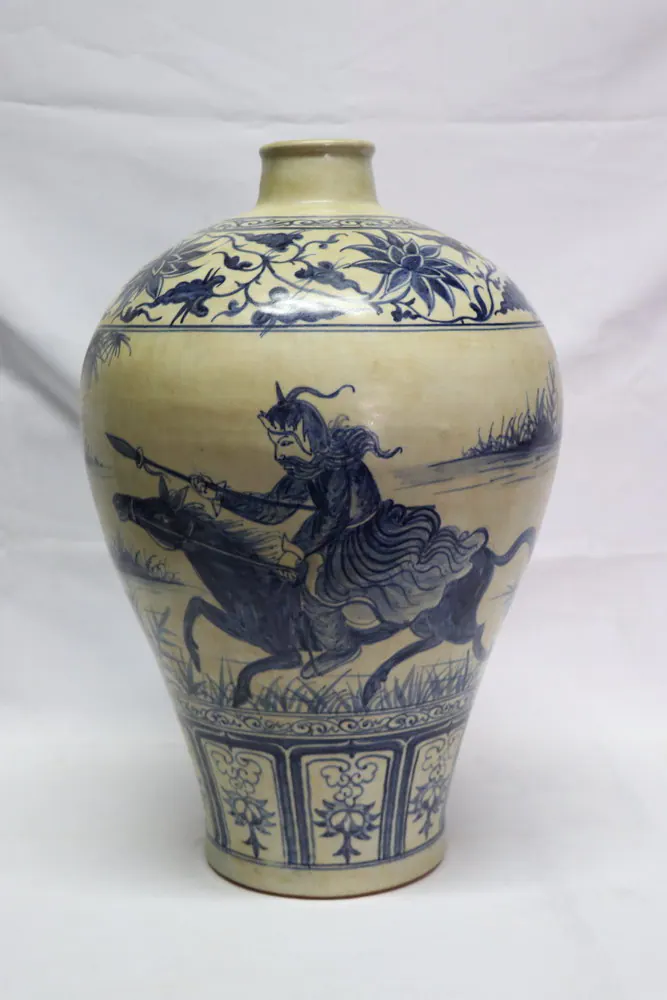
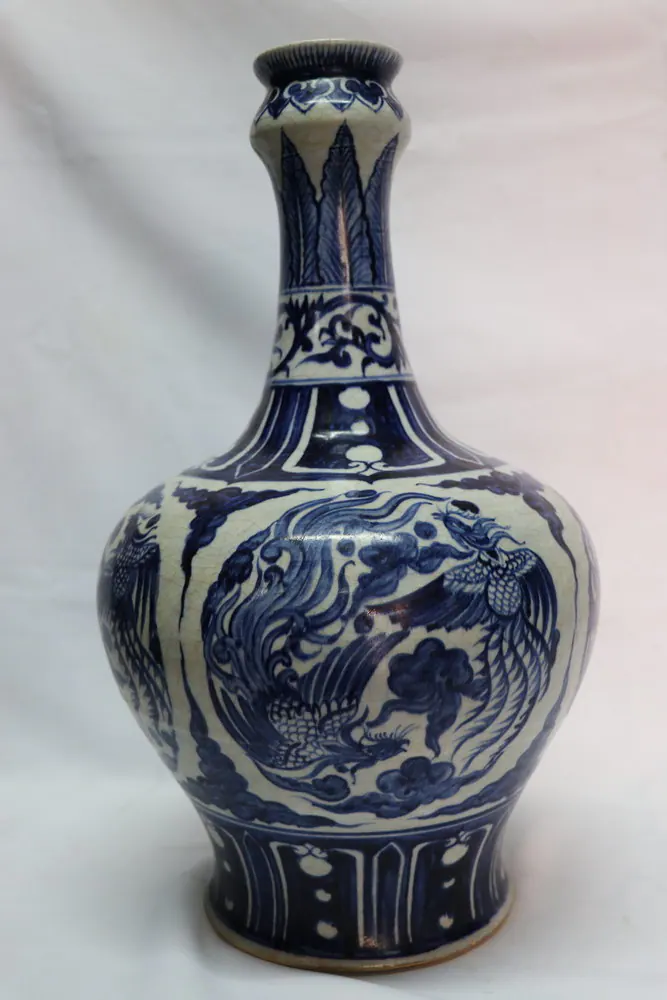
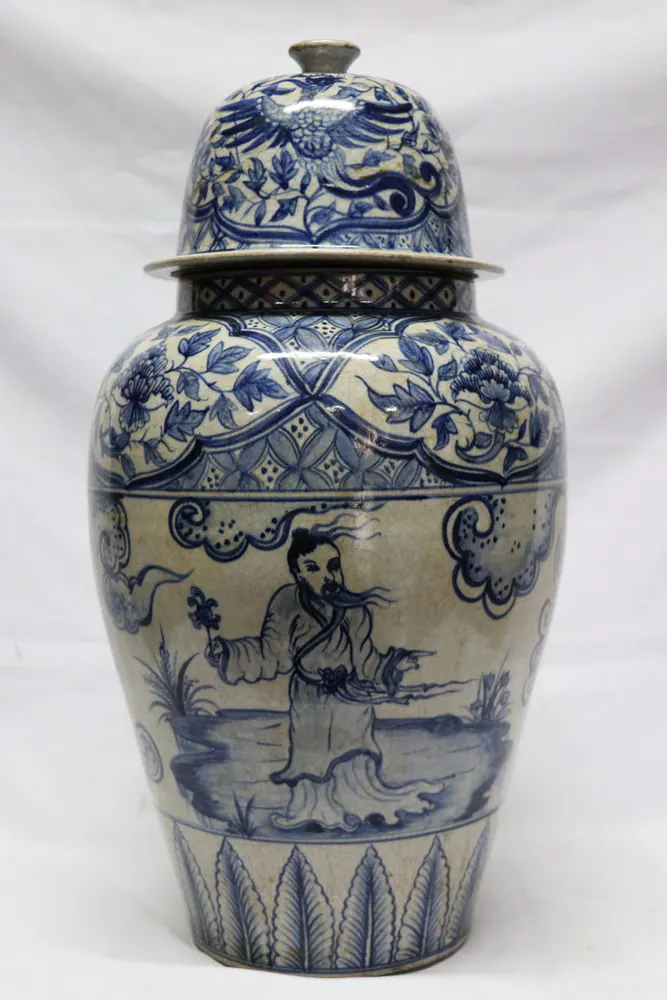
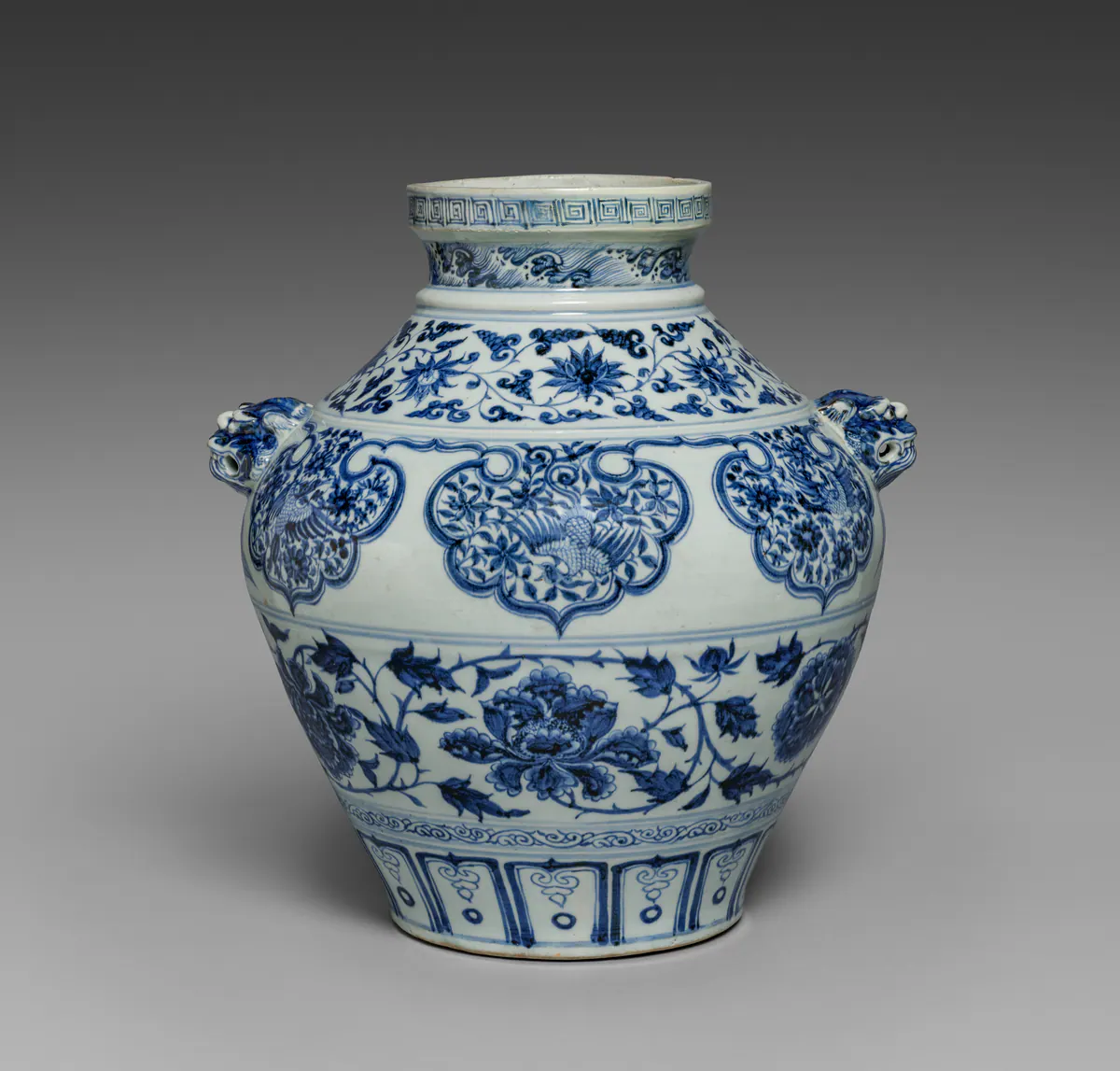
Yuan decoration is dense and arranged in bands: lotus panels at the foot, scrolling peony or lotus on the body, cloud-collar panels on the shoulder, and main scenes of dragons, phoenixes, fish among water plants or figures from stage plays. Typical forms include very large dishes, often with a lobed rim, broad-shouldered guan jars, meiping vases, pear-shaped bottles and flasks. There are no reign marks. Bases are usually unglazed and often burned orange where the body was exposed in the kiln. A vase in our collection catalogued as Yuan shows the arrangement well, with a pair of phoenixes circling among clouds between bands of formal ornament.
Much of the finest Yuan blue and white went abroad. Very large dishes suited communal dining in the Islamic world, and important groups survive in the Topkapı Palace in Istanbul and in the collection Shah Abbas I gave to the Ardebil Shrine in Iran. Smaller jars, bowls and ewers went to Southeast Asia. Yuan blue and white was barely recognised as a group until the 1950s, when the American scholar John Pope used the 1351 vases as a yardstick to identify fourteenth-century pieces in those two collections. Our guide to Yuan blue and white porcelain covers recognition in detail, and our page on underglaze red explains the copper-red wares made alongside it.
Early Ming: Hongwu, Yongle and Xuande
The Ming dynasty, founded in 1368, kept Jingdezhen at the centre of the industry, and from early in the dynasty porcelain was made there for the court. In the Hongwu reign (1368–1398) underglaze red was used on a scale never seen again, and much of the blue is greyer and softer than Yuan cobalt, which suggests that supplies of the imported mineral were irregular.
Under Yongle and Xuande, in the first decades of the fifteenth century, imported cobalt returned in quantity and the imperial kilns reached a standard that later potters copied for centuries. The body became finer and the glaze smoother, often with a gentle orange-peel texture. Designs are more open than in the Yuan, with space left around flower sprays, fruiting branches and scrolls, and the blue still shows the dark iron spots of imported cobalt. Some of the most striking shapes, such as flasks, ewers and basins, were borrowed from Islamic metalwork and glass, a reminder of how closely Jingdezhen still followed the tastes of its western markets. The maritime expeditions led by Zheng He between 1405 and 1433 carried Chinese porcelain across the Indian Ocean.
The Xuande reign is also when six-character reign marks became usual on porcelain from the imperial kilns. Our guide to Chinese porcelain marks explains how they are read and why a mark alone never dates a piece. Between Xuande and Chenghua lies the so-called interregnum (1436–1464), three reigns from which very little marked porcelain survives, although the kilns kept working. Our overview of Ming dynasty porcelain places blue and white among the other Ming wares.
Middle and late Ming: Chenghua to Wanli, and export on a new scale
From the Chenghua reign (1465–1487) the blue changes character. The imperial kilns used a domestic cobalt known as pingdengqing, which gave a pale, soft, even blue with little of the dark spotting of earlier wares. Painting became more delicate, with fine outlines filled in with a wash. Chenghua and Hongzhi porcelain is small in scale and admired above all for its refinement. It was copied from as early as the sixteenth century, and Chenghua marks appear on a great many later pieces, as our guide to apocryphal marks explains.
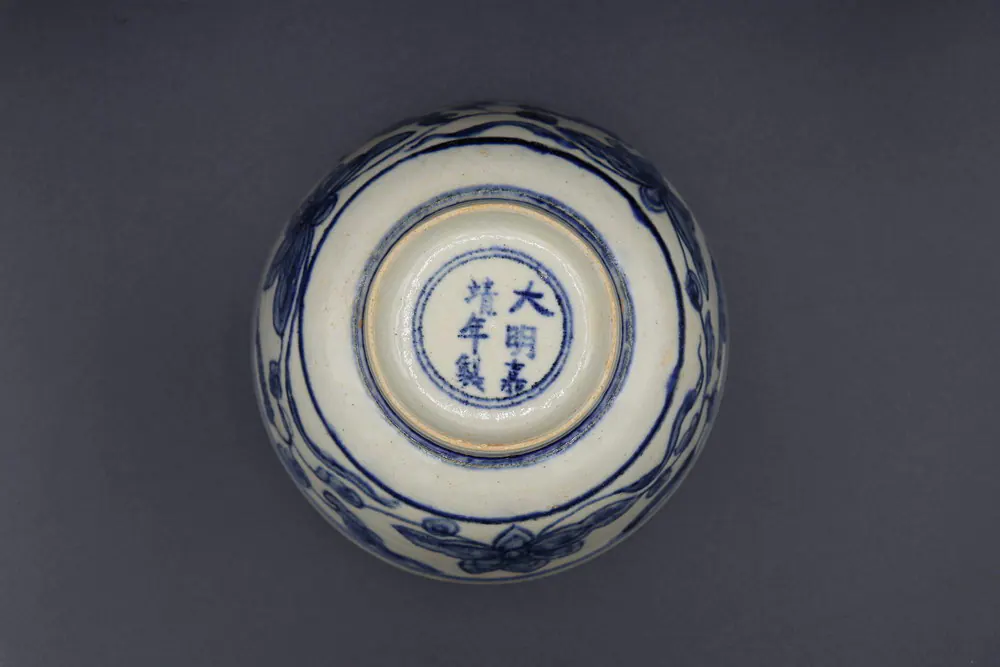
Under Zhengde (1506–1521) some pieces made for the court carry Arabic or Persian inscriptions. The Jiajing reign (1522–1566) brought huiqing, an imported cobalt mixed with local ore to give a strong, purplish blue, and Daoist subjects became popular. Output rose sharply, and a growing share of the court's orders was fired in private kilns. A bowl in our collection with a Jiajing mark, painted with a lotus scroll outside and a fish inside, shows a fault that came from firing: the blue has blurred where the bowl stood too close to the fire.
The late Ming was the age of export on a new scale. In 1567 the court relaxed its ban on private overseas trade, the Portuguese were already established at Macau, and from the 1570s Spanish galleons carried porcelain from Manila across the Pacific to Mexico. Jingdezhen answered with kraak porcelain, thin dishes and bowls with panelled borders that reached northern Europe in quantity after the Dutch captured two Portuguese carracks in 1602 and 1603. At home, private kilns turned out a vast amount of blue and white for everyday use, described in our guide to Ming folk kiln porcelain. Wanli blue ranges from the strong purplish tone of Jiajing early in the reign to greyer, more watery shades later on.
The Transitional period and Kangxi
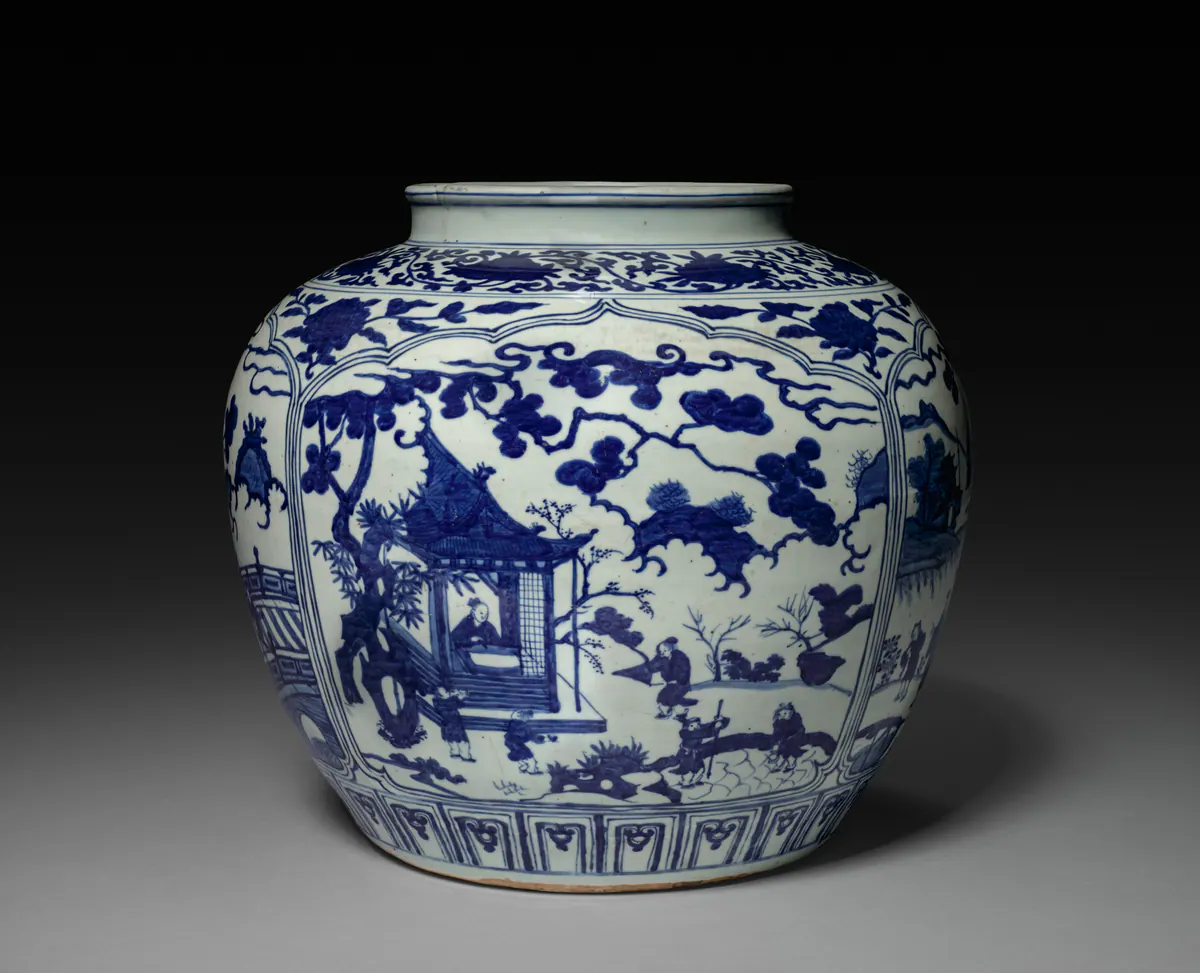
Imperial orders dwindled in the last years of the Wanli reign and all but stopped as the Ming collapsed. Jingdezhen's potters turned to new customers: Chinese scholars and merchants, Japanese tea masters and Dutch traders. The result, known as Transitional porcelain (roughly 1620 to 1683), is some of the most freely painted blue and white ever made: figures from novels and plays, landscapes and the moon among swirling clouds, on sleeve vases, brush pots and jars, often in a bright violet-blue on a fine white body. Some pieces carry cyclical dates rather than reign marks, and these have allowed the style to be followed almost decade by decade.
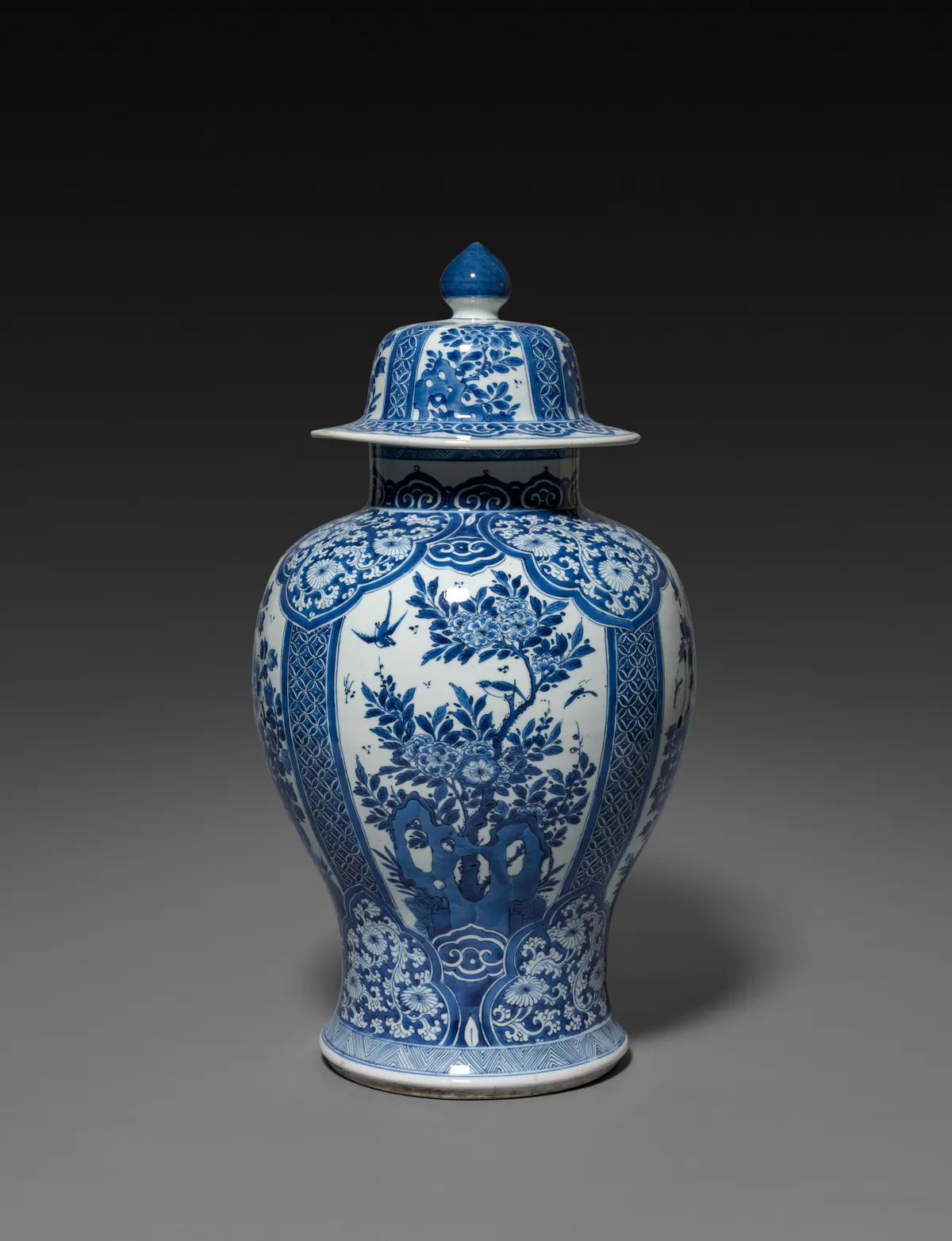
The Kangxi reign (1661–1722) brought Jingdezhen back under imperial direction. After the imperial kilns were re-established in 1683, blue and white reached a new technical peak. Refined cobalt gave a clear sapphire blue, and painters laid it in many graded tones, from a pale wash to deep blue, so that landscapes and flowers take on real depth. The body is hard, white and well prepared, and the glaze thin and glassy.
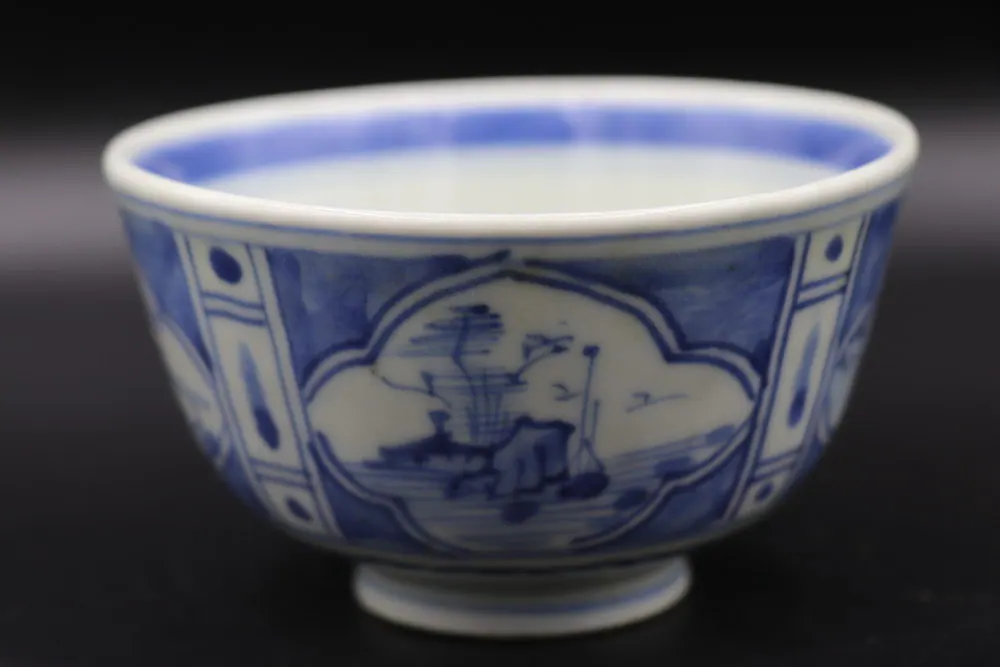
Kangxi blue and white was also made for export in enormous quantities. Tall vases, covered jars and beakers were sold in sets to stand on European chimneypieces and cabinets, and the slender women painted on many of them gave rise to the Dutch name lange lijzen, which English buyers turned into Long Elizas. Many export and domestic pieces carry a symbol, such as a leaf or a lingzhi fungus, instead of a reign mark. A bowl in our collection catalogued as Kangxi period, painted outside with mountains and water in a shaped panel, has a small leaf mark inside.
Later Qing and the export trade
Under Yongzheng (1723–1735) and Qianlong (1736–1795) the imperial kilns looked back to the early Ming. Painters copied Yongle and Xuande designs and even imitated their iron spots, adding dark dots deliberately with the tip of the brush. These dots sit neatly on the surface of the blue rather than sinking irregularly into it, which is one of the clearest ways to separate the copies from the originals.
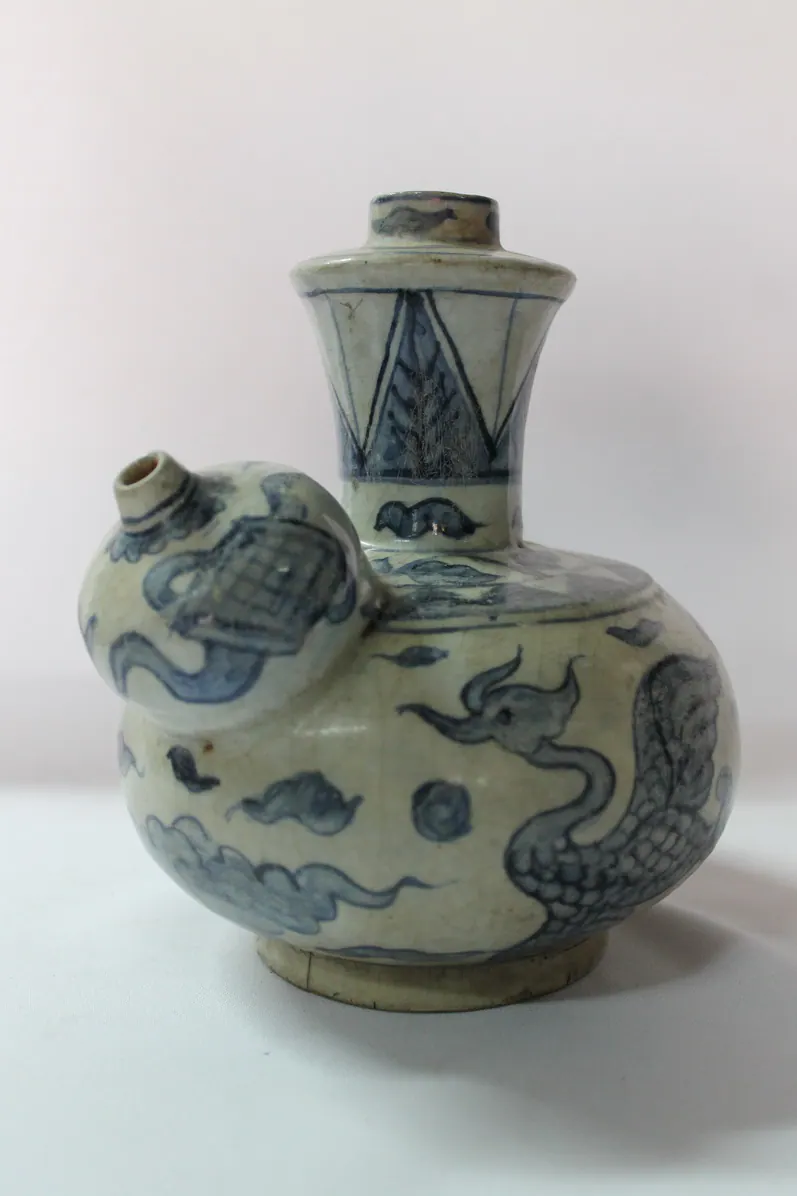
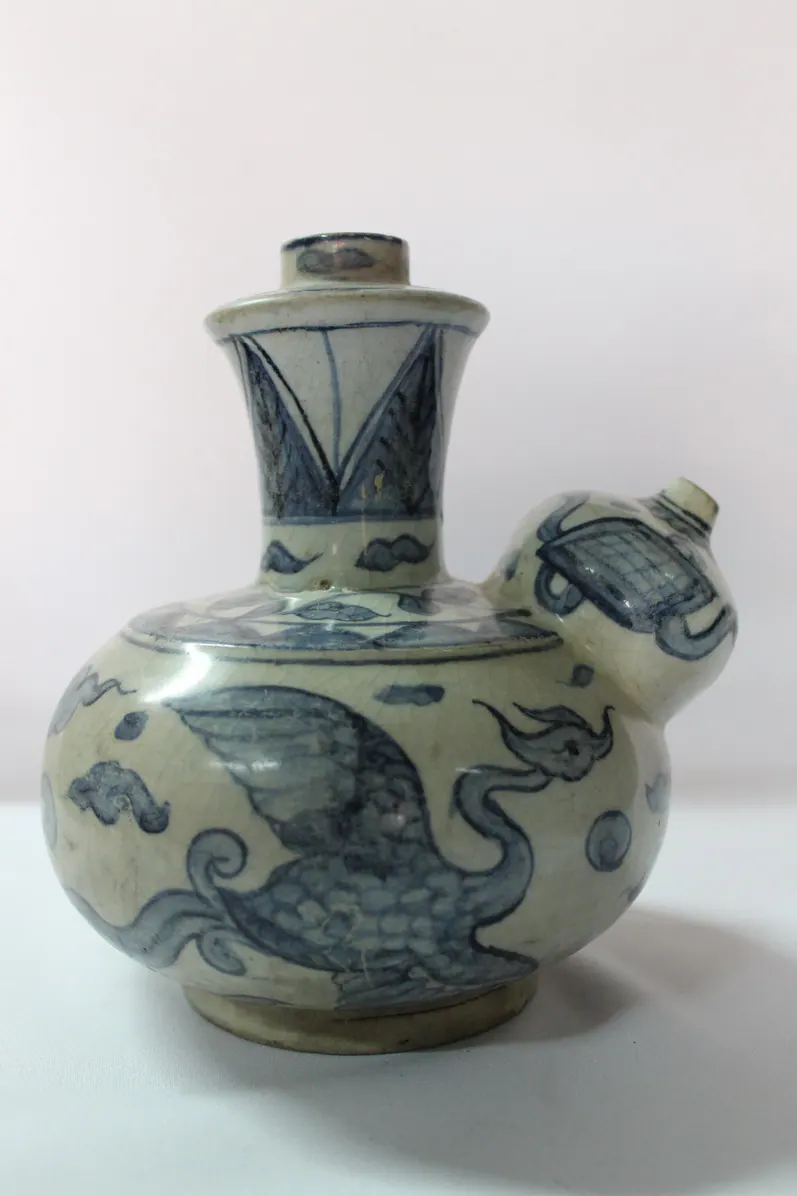
The export trade grew with them. From 1757 foreign trade was confined to Canton, and the European East India companies bought blue and white dinner services, garnitures and tea wares by the shipload. The Geldermalsen, a Dutch East India Company ship that sank in the South China Sea in 1752, was carrying many thousands of pieces of blue and white when she went down. Much was painted with Chinese landscapes for European buyers, and some was made in European shapes for the table. Older markets were supplied too: the kendi, a pouring vessel used in Southeast Asia, was made in China in large numbers from the late Ming. Our blue and white kendi, catalogued as early Qing, came from a private kiln rather than an official one.
In the nineteenth century quality became more uneven, and the Taiping war did great damage at Jingdezhen in the 1850s. The later Guangxu reign saw a revival that included many copies of Kangxi blue and white, often with Kangxi marks, and these are among the pieces collectors most often misdate. Our guide to Qing dynasty porcelain follows the later reigns in more detail.
A style copied around the world
Chinese blue and white was imitated wherever it was traded, and many of these imitations are now antiques in their own right. Knowing them helps with attribution, because a piece that looks Chinese at first glance may come from somewhere else entirely.
Vietnamese potters were making blue and white by the fifteenth century, on a greyer stoneware body, often with a brown wash on the base. Korean potters of the Joseon dynasty painted cobalt on porcelain from the fifteenth century, in a sparer style of their own. In Japan, porcelain was first made at Arita early in the seventeenth century, and from the late 1650s, when the upheavals of the Ming to Qing change cut Chinese supply, the Dutch bought Japanese blue and white in the Chinese manner for Europe.
Further west, Persian potters copied Chinese designs on a soft fritware body, and Dutch potters at Delft made tin-glazed earthenware painted in blue that imitated first kraak and then Kangxi porcelain. Neither is porcelain, and a chip or unglazed edge shows the difference at once. Our guide to telling Chinese, Japanese and Vietnamese blue and white apart sets out the tests in detail.
How to date blue and white porcelain: five questions
No single feature dates a piece. Ask each of these questions in turn, and trust a date only when all five answers agree.
- What is the blue like? Dark, iron-spotted blue that sinks into the glaze points to the imported cobalt of the Yuan and early Ming; a pale, even blue to Chenghua; a purplish tone to Jiajing and early Wanli; a clear, graded sapphire to Kangxi. Our guide to cobalt blue explains the differences.
- How was it painted? Yuan and early Ming painters built up colour in brushstrokes. From Chenghua, outlines filled with washes become usual, and Kangxi painters worked in graded washes. Hesitant, fussy or mechanically even drawing is a warning on any piece that claims an early date.
- Does the shape fit? Every period had its own forms and proportions. A shape that did not exist when the decoration suggests, or a profile that is slightly wrong, is often the first sign of a later copy.
- What does the base show? Look at the clay where it is exposed, the cut of the foot, any orange burn, kiln grit, radial chatter marks from trimming and the way the glaze stops at the foot. Bases are hard to fake well.
- What does the mark say? A mark records what was written, not when the piece was made. Potters routinely used earlier reign marks, so a mark counts only when everything else agrees with it.
Wear, crackle and staining can support a date but never prove one. Our guide to age signs sets out what they can and cannot tell you.
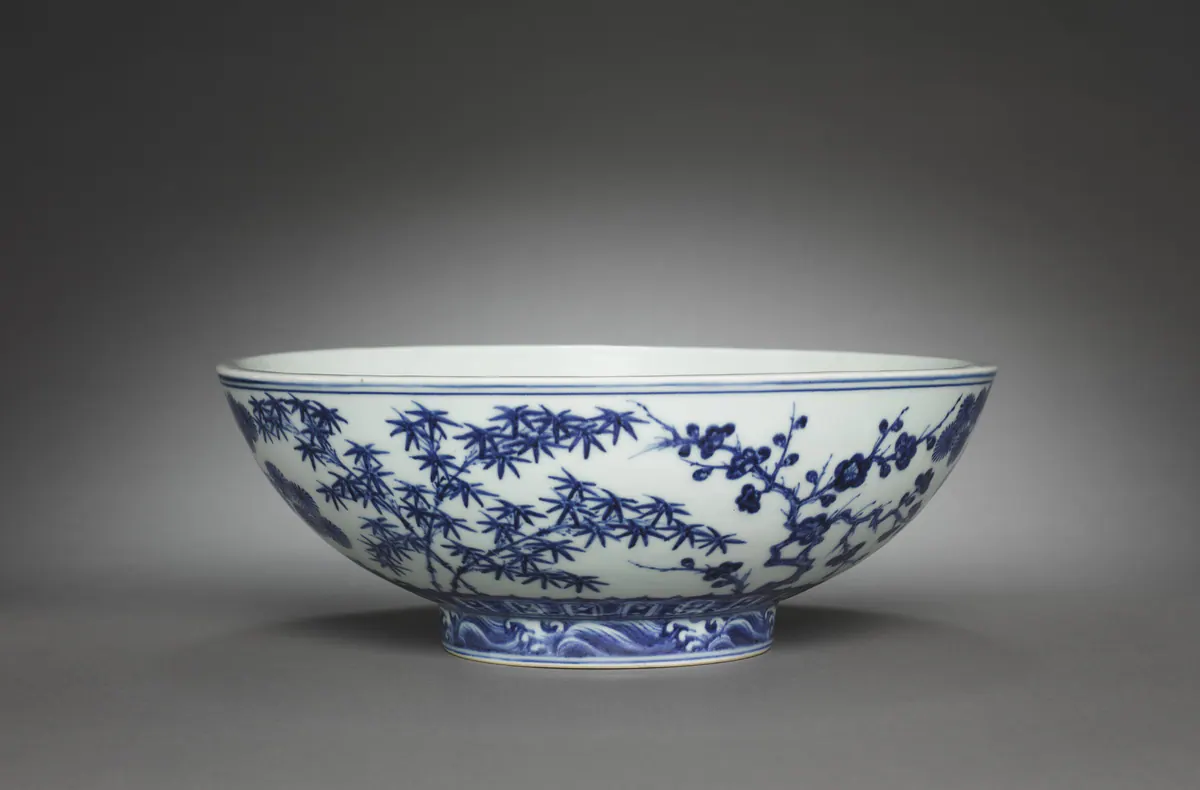
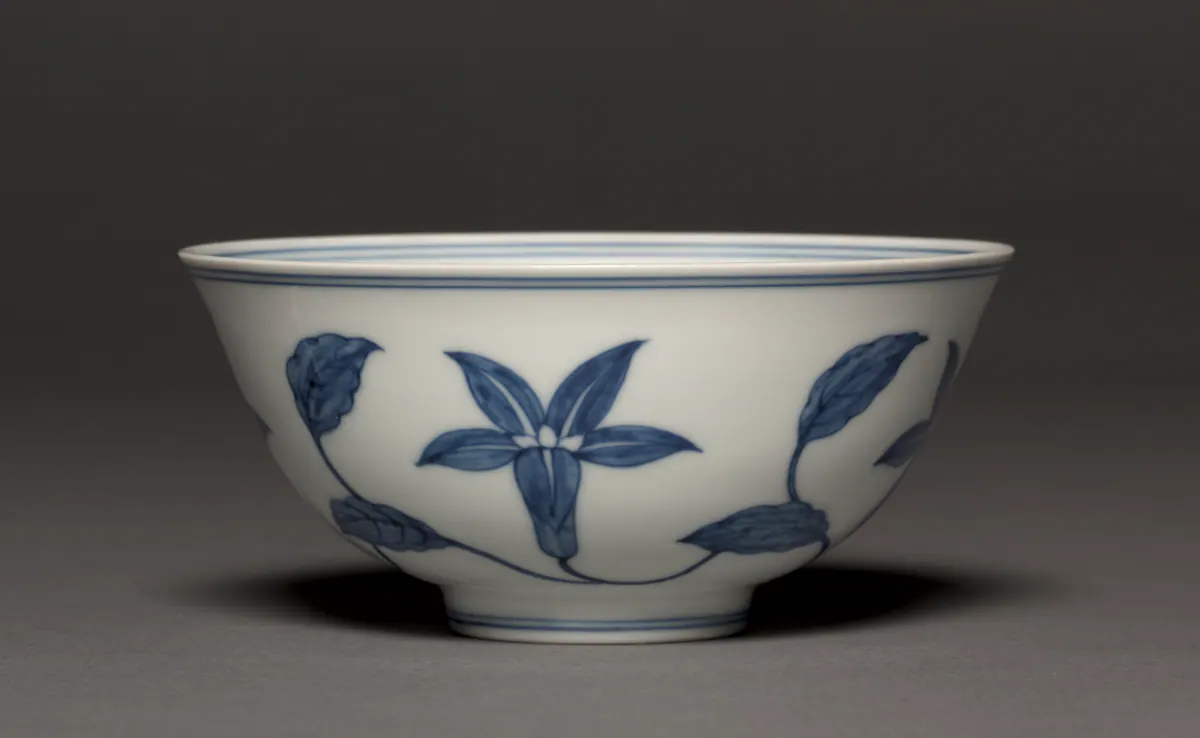
The five museum pieces below show how the blue and the painting changed from the Yuan to the Kangxi reign.
Museum examples
Blue and white in our collection
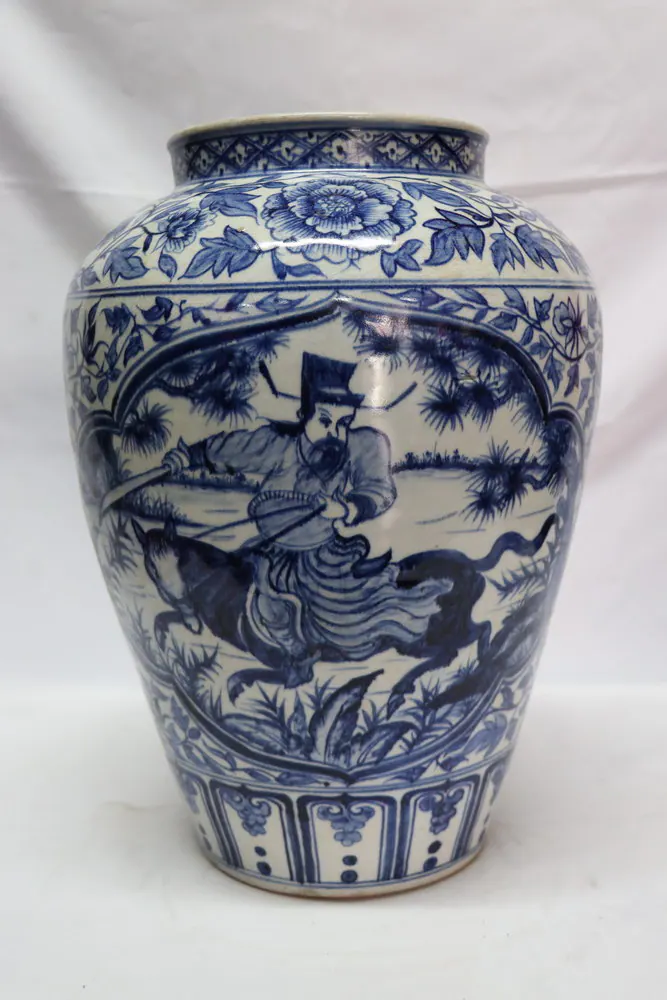
Blue and white makes up a large part of our collection, from pieces catalogued as Yuan and early Ming to Qing wares made for the home and export markets. The photographs on each piece page let you apply the five questions above for yourself: the tone of the blue, the drawing, the shape and, wherever we can show it, the base.
It helps to know what to expect of old blue and white. Pieces made for daily use usually show wear to the foot and rim, and many have small frits where the thin glaze at the edge has flaked. Kiln faults such as glaze contractions, specks of grit and blurred blue happened in the firing and are not later damage, though a careful description still mentions them. Cracks and restorations are a different matter, and they should be disclosed plainly.
The same factors decide value across the whole field: the period, the quality of the potting and painting, condition, provenance, rarity and the state of the market. A well-painted piece with a convincing base and honest wear can matter more than a famous mark.
You can see everything currently available in our blue and white porcelain collection. To buy a piece, use the Request price form on its page and we will reply by email. Every shipment is fully insured, and all sales are final.