About 1620–1683
Transitional Porcelain (1620 to 1683): From Ming to Qing
Transitional porcelain is the name collectors give to the blue and white and enamelled wares made at Jingdezhen between the end of the Wanli reign and the restoration of the imperial kilns in 1683. With little work for the court, the potters painted for private buyers at home and abroad, and produced some of the freshest, most pictorial porcelain in Chinese history. This guide explains why the period stands apart, what its porcelain looks like and how it is dated.
- Dates
- About 1620–1683
- Reigns
- Tianqi and Chongzhen (Ming); Shunzhi and early Kangxi (Qing)
- Kilns
- Private kilns at Jingdezhen
- Key wares
- Blue and white; also wucai enamels
- Marks
- Few reign marks; cyclical dates, symbols and earlier Ming marks
- Main markets
- Chinese scholars and merchants, Japan, the Dutch
Why transitional porcelain has its own name
Most Chinese porcelain is dated by reign, and the finest by the reign mark of the emperor whose kilns made it. For roughly sixty years in the seventeenth century that system does not work. The Ming dynasty was failing and then fell in 1644; the Qing took decades to secure the south; and the imperial kilns at Jingdezhen received few orders until the Kangxi Emperor restored them in 1683.
Yet the kilns did not stop. They worked for new customers and developed a style distinct from the kraak porcelain that came before it and from the Kangxi porcelain that followed. Western collectors and scholars began to call it Transitional in the twentieth century, and the name has stuck. Definitions vary a little: some use it for the whole span from about 1620 to 1683, others mainly for the Chongzhen and Shunzhi reigns, when the style was at its most distinctive.
The loss of imperial orders and the new private patrons
Imperial demand fell away in the last years of the Wanli reign and never recovered under the Ming. The court was short of money, rebellion spread through the countryside, and the last Ming emperor, Chongzhen, took his own life when rebels entered Beijing in 1644.
For Jingdezhen's potters the loss of the court was also an opportunity. Freed from imperial pattern books, they worked for the scholar officials and merchants of the prosperous Jiangnan region, who wanted vases, brush pots and jars for their studios and homes, painted with subjects they knew from literature. They also served foreign buyers, above all the Dutch and the Japanese. The best Transitional porcelain is finely potted from a well-refined white body, and painted with a care that matches much imperial ware.
Painting from woodblock prints: figures, landscapes, clouds and the moon
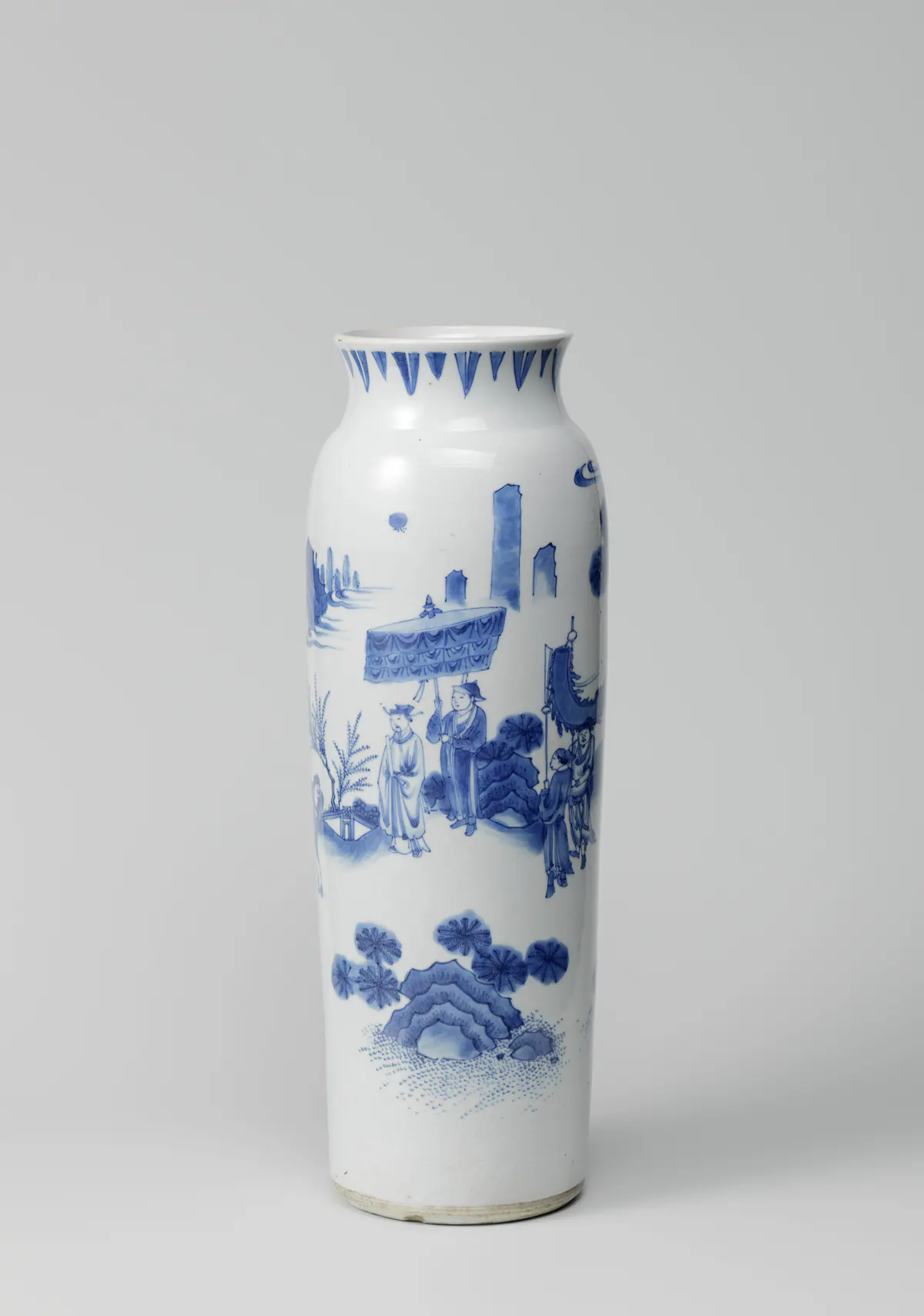
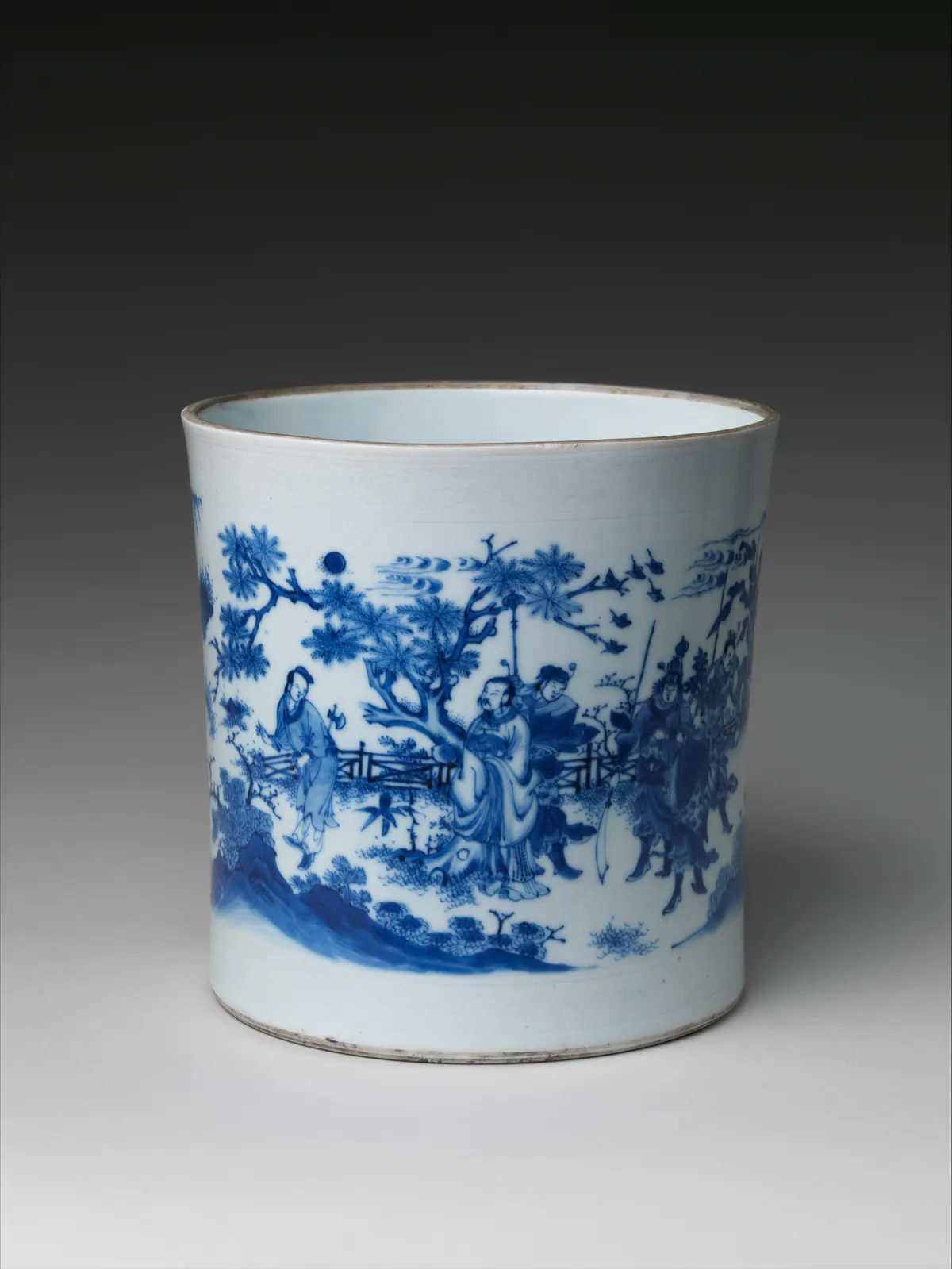
The late Ming saw a boom in printed books, and illustrated editions of novels and plays sold widely. Porcelain painters borrowed their compositions. Scenes from the Romance of the Three Kingdoms, the Water Margin and the Romance of the Western Chamber appear on vases and jars, along with scholars in gardens, Daoist immortals, and mounted officials with their attendants.
The painting has a character of its own. Figures stand in real landscapes of rocks, pines and banana plants, and tufts of grass are drawn as small V-shaped strokes. Bands of swirling cloud divide one scene from the next or drift across the sky, and a moon, sometimes half hidden by cloud, hangs above. Many pieces have borders of finely incised scrolls under the glaze at the shoulder and above the foot, and the blue is often laid in flat, clear washes within crisp outlines.
Calligraphy became part of the design. Many pieces carry a poem or a short inscription beside the scene, written in a fluent hand, and some are signed with a studio name or dated. For buyers who read, a vase could now be enjoyed in much the same way as an illustrated page or a painted scroll.
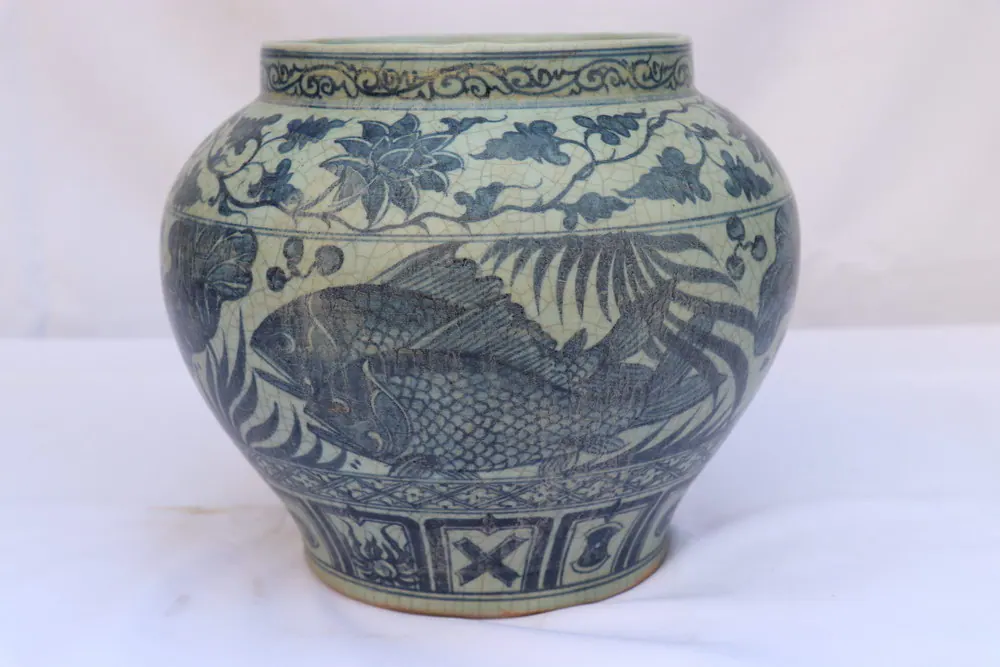
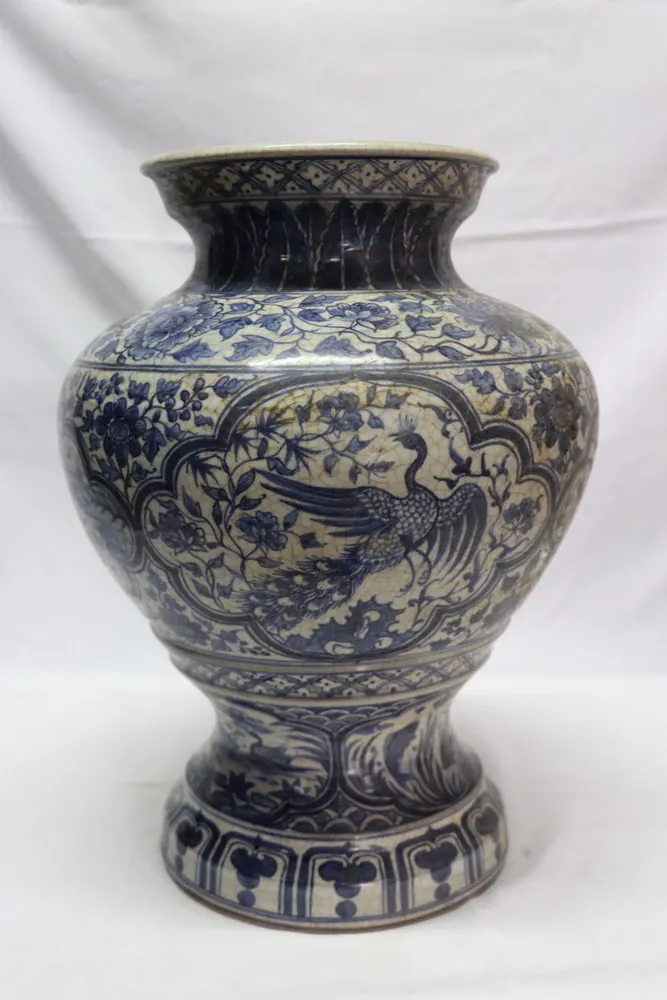
Animals were painted with the same freedom. A folk kiln vase in our collection, catalogued as late Ming to early Qing and painted in imitation of the earlier Yuan style, has a galloping qilin, a peacock and a fish, each set in its own shaped panel. Our guide to symbols on Chinese porcelain explains what such creatures meant.
Forms: sleeve vases, brush pots and ovoid jars
Three forms define the period. The sleeve vase is a tall, straight-sided cylinder with a slightly flared mouth, which gives a wide, continuous surface for a narrative scene. The brush pot, a plain cylinder for a scholar's desk, offered the same space on a smaller scale. Ovoid jars, often with covers, carried figure scenes or flowering plants around their broad shoulders.
Alongside these came bottles, beaker vases, bowls and incense burners for the Chinese market, and shapes made to order for foreign buyers. Many sleeve vases and jars have flat, unglazed bases, and the body exposed there is usually fine and pale. Our guide to Chinese porcelain shapes sets these forms in the wider history of vessel types.
Museum examples
Colour beyond blue: Transitional wucai
Blue and white dominates the period, but Jingdezhen also made enamelled porcelain in the wucai manner, combining underglaze blue with overglaze red, green, yellow and aubergine. The subjects are the same as on the blue and white: figures from novels and plays, scholars in landscapes, flowers and birds. The enamels are applied with the same freedom as the blue, and the drawing is often as lively.
Transitional wucai sits between the crowded, strongly coloured wucai of the Jiajing and Wanli reigns and the more controlled famille verte of the Kangxi period, and has something of both. Our guide to doucai and wucai explains how the palettes differ.
Markets in Japan and Europe
Japan was an important buyer. Tea masters there ordered porcelain in informal shapes and deliberately imperfect finish. The Japanese call the simpler Tianqi-period wares ko-sometsuke, and admire the small rim frits that they describe as moth-eaten. A finer group of the Chongzhen period, with dense geometric patterns, is known in Japan as shonzui.
The Dutch East India Company, working from its base on Taiwan, bought Transitional porcelain in large quantities for Europe. It sent wooden models so that Jingdezhen could make European shapes such as jugs, mustard pots and candlesticks, painted with Chinese subjects or with tulip-like flowers that suited Dutch taste.
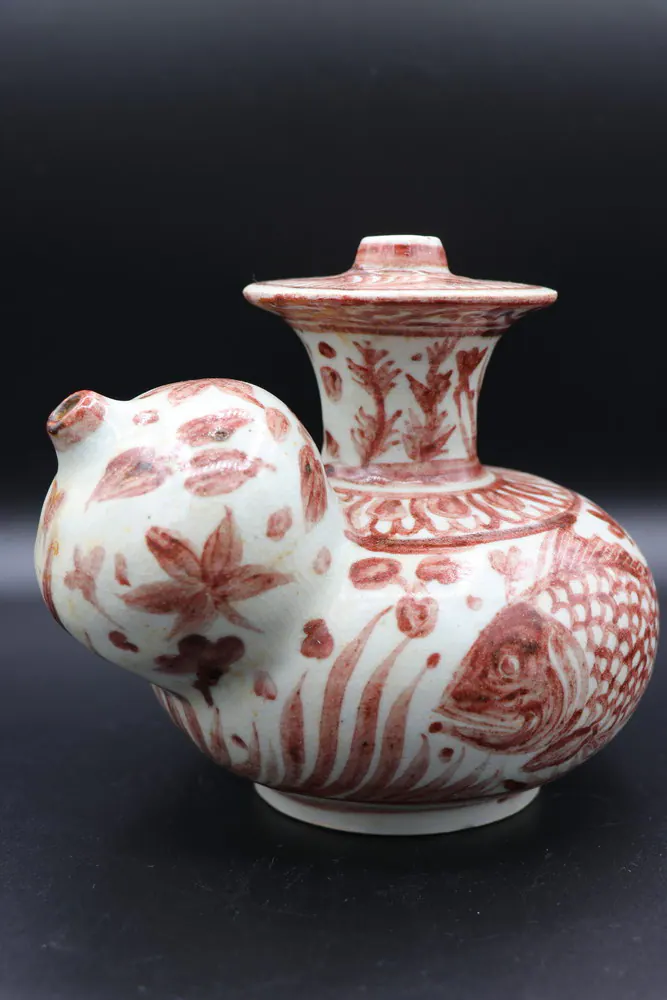
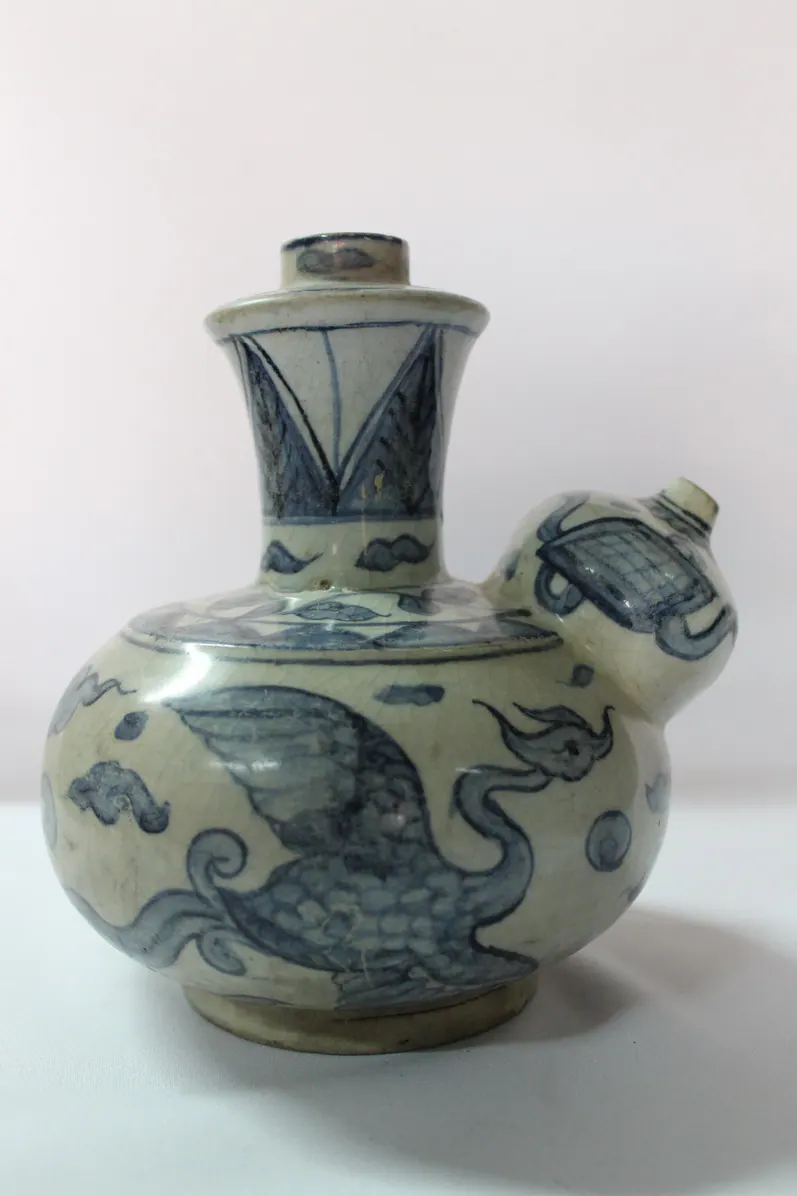
Southeast Asia remained a market throughout. Pouring vessels such as the kendi continued to be made for it, and a blue and white kendi in our collection, catalogued as early Qing, came from a private kiln rather than an official one.
The trade was badly disrupted after 1644. Fighting reached Jingdezhen, and in 1661 the Qing ordered the evacuation of the south-eastern coast to cut off supplies to the Ming loyalist forces of Zheng Chenggong, who held islands off the coast and, from 1662, Taiwan. By then the Dutch had turned to Japan, and from the late 1650s Arita porcelain took much of the place Chinese porcelain had held in Europe.
Marks, cyclical dates and violets in milk
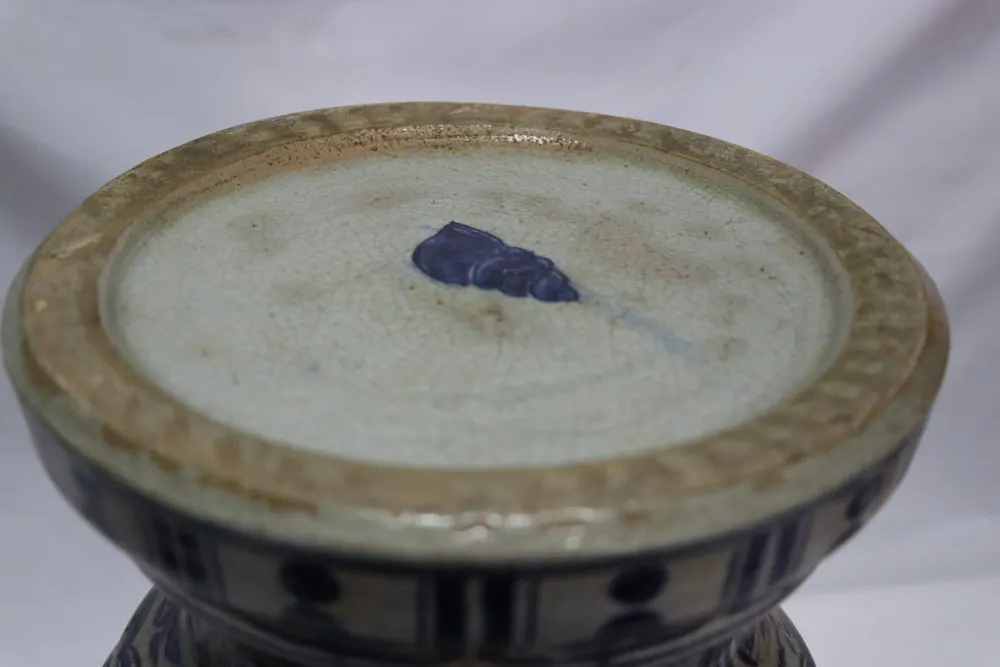
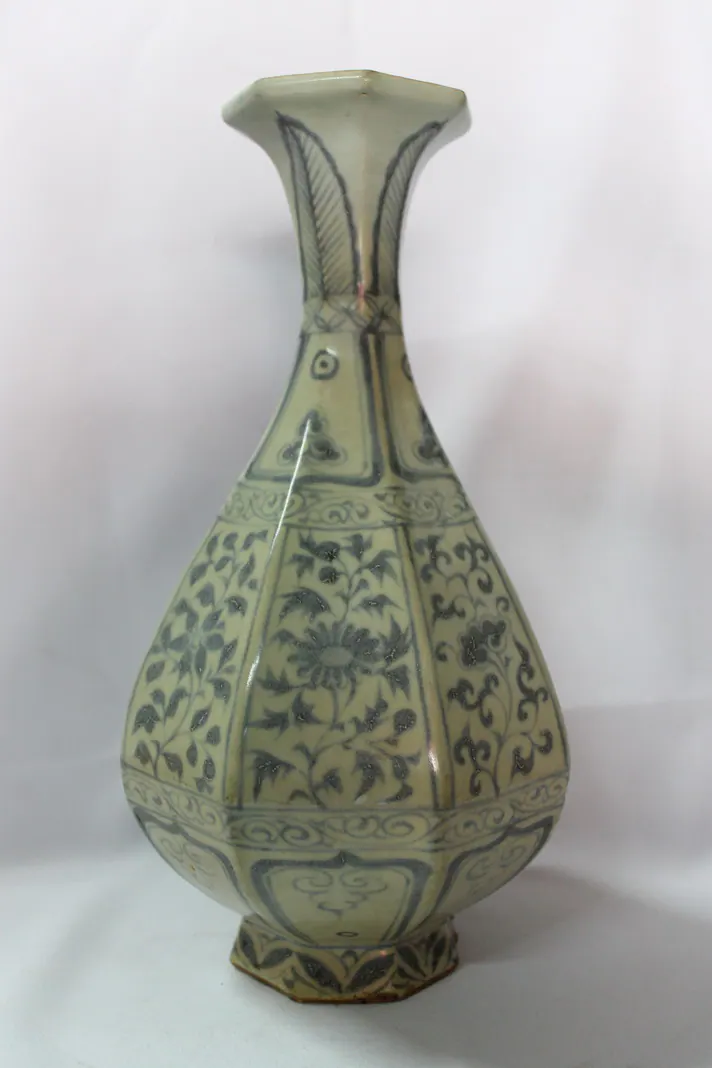
Reign marks are rare on Transitional porcelain. Very few pieces carry the Chongzhen or Shunzhi mark, and many have no mark at all. Some carry earlier Ming reign marks, such as Xuande or Chenghua, following a long habit of honouring admired earlier wares, and others carry a symbol. The folk kiln vase with a shell mark in our collection is an example of the latter.
What makes the period datable is the number of pieces inscribed with cyclical dates, which name a year in the sixty-year cycle. Set against the historical record, these allow the style to be followed almost decade by decade. Dated cargo helps too: the Hatcher cargo, raised from a Chinese junk in the South China Sea in the 1980s, included pieces dated by inscription to the early 1640s.
The blue itself is often the first clue. At its best it is a bright, clear, slightly violet blue on a smooth white ground, which some writers describe as violets in milk. It is purer than most late Wanli blue and less layered than the graded tones of the Kangxi period. Our guide to cobalt blue compares it with the other periods.
The end of the period: the imperial kilns restored in 1683
The Revolt of the Three Feudatories in the 1670s brought fresh fighting to Jiangxi, and Jingdezhen suffered heavily. Once the revolt was crushed, the Kangxi Emperor turned to the kilns. In 1683 the imperial factory was re-established under the direction of Zang Yingxuan, and the following year, with Taiwan taken, the ban on sea trade was lifted.
The porcelain that followed is recognisably Qing: whiter and more precisely potted, painted in graded tones of sapphire blue and, before long, in the new famille verte enamels. Much of the Transitional repertoire lived on in it, from figure scenes to sleeve vases, but the independent spirit of the previous decades gave way to imperial order. Our guide to Qing dynasty porcelain continues the story, and our history of Chinese blue and white porcelain places the period in the longer tradition.
A note on the other transitional period, 1912 to 1916
The word is occasionally used in the trade for a quite different moment: the years between the fall of the Qing in 1912 and the end of Yuan Shikai's short-lived attempt to make himself emperor in 1916, whose era name, Hongxian, is found as a mark on porcelain, although much of the porcelain with that mark was made later. Pieces from these years continue late Qing styles under a new government. They have nothing to do with seventeenth-century Transitional porcelain, and are covered in our guide to late Qing and Republic porcelain.