Guide
Qing Dynasty Reign Marks: A Chart from Shunzhi to Xuantong
Qing reign marks name the reign in which a piece of porcelain claims to have been made, from Shunzhi in the 1640s to Xuantong, whose reign ended with the fall of the dynasty in 1912. This chart gives the characters, dates and usual script of each mark, with the points collectors most need to know. A mark records what was written on the porcelain, not when it was made, so it should always be read with the piece itself. Our guide to Chinese porcelain marks explains the wider subject.
What to look for
- Read the characters from the top of the right-hand column and check the era name against the chart.
- Note the script, regular or seal, and whether it is the one the reign usually used.
- Look at the calligraphy: fluent, evenly spaced characters, or stiff, crowded and uncertain ones.
- Check that the colour of the mark suits the piece: underglaze blue, iron red or overglaze blue enamel.
- Judge the body, glaze, foot and painting first; they must belong to the reign the mark names.
- Take most care with Kangxi, Yongzheng and Qianlong marks, which were copied in the greatest numbers.
How to read Qing reign marks
A full Qing reign mark has six characters. The first two, 大清 (Da Qing), mean "Great Qing". The middle two are the era name, the title chosen for the reign, such as 康熙 (Kangxi). The last two, 年製 (nian zhi), mean "made in the reign". Together they read "made in the Kangxi reign of the Great Qing".
The characters are read in columns from right to left, starting at the top of the right-hand column. A mark in regular script is usually set in two columns of three characters. A mark in seal script is usually set in three columns of two, forming a square. Four-character marks leave out 大清 and give only the era name and 年製.
Collectors call each emperor by his era name, so "the Kangxi Emperor" is the emperor of the Kangxi era, whose personal name was Xuanye. The dates below are era-name years: the years in which each era name was in use. An era usually began with the first new year after an emperor came to the throne, so its dates can differ by a year from those of the reign. The Kangxi Emperor succeeded in 1661, but the Kangxi era began in 1662. We use era-name years throughout this page.
The chart: each Qing reign mark from Shunzhi to Xuantong
The chart begins with Shunzhi, the first Qing emperor to rule China from Beijing; the Qing emperors page covers every reign. Each entry gives the era name, the six-character mark, the era-name years, the script most often used for the reign's own marks, and one point collectors should know. Later copies may use either script.
| Reign | Mark | Dates | Usual script and colour | Note |
|---|---|---|---|---|
| Shunzhi | 治年製大清順 | 1644–1661 | Regular script | Marked pieces scarce |
| Kangxi | 熙年製大清康 | 1662–1722 | Regular script, two columns in a double ring | Widely copied; much Kangxi porcelain unmarked |
| Yongzheng | 正年製大清雍 | 1723–1735 | Mostly regular script; seal script begins | Common on later famille rose |
| Qianlong | 隆年製大清乾 | 1736–1795 | Usually seal script, underglaze blue or iron red | Most often found on later porcelain |
| Jiaqing | 慶年製大清嘉 | 1796–1820 | Usually seal script | Judge with the style |
| Daoguang | 光年製大清道 | 1821–1850 | Seal script, often underglaze blue | Also the Shendetang hall mark |
| Xianfeng | 豐年製大清咸 | 1851–1861 | Seal and regular script | Scarce |
| Tongzhi | 治年製大清同 | 1862–1874 | Usually regular script, often iron red on enamelled wares | Wedding commission of 1872 |
| Guangxu | 緒年製大清光 | 1875–1908 | Usually regular script, underglaze blue or iron red | Common |
| Xuantong | 統年製大清宣 | 1909–1912 | Regular script | Scarcer, as the reign was short |
Notes on each reign
- Shunzhi. Marked pieces are scarce. Much porcelain of the reign belongs to the Transitional style, and some carries a cyclical date instead of a reign mark.
- Kangxi. Regular script, usually in two columns within a double ring; seal-script Kangxi marks are rare. One of the most copied of all marks, while a great deal of porcelain of the period carries no Kangxi mark at all.
- Yongzheng. Mostly regular script, in a small, careful hand; seal-script marks came into use during the reign. Yongzheng marks are common on later famille rose and monochromes made in the Yongzheng manner.
- Qianlong. Usually seal script, in underglaze blue or iron red; regular script also occurs. It is the Qing mark most often found on later porcelain, and it needs the most caution.
- Jiaqing. Early Jiaqing porcelain follows late Qianlong styles closely, so the mark is best judged together with the style.
- Daoguang. The Daoguang seal mark, often in underglaze blue, is the usual form; regular script is less common. The reign is also known for the hall mark Shendetang, associated with the emperor himself.
- Xianfeng. Seal script and regular script both occur. The Taiping Rebellion disrupted Jingdezhen in the 1850s, and porcelain with the mark is correspondingly scarce.
- Tongzhi. Usually regular script, often in iron red on enamelled wares. The imperial kilns were rebuilt in the 1860s, and a large commission followed for the emperor's wedding in 1872.
- Guangxu. Usually regular script, in underglaze blue or iron red. The Guangxu mark is common, and much porcelain of the period was made in earlier styles with earlier marks.
- Xuantong. The porcelain continues Guangxu styles, and the mark is scarcer simply because the reign was short.
Regular script and seal script
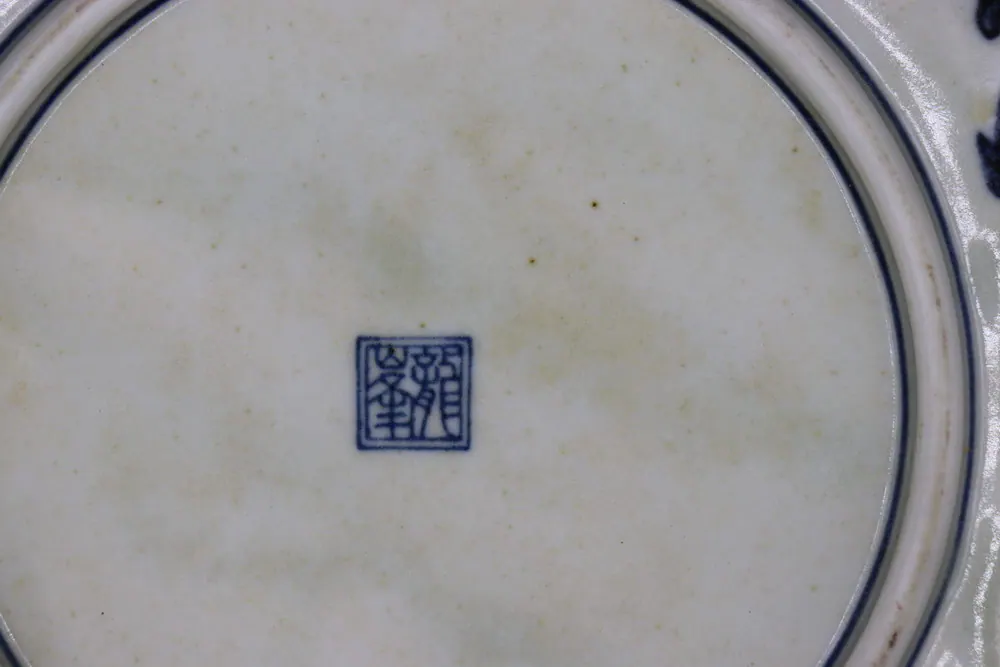
Two scripts dominate Qing marks. Regular script (kaishu) is the ordinary written hand, with each stroke made separately by the brush. Seal script (zhuanshu) is an archaic form based on the characters cut into seals, built from lines of even thickness folded into a compact block.
Early Qing marks follow Ming practice and are written in regular script. Seal-script marks came into use under Yongzheng, and under Qianlong seal script became the usual form, generally in three columns of two and often without a border. Jiaqing and Daoguang continued it. From the Xianfeng reign regular script returned to favour, and it is the usual form on Tongzhi, Guangxu and Xuantong marks.
These are tendencies, not rules. Both scripts occur in most reigns from Yongzheng onwards, and later potters used whichever script suited the piece they were copying. A seal-script mark on a piece in Kangxi style, or a stiff regular-script Qianlong mark on famille rose, is a reason to look more closely, not a verdict in itself.
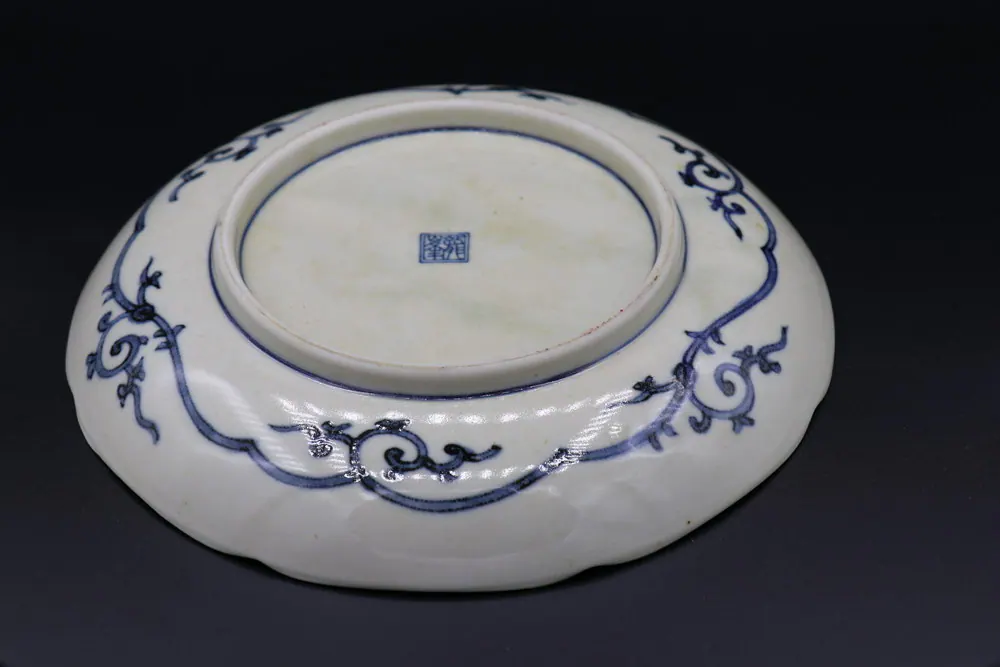
Square marks in a seal-like style are not always reign marks. A blue and white plate in our collection, listed as Qing, has a square mark of this kind on its base, and our guide to symbol, hall and workshop marks explains the other kinds.
Kangxi marks: empty rings, symbols and Ming marks
The Kangxi reign produced some of the finest Qing porcelain, yet much of it carries no Kangxi mark. Jingdezhen suffered in the civil war of the 1670s, imperial production was reorganised in the early 1680s, and a great deal of the porcelain of the period was made by private kilns for the Chinese market and for export.
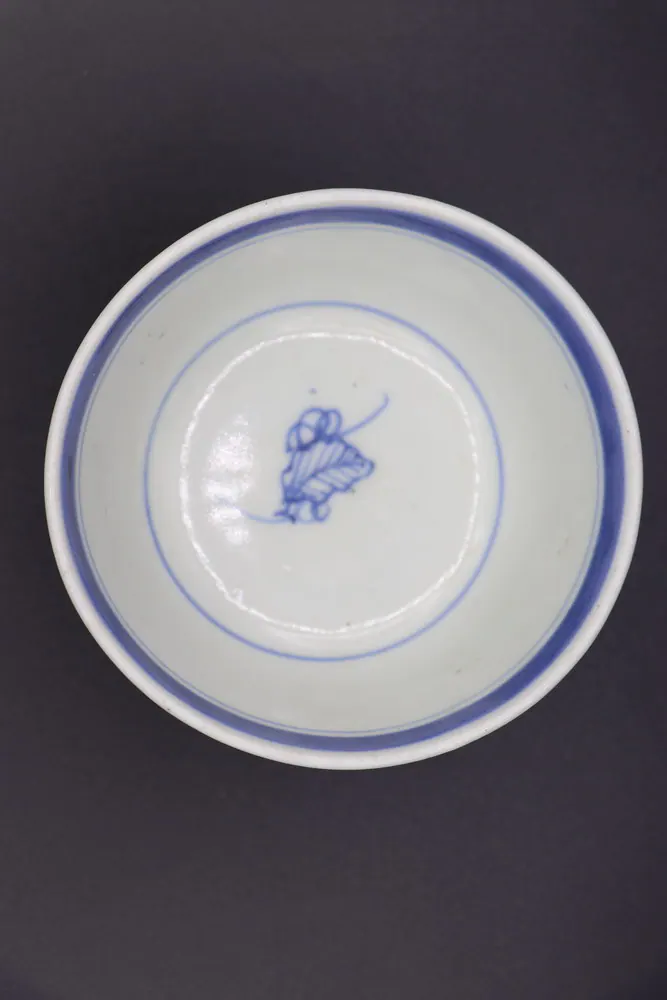
Three habits stand out. Many pieces have a double ring in underglaze blue on the base with nothing written inside it. Others carry a small picture instead of characters: an artemisia leaf, a lingzhi fungus, a conch shell, a flower spray or one of the precious objects. Many carry the mark of an earlier Ming reign, above all Chenghua, but also Xuande and Jiajing, written in a Kangxi hand.
A prohibition issued at Jingdezhen in 1677 against writing the emperor's reign title on porcelain is often cited as one reason for the empty rings. How long it applied, and how strictly, is not clear, and it does not account for every unmarked piece.
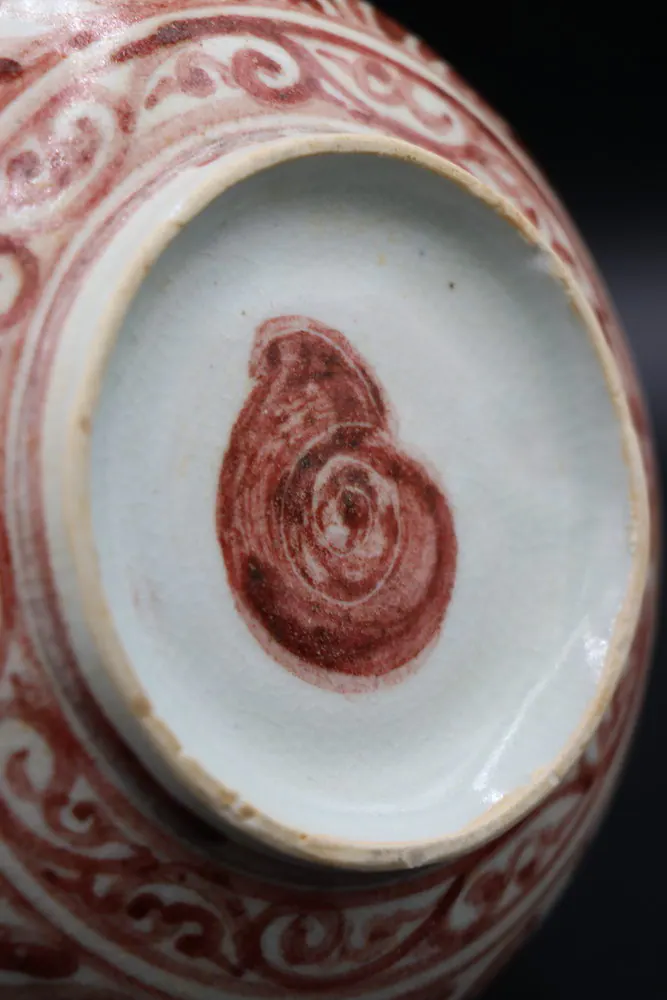
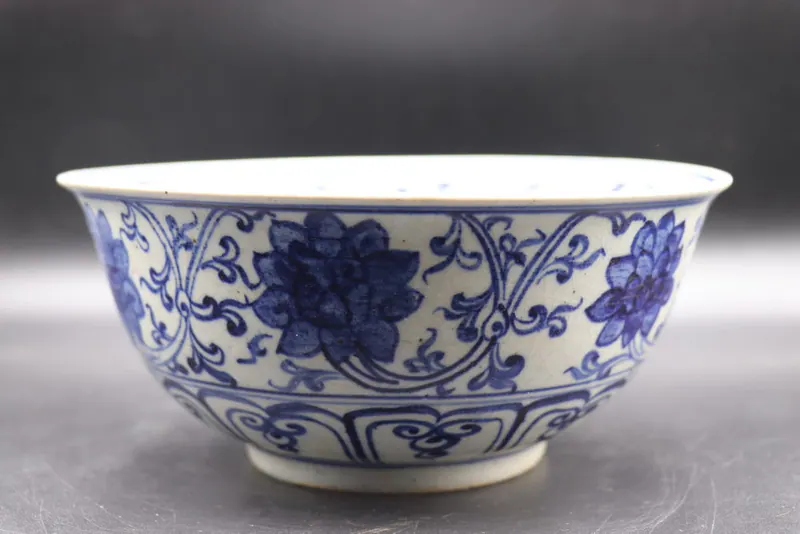
For collectors, the absence of a Kangxi mark says nothing against a Kangxi date, and a Ming mark on a piece in Kangxi style is common. A blue and white bowl in our collection, listed as Kangxi period, has a small leaf painted inside it instead of a reign mark. Our guide to apocryphal marks explains why Ming marks appear on Qing porcelain, and the Ming reign marks chart shows the marks being copied.
Iron red, enamel and incised marks, and marks on export wares
Most Qing reign marks are painted in underglaze blue on the base before glazing and firing, in the same cobalt as the decoration. Iron red, painted over the glaze, was used increasingly from the Qianlong reign onwards, particularly on enamelled porcelain, and it is common on late Qing famille rose.
Painted enamels made for the court under Kangxi, Yongzheng and Qianlong often have a four-character mark in overglaze blue enamel within a double square, such as 康熙御製 (Kangxi yuzhi, "made by imperial command of Kangxi"). Some monochromes have the mark incised or impressed before glazing, so that it shows faintly through the glaze. Frames vary: a double ring, a double square, or none at all.
Porcelain made for export, whether to Europe or to Southeast Asia, is usually unmarked, or carries a symbol or an earlier Ming mark rather than the mark of the current reign. Chinese Imari and most eighteenth-century famille rose made for Europe have no mark at all. The mark of the current reign on a piece of obvious export type is unusual and deserves a closer look.
After the Qing: the Hongxian mark
One more mark belongs with the Qing sequence. Yuan Shikai, president of the Republic, declared himself emperor in December 1915 and took Hongxian as his reign name, and he abandoned the monarchy in March 1916. Hongxian marks therefore refer to his reign of 1915 to 1916. The mark, 洪憲年製 (Hongxian nian zhi), is usually four characters in iron red, and it is found mostly on finely painted famille rose.
The reign lasted only a few months, and most Hongxian-marked porcelain is regarded as made later in the Republic period, when the name had become sought after for its own sake.
Our guide to late Qing and Republic porcelain covers the period in more detail.
Later copies of Qing marks
Copying began within the Qing itself. Under Guangxu, both the imperial kilns and private workshops made porcelain in the styles of Kangxi, Yongzheng and Qianlong. The imperial kilns generally marked such pieces with the Guangxu mark, but a great deal of private kiln porcelain carries the earlier marks. Some of this was homage, in a long Chinese tradition of honouring admired reigns; some was made for buyers who valued the older names.
In the Republic period, from 1912, private workshops at Jingdezhen made large quantities of porcelain in eighteenth-century styles, and Yongzheng and Qianlong marks are common on it, especially on famille rose. The best Republic pieces are skilfully made and are collected in their own right. Since the later twentieth century, reproductions with Qing marks have been made in very large numbers, some with artificial wear and staining intended to suggest age.
A mark on its own cannot separate these groups from each other or from the porcelain they copy, and not every later mark was meant to deceive. The calligraphy is the first clue: marks of the reign are usually fluent and evenly spaced, while later ones are often stiff, crowded or uncertain, with characters wrongly formed. The colour and tone of the mark should match the rest of the decoration. Above all, the body, glaze, foot and painting must belong to the reign the mark names. Our guide to Qing dynasty porcelain describes what each reign's wares look like.