Guide
Symbol, Hall and Workshop Marks on Chinese Porcelain
Not every mark on Chinese porcelain names a reign. Chinese porcelain symbol marks, hall marks, auspicious phrases and painters' seals are found on a great deal of Ming and Qing porcelain, much of it from private kilns. This guide explains what each kind looks like, what it says, and what it can and cannot tell you about date and market. For reign marks, see our guide to Chinese porcelain marks.
What to look for
- Decide first whether the mark is written characters, a small picture or a seal-like pattern.
- For a symbol mark, check that its blue and brushwork match the rest of the decoration.
- Read a hall mark for its place word, such as tang (hall) or zhai (studio), followed by zhi (made).
- Treat famous hall names such as Shendetang, Dayazhai and Jurentang as marks that were copied, not as proof of origin.
- On a signed piece, find the cyclical date and remember that the same date name returns every sixty years.
- Date the piece by its body, glaze, foot and painting; the mark only narrows the field.
Marks that are not reign marks, and why they matter
Reign marks attract most attention, but a great deal of antique Chinese porcelain carries something else. Private kilns, which made most of the porcelain that survives, often used a small picture, a lucky phrase, the name of a hall or studio, or a painter's signature and seal. Many pieces have no mark at all.
These marks tell you something about who made a piece and for whom. A symbol or an auspicious phrase usually points to a private kiln, while a hall name that can be traced may connect a piece to a particular household or period. They are clues to date, though never proof of it, and each has to be read with the porcelain it is painted on.
They fall into four broad groups: symbols, hall and studio names, auspicious or dedicatory phrases, and painters' signatures and seals. Square, seal-like marks can belong to several of these groups, and some are not writing at all.
The table sets the kinds side by side; the sections below explain each.
| Mark | What it shows | Typical period | Note |
|---|---|---|---|
| Symbol mark | A small picture: leaf, shell, lingzhi, hare | Late Ming, Transitional, Kangxi | Private kilns; copied later |
| Hall or studio mark | A hall, studio or pavilion name, often with 製 | Late Ming onwards | Most names cannot be traced |
| Fu mark | The character 福, often in a ring or square | Sixteenth and seventeenth centuries | Private kilns; also on later wares |
| Auspicious phrase | A wish for the owner or praise of the vessel | Late Ming and early Qing | Mostly the domestic market |
| Dedicatory inscription | The person a piece was painted for | Late Qing and Republic | Part of the decoration, not the base |
| Seal mark | Seal script, or a square like a seal impression | Qianlong to Daoguang (reign marks) | May be a reign, hall or painter's mark |
| Pseudo-seal mark | Lines and hooks imitating seal characters | Later Qing | Names no one; not a date |
| Signature and seal | Painter's name with 寫 or 畫 and small red seals | Late Qing and Republic | Often with a cyclical date |
Chinese porcelain symbol marks: shell, leaf, lingzhi and hare
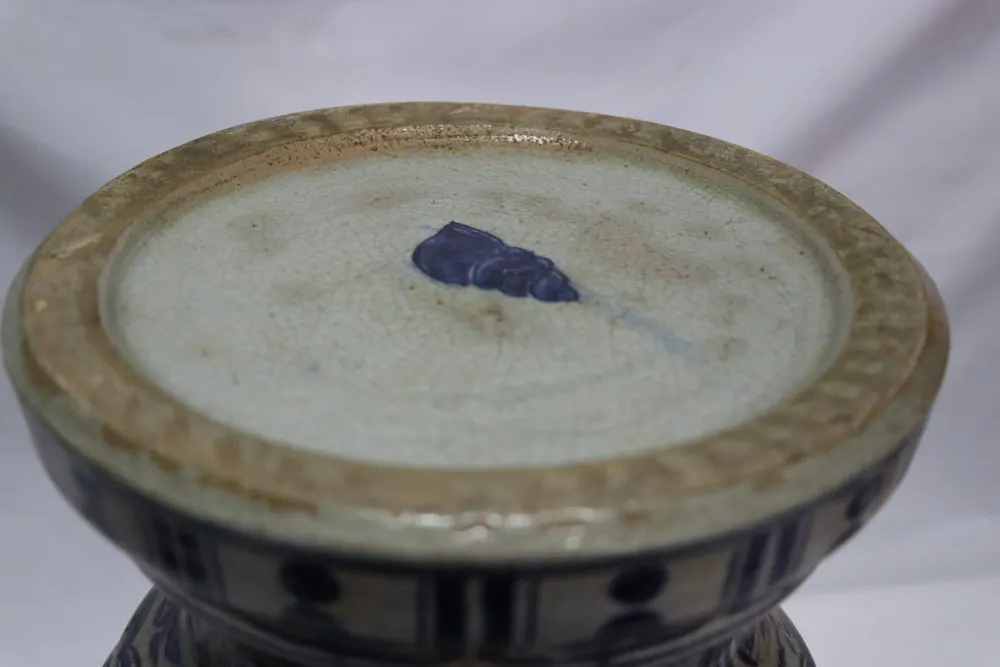
A symbol mark is a small picture painted on the base, usually in underglaze blue and often within a double ring. Most are auspicious or Buddhist emblems:
- Artemisia leaf. One of the precious objects, and the symbol mark most associated with the Kangxi period, above all on blue and white.
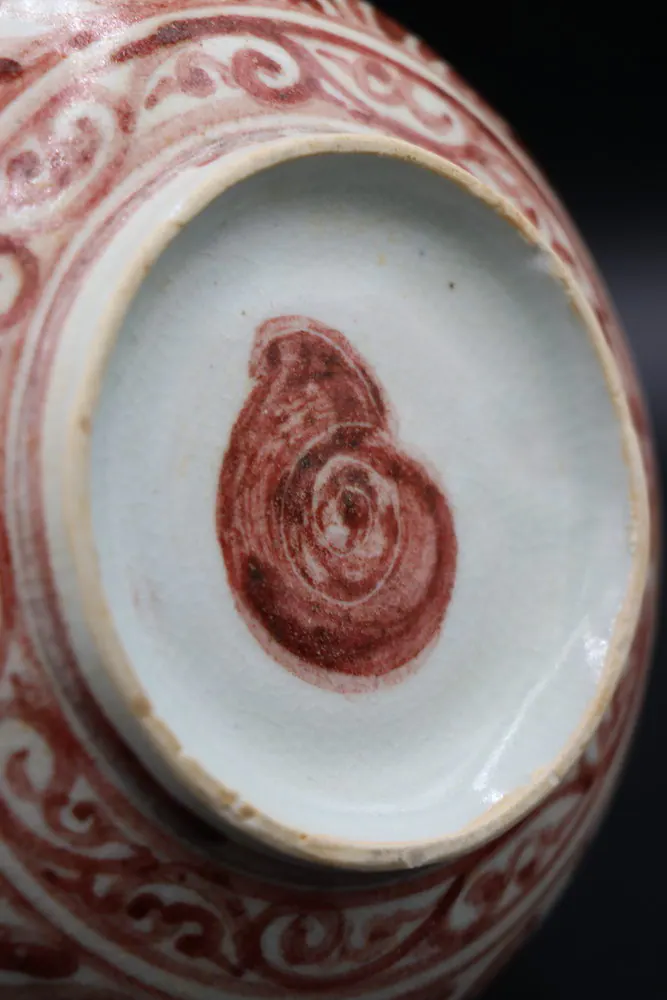
- Conch shell. One of the eight Buddhist emblems, its sound said to carry the Buddha's teaching. It is found on Ming private kiln porcelain and on later wares.
- Lingzhi fungus. The fungus of immortality, a wish for long life, found especially on Kangxi porcelain.
- Hare. Found on some late Ming and Transitional porcelain.
- Others. A flower spray, a tripod censer, a pair of fish, a lozenge or a scroll, many drawn from the precious objects or the Buddhist emblems.
Symbol marks belong above all to private kilns. They were used from the Ming into the late Qing, but they are most typical of the late Ming, the Transitional period and the Kangxi reign, when a picture often took the place of a reign mark. Later potters copied them along with the styles they imitated, so a leaf mark alone does not make a piece Kangxi.
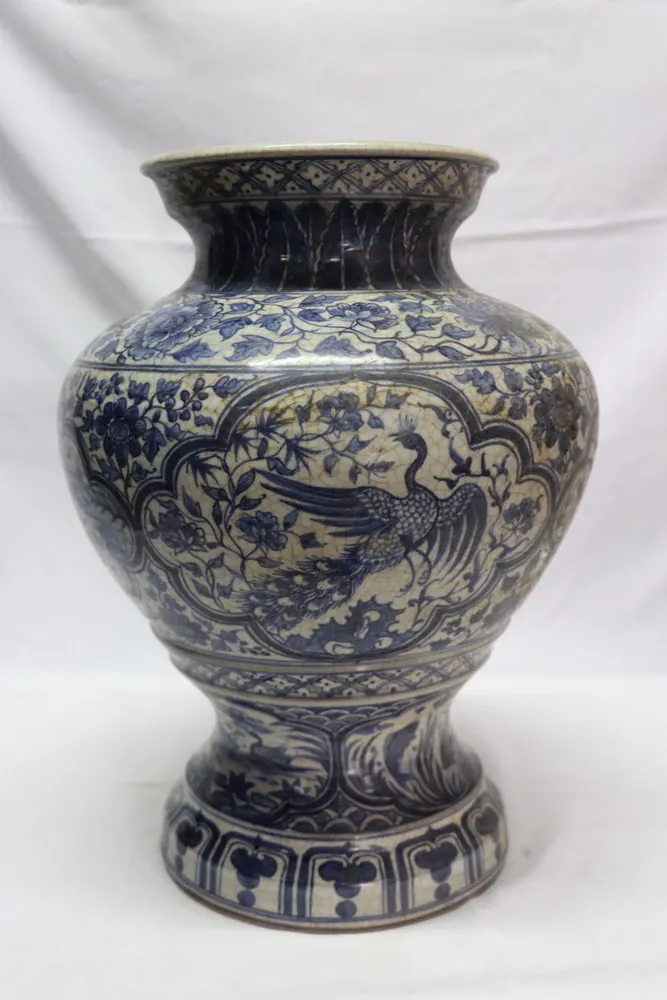
A small shell in underglaze blue marks the base of a folk kiln vase in our collection, listed as late Ming to early Qing. A kendi painted in underglaze red, listed as Ming, has a conch shell painted in red on its base. Our guide to Ming folk kiln porcelain shows how common such marks are on everyday wares.
Hall and studio marks: "made for the hall of"
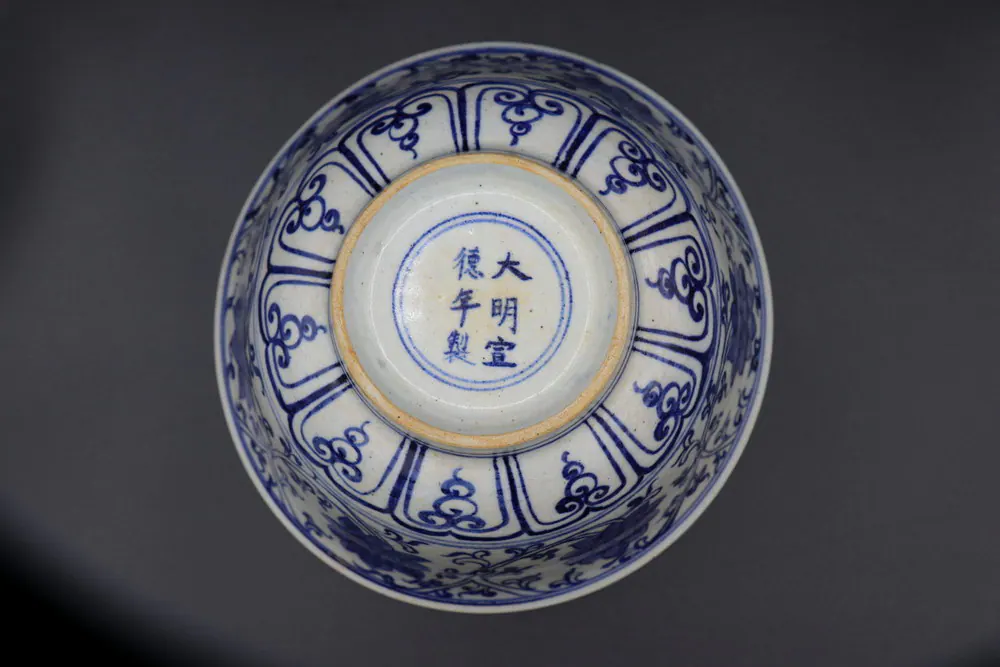
A hall mark (tangming kuan) gives the name of a hall, studio or pavilion. The name ends in a place word, such as 堂 (tang, hall), 齋 (zhai, studio) or 軒 (xuan, pavilion), and is usually followed by 製 (zhi, made) or 珍藏 (zhen cang, treasured collection). A mark ending 堂製 (tang zhi) is usually translated "made for the Hall of", although some hall names belonged to potters' workshops or dealers rather than to the households that used the porcelain.
A few hall marks can be linked to known people:
- Shendetang zhi (慎德堂製), from a hall in the Yuanmingyuan used by the Daoguang Emperor, on porcelain of his reign, usually written in iron red.
- Dayazhai (大雅齋), a studio name of the Empress Dowager Cixi, written on the side of porcelain made for her residences in the 1870s, mostly famille rose on coloured grounds.
- Jurentang zhi (居仁堂製), from a hall in the Zhongnanhai compound in Beijing that Yuan Shikai used as his office. It calls for the same caution as the Hongxian mark, which our Qing reign marks chart explains.
Most hall names cannot be traced to anyone. They appear on private kiln porcelain from the late Ming onwards, and the famous names were copied as readily as reign marks. A hall mark is best treated as part of a piece's style: useful for dating when it agrees with the porcelain, of little weight when it does not.
Auspicious and dedicatory marks, and the fu mark
A single character can serve as a mark. The most common is 福 (fu, good fortune), often written within a double ring or a square, on a great deal of Ming private kiln porcelain of the sixteenth and seventeenth centuries and on later wares. Painted in a few quick strokes, a fu mark can be hard to recognise. 壽 (shou, longevity) is used in the same way.
Longer phrases wish the owner well or praise the vessel. Examples include 富貴佳器 (fu gui jia qi, "a fine vessel for the rich and honoured"), 玉堂佳器 (yu tang jia qi, "a fine vessel for the jade hall"), 長命富貴 (chang ming fu gui, "long life, wealth and honour") and 萬福攸同 (wan fu you tong, "may all blessings be shared"). They are especially common on private kiln porcelain of the late Ming and early Qing.
Dedicatory inscriptions go further and name the person a piece was made or painted for. On late Qing and Republic porcelain they are usually part of the painted decoration rather than a mark on the base: a line offering the piece "for the elegant enjoyment" (雅玩, ya wan) of a named gentleman, with the painter's name and a date.
Chinese seal marks on porcelain
A seal mark is any mark written in seal script, or drawn in a square like the impression of a seal. On Chinese porcelain it may be a reign mark, as on much porcelain from Qianlong to Daoguang, a hall name, or a painter's seal.
Other square marks are not writing at all. On later Qing porcelain, much of it for everyday use or for export, potters painted squares of lines and hooks that imitate seal characters without spelling anything. Collectors call these pseudo-seal marks. They show that the potter was imitating a formal mark; they do not name anyone, and they cannot be read as a date.
Artists' seals on late Qing and Republic porcelain
From the later nineteenth century painters at Jingdezhen began to sign their work. Signatures are typical of qianjiang enamel painting and of the Republic painters who followed, whose vases and plaques were painted like pictures on paper. The signature sits within the design, often after a poem, and usually gives the painter's name or studio name followed by 寫 (xie) or 畫 (hua), "painted by", with one or two small seals in red.
Such inscriptions often carry a cyclical date, named in the sixty-year cycle of stems and branches. The same name returns every sixty years, so a date has to be matched to the style of the piece before it can be turned into a year. A separate mark on the base may name a workshop or repeat a studio name, and the Jiangxi Porcelain Company, founded in the last years of the Qing, marked some wares with its own name.
Our guide to late Qing and Republic porcelain covers the painters and their styles.
What each kind of mark suggests about date and market
Symbol marks suggest a private kiln, most often of the late Ming, the Transitional period or the Kangxi reign, making porcelain for ordinary Chinese households or for export. The fu mark and auspicious phrases also point to private kilns and mostly to the domestic market, above all in the sixteenth and seventeenth centuries.
Hall marks range from the closely datable, when the name can be traced and the porcelain agrees, to the untraceable. Signatures and seals belong mainly to the late Qing and the Republic, and a dedication shows that a piece was painted as a gift or to order.
In every case the mark narrows the field and the porcelain decides. Look at the body where the foot is unglazed, the glaze, the potting and the painting, and see whether they agree with what the mark suggests.