Guide
Chinese Porcelain Shapes: A Guide to Vases, Jars and Vessels
Shape is often the first thing a specialist reads on a piece of Chinese porcelain, before the decoration and long before the mark. This guide names the main Chinese vase shapes, and the jars, dishes, bowls and pouring vessels collectors meet most often, explains where each came from, and shows how their proportions changed between the Song and the Qing.
What to look for
- Read the profile first: where the widest point sits, how the shoulder turns and how the neck meets it.
- Compare the proportions with well-documented pieces of the period the piece claims, not with the shape in general.
- Look inside for throwing rings and joins: large vases, jars and double gourds were made in sections.
- Turn the piece over and check that the foot and base suit both the form and the period.
- Weigh it in the hand: many copies are clearly heavier or lighter than a period piece of the same size.
- Check that the painted bands and panels are laid out the way that period arranged them on that shape.
Why shape is the first clue to date
Potters at Jingdezhen and the other great kilns worked to the shapes their own markets wanted. A form could stay in production for centuries, but its proportions rarely stood still. The height of the shoulder, the curve of the belly, the width of the neck and the way the foot was cut all shifted with taste, with technique and with the buyers a kiln was serving.
That is why an experienced eye reads the silhouette before anything else. A profile can be judged across a room, in poor light or in a small photograph, and one that is wrong for the period a piece claims is a warning before the painting has even been examined. Some forms belong to fairly short periods: the monk's cap jug to the early fifteenth century and its later revivals, the rouleau vase largely to the Kangxi reign. Others, such as the meiping, run from the Song to the Qing, and there it is the proportions that tell the story.
Collectors describe a vessel from the top down: mouth or rim, neck, shoulder, belly and foot. On a dish, the cavetto is the curved wall between the rim and the flat centre, or well. Our glossary of Chinese porcelain terms explains these and many more.
Shape also governs decoration. Painters divided a vase or jar into zones that follow its form, with bands at the neck, shoulder and foot and a main scene around the widest part, so the layout of the painting and the profile of the pot should agree. Our guide to symbols on Chinese porcelain covers the motifs themselves.
Museum examples
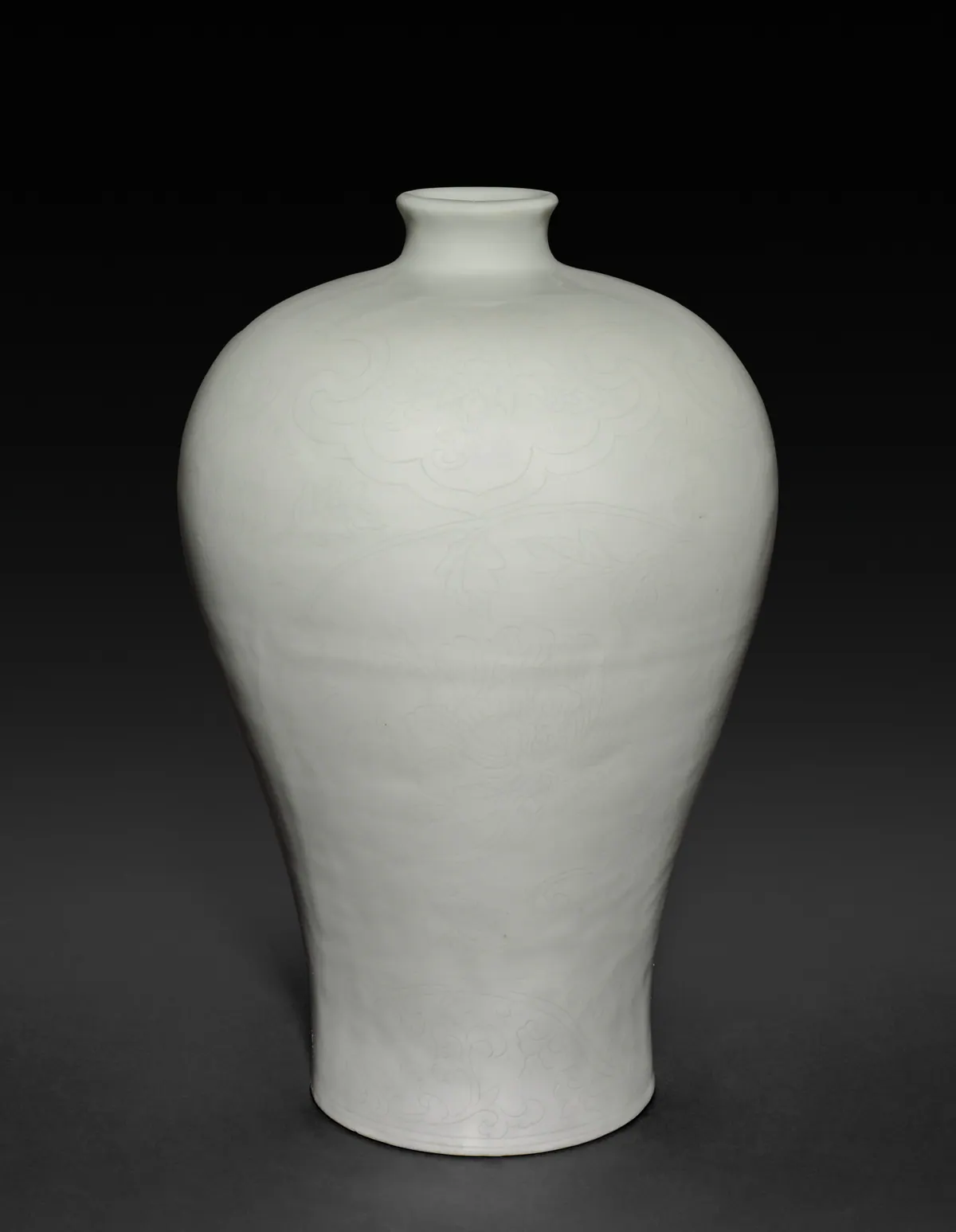
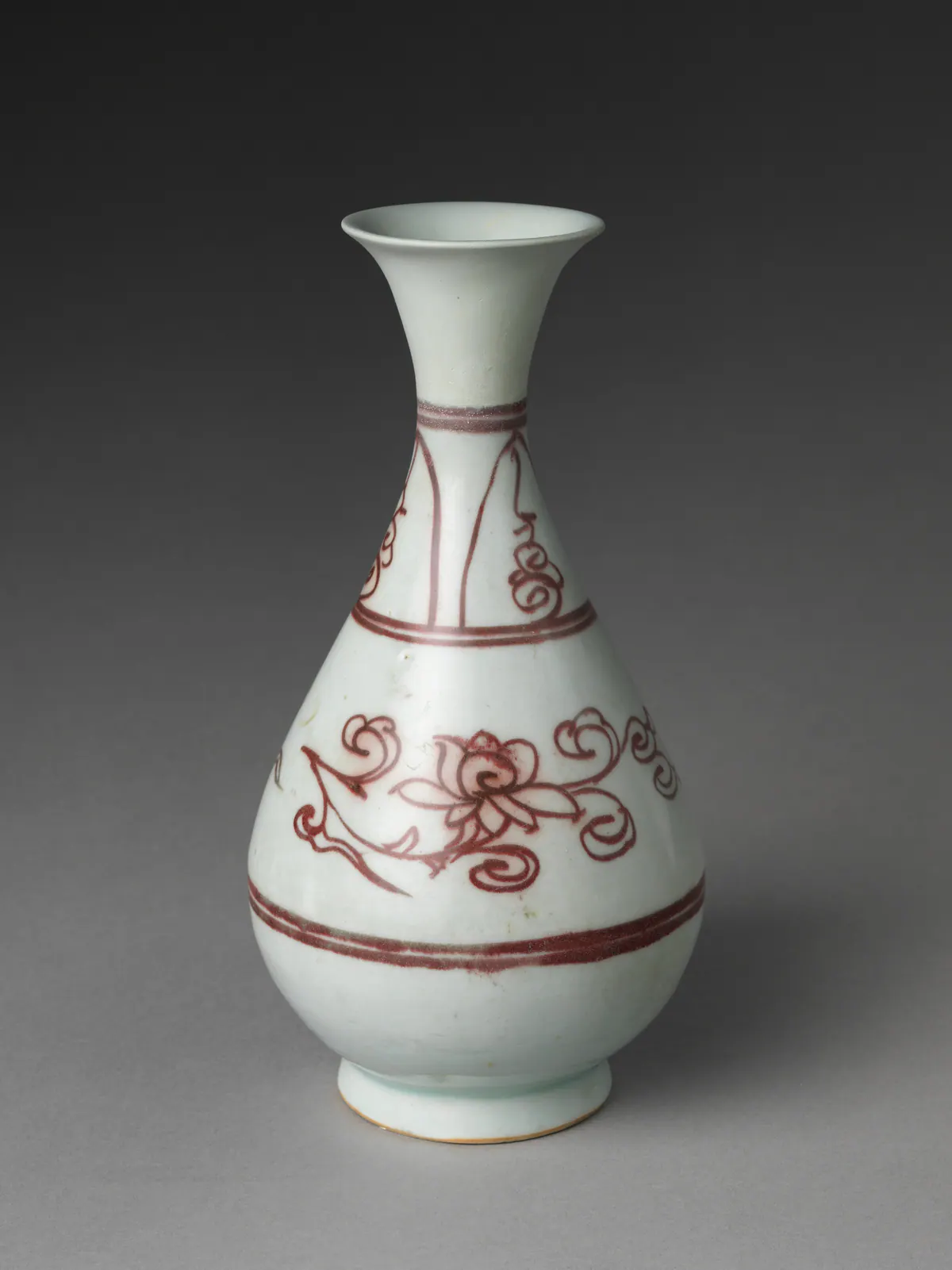
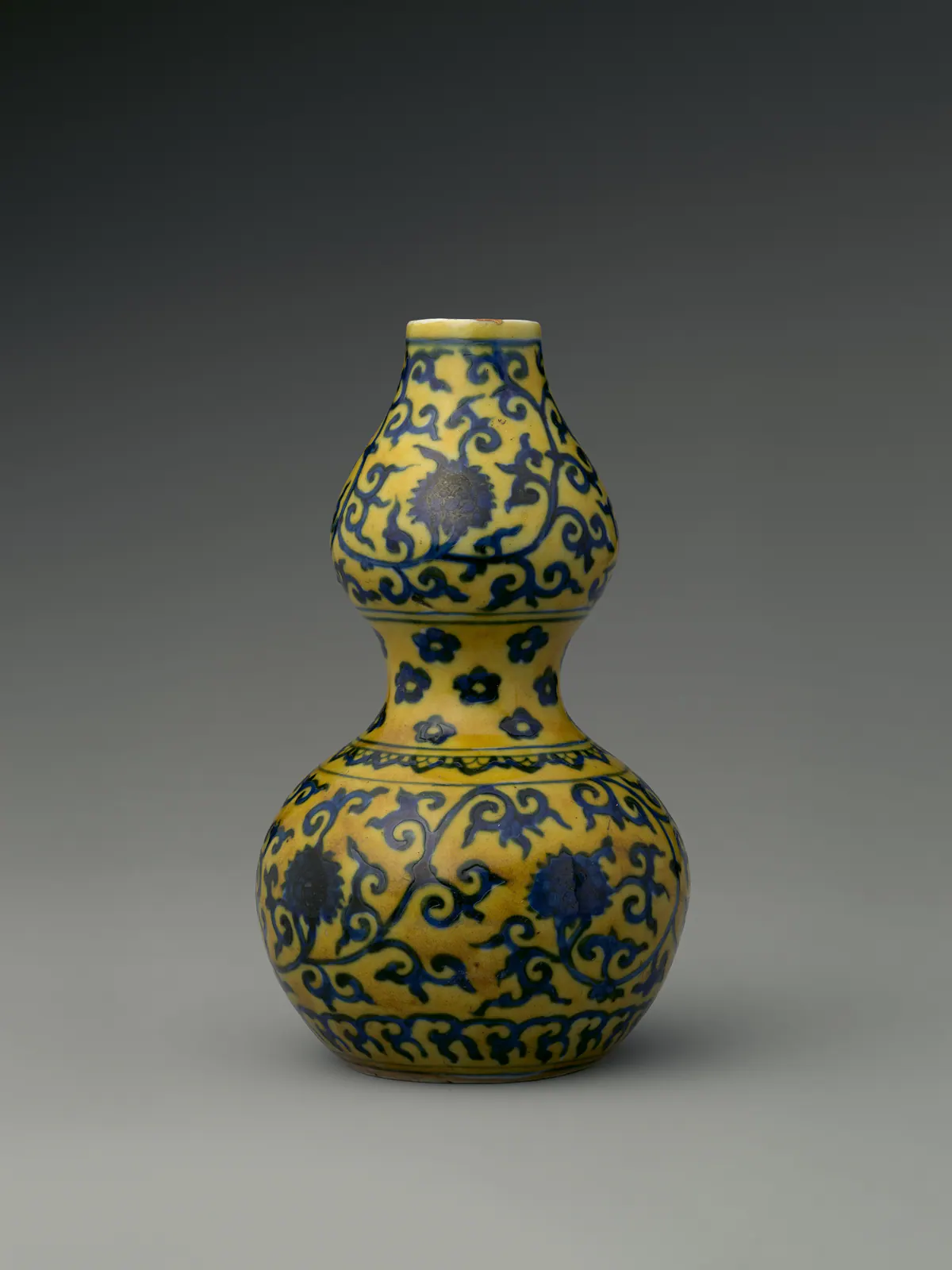
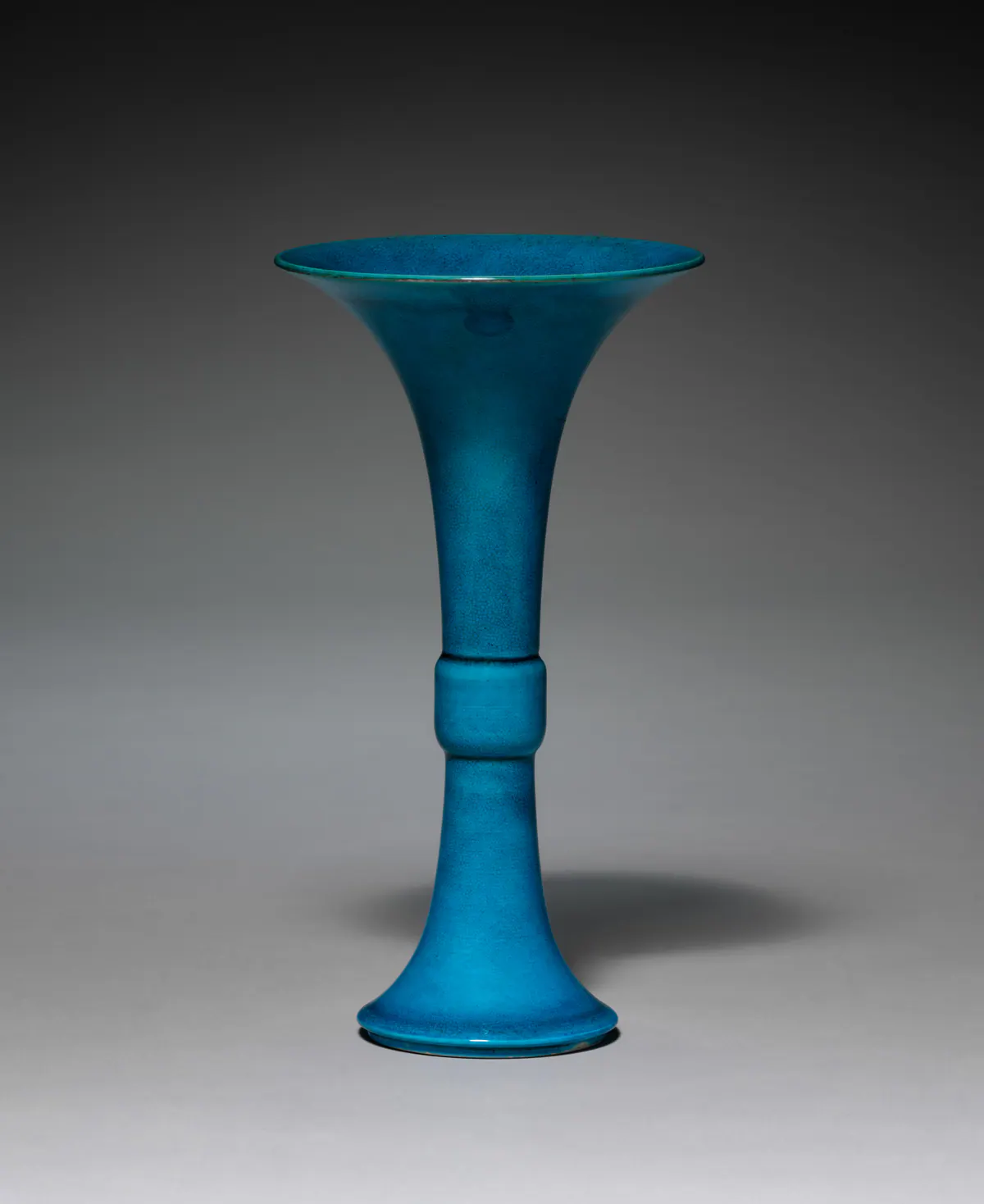
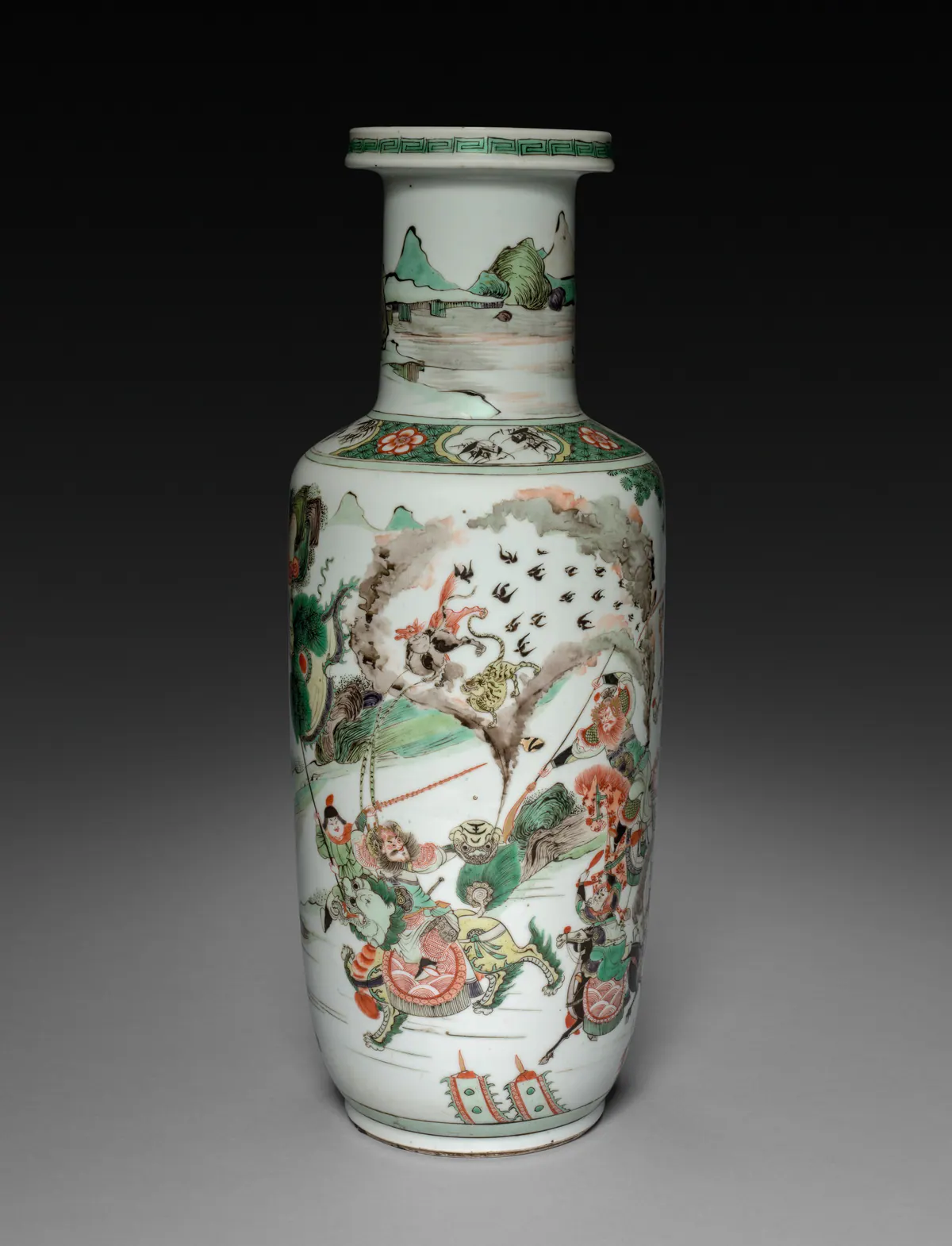
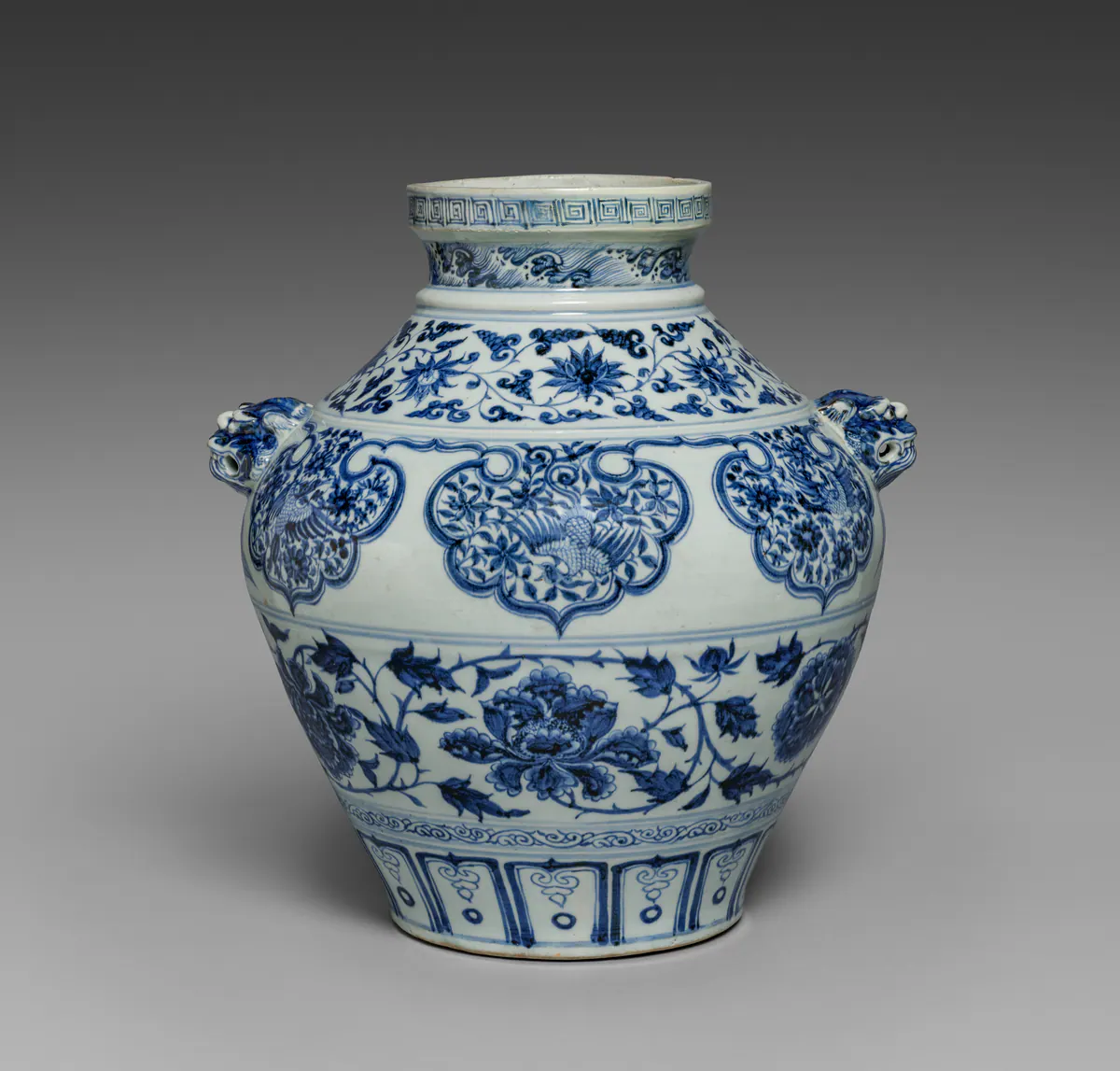
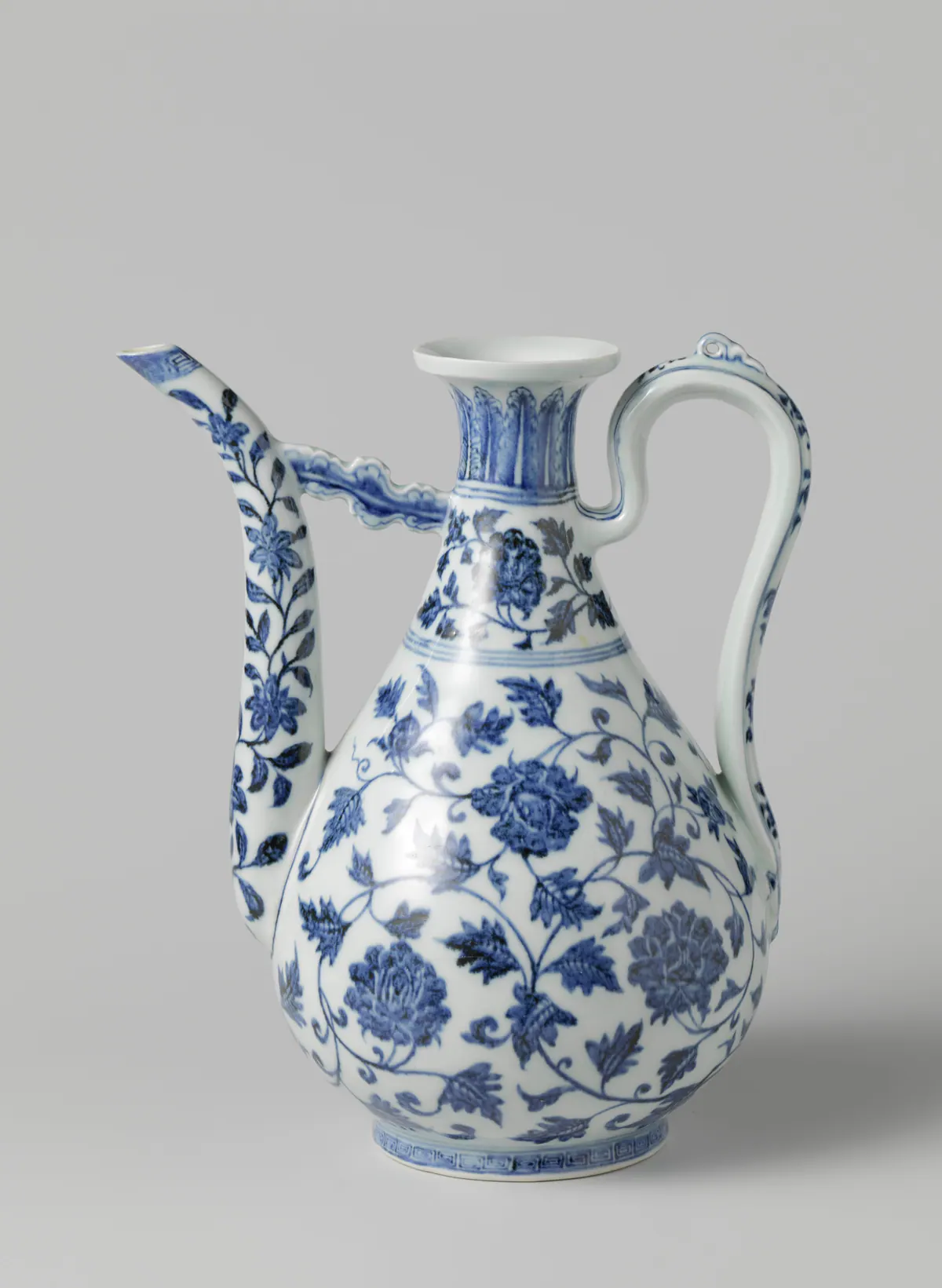
Chinese vase shapes: meiping, yuhuchunping, gu and double gourd
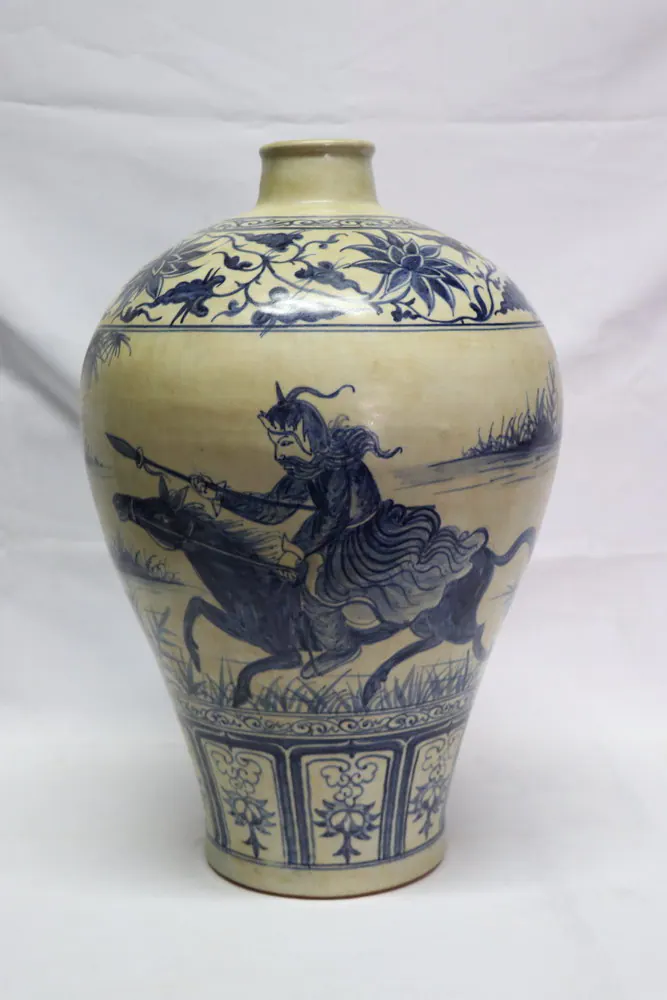
Meiping. A tall vase with a broad, high shoulder, a body that tapers towards the foot, a very short neck and a small mouth. The name means ‘plum vase’ and refers to displaying a single branch of prunus blossom, but it was applied long after the shape first appeared: many early examples were made to hold wine, and some had covers. The form was made at several kilns in the Song period and stayed in production into the Qing. Song meiping tend to be slender, Yuan and early Ming examples heavier and broader across the shoulder, and eighteenth-century versions of early forms crisper and more regular.
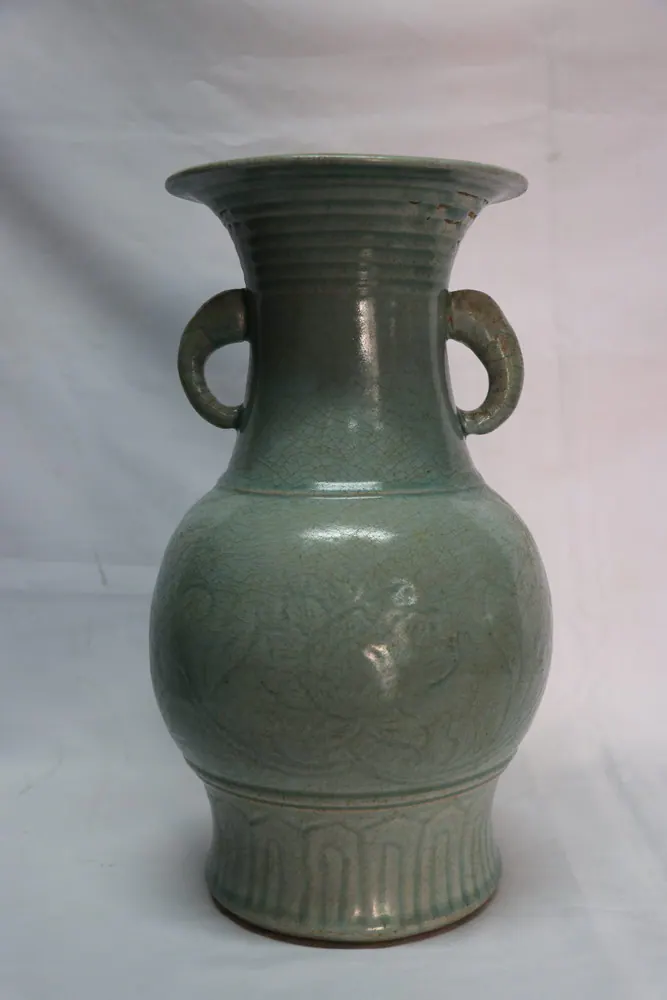
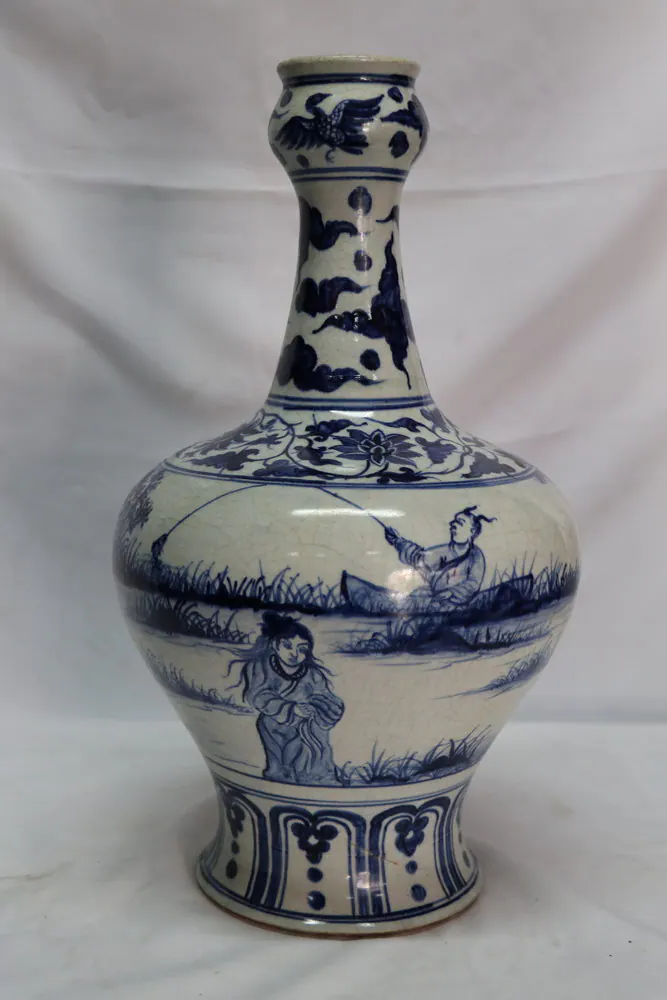
Yuhuchunping. A pear-shaped bottle vase whose slender neck flares out to an everted mouth, standing on a foot ring. The name is usually translated as ‘jade flask of spring’. It developed in the Song, became one of the standard shapes of Yuan and early Ming blue and white and underglaze red, and was revived in the Qing. The line where the neck swells into the body is worth studying closely, because copies often pinch the neck too sharply or let the belly sag too low.
Gu. A tall beaker vase with a wide trumpet mouth, a middle section that is often slightly swollen, and a flared foot. It copies an archaic bronze wine vessel of the Shang and Western Zhou periods. Porcelain versions were made in large numbers in the late Ming, the Transitional period and the Kangxi reign, often painted with figure scenes or flowering plants. In the West the same form is usually called a beaker vase, and pairs of them stood alongside covered jars in the sets, or garnitures, that decorated European mantelpieces and cabinets.
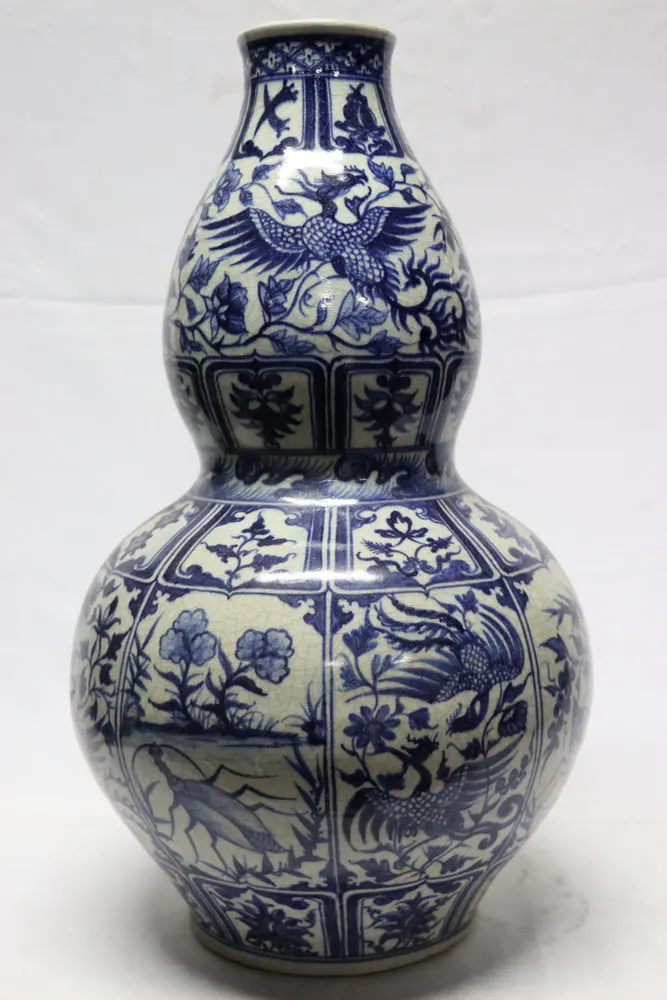
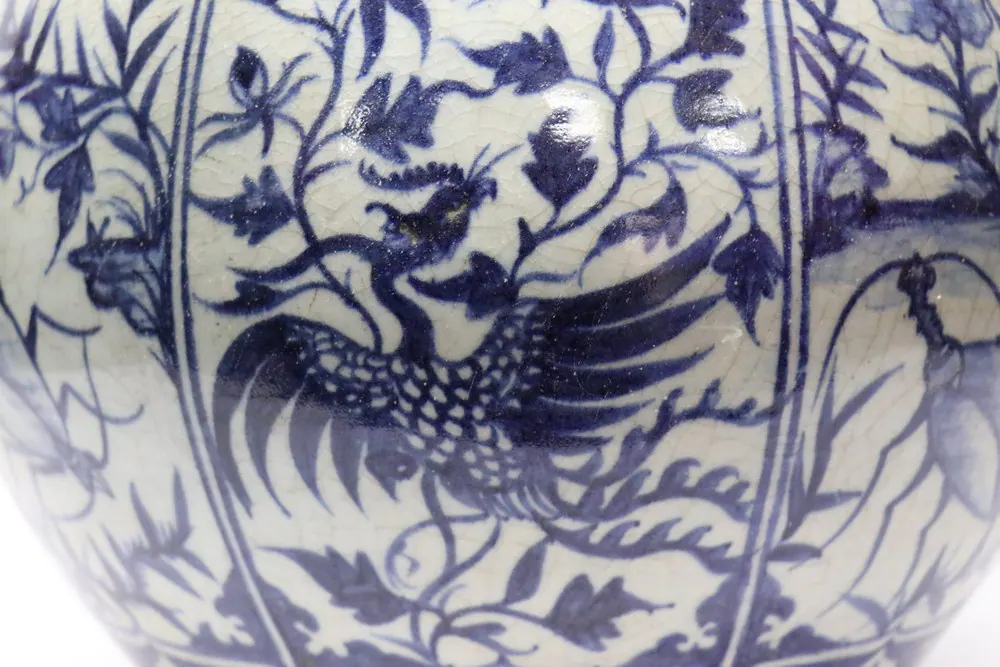
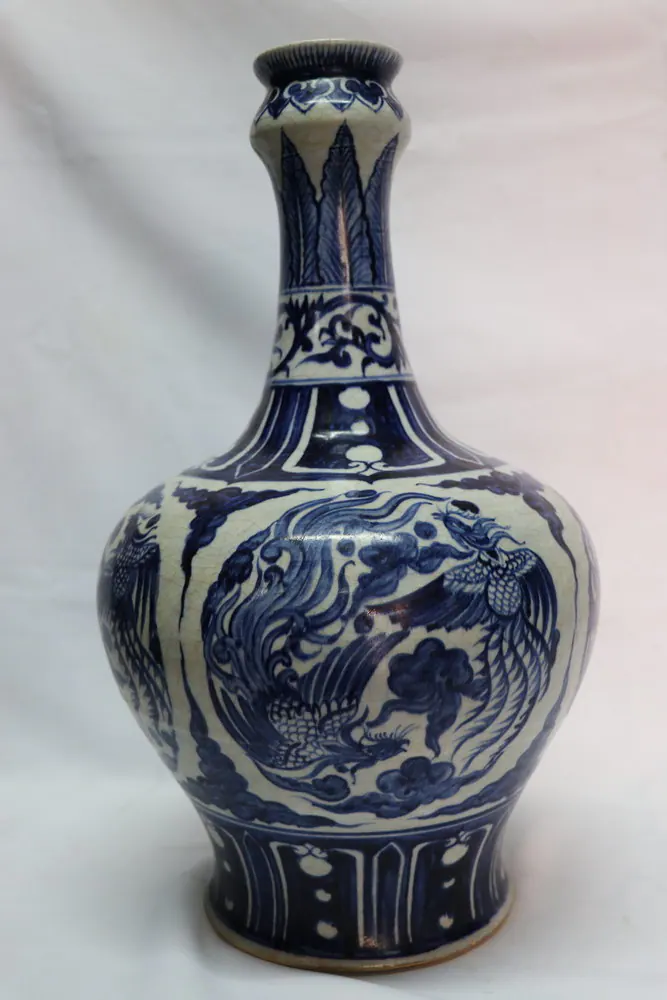
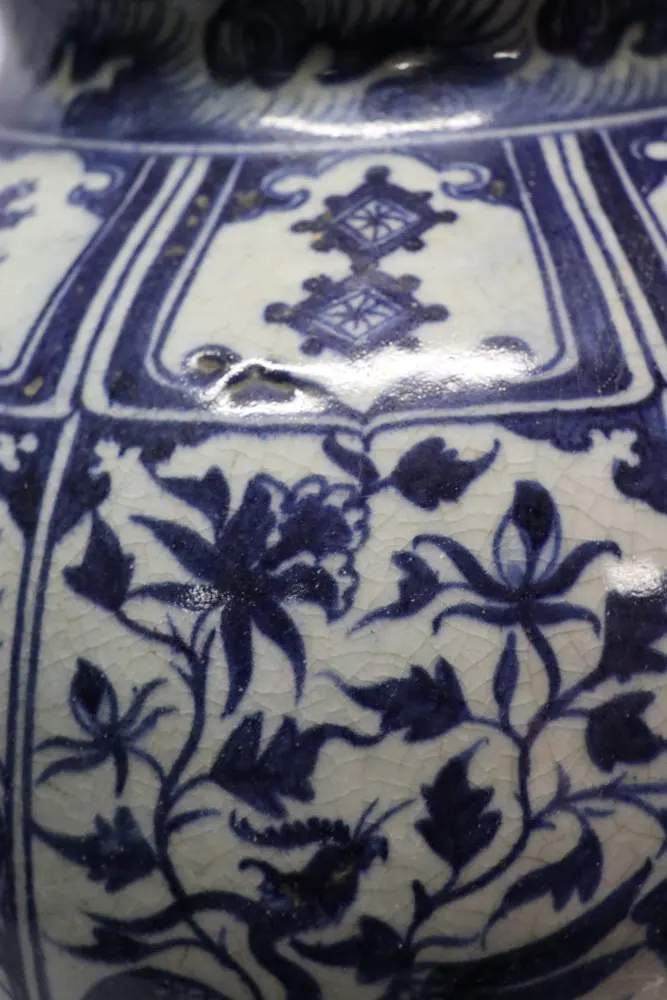
Double gourd. Two rounded bulbs, one above the other, joined at a narrow waist. The gourd, hulu, sounds like fulu, ‘blessings and emolument’, and it is an emblem of long life associated with the Daoist immortals. Gourd forms are far older than porcelain, and in blue and white the double gourd runs from the Yuan to the Qing. It was especially favoured under the Jiajing Emperor, whose devotion to Daoism is well recorded, and many Jiajing examples have a square lower section. The two bulbs were usually thrown separately and joined at the waist. A blue and white double gourd vase in our collection, listed as Yuan, is painted in panels with phoenixes and peony.
Baluster, rouleau and tianqiuping. A baluster vase has a high rounded shoulder tapering to a narrower foot, like the turned post of a balustrade; Kangxi potters made many, including tall versions with a flaring trumpet neck that Western dealers call yenyen vases. The rouleau vase, with a straight cylindrical body, a flat angled shoulder and a straight neck, is typical of the Kangxi period. The tianqiuping, or ‘celestial globe vase’, has a globular body and a tall cylindrical neck; it belongs above all to the Yongle and Xuande reigns and was revived in the eighteenth century.
Jars: the guan jar, covered jars and lion finials
Guan is the general Chinese word for a jar. It should not be confused with Guan ware, the ‘official’ ware of the Song, which is written with a different character and is described in our guide to the five great kilns. A guan jar in the collector's sense has a wide mouth, a short neck, a broad shoulder and a body that narrows towards the base.
The large jars of the Yuan are among the most imposing pieces of early blue and white. They are heavily potted, painted in horizontal zones that usually end in a band of lotus-petal panels above the foot, and many have flat or shallow unglazed bases. Some have moulded animal-mask handles on the shoulder. Our page on Yuan blue and white porcelain looks at these jars in more detail.
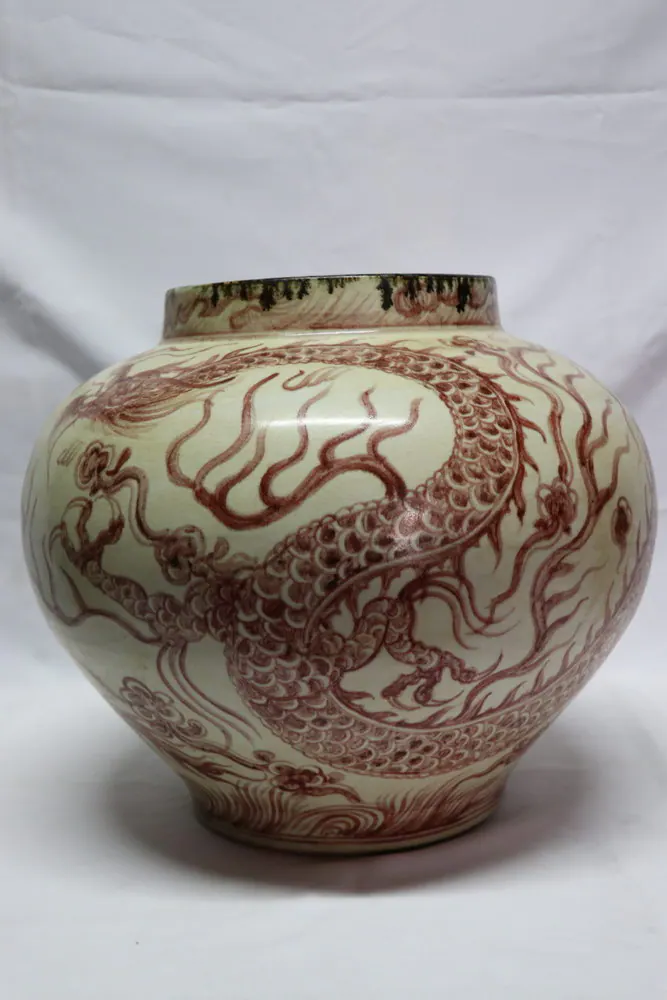
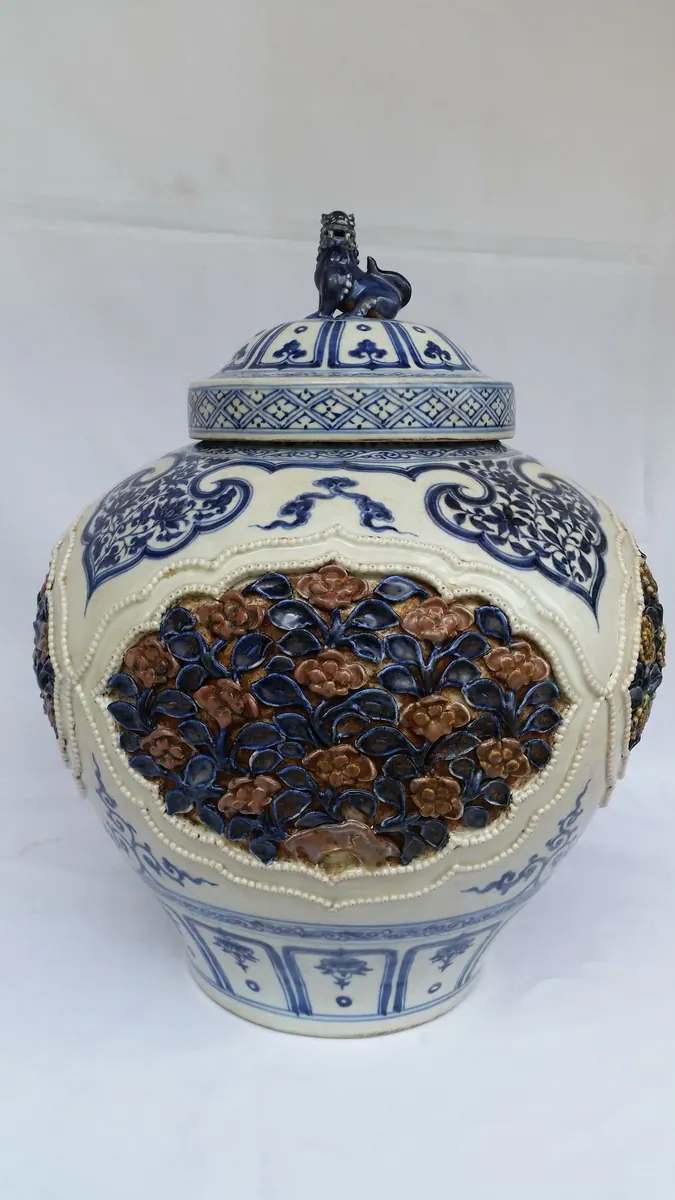
Covered jars were made in every period. The lotus-leaf cover, with a wavy edge and a small stalk-like knob, is typical of a well-known group of Yuan jars. Later covers are usually domed, and a seated Buddhist lion appears as a finial on covers of several periods; it is especially common on late Ming and early Qing jars and vases. A covered jar in our collection, listed as late Yuan to early Ming, has a lion finial on its domed cover and, within beaded panels, flowering branches in raised relief picked out in blue and red. Covers were easily broken or separated from their jars, so a jar that keeps its original cover is less common than one without. A cover that sits badly, or whose glaze, blue and body differ from the jar's, may be a later pairing.
The ovoid jar with a domed cover that Western collectors call a ginger jar is an old shape with a later name, taken from its use in the export trade. The best known are Kangxi jars painted with prunus blossom on a blue ground cracked like ice.
Dishes and chargers, including barbed rims
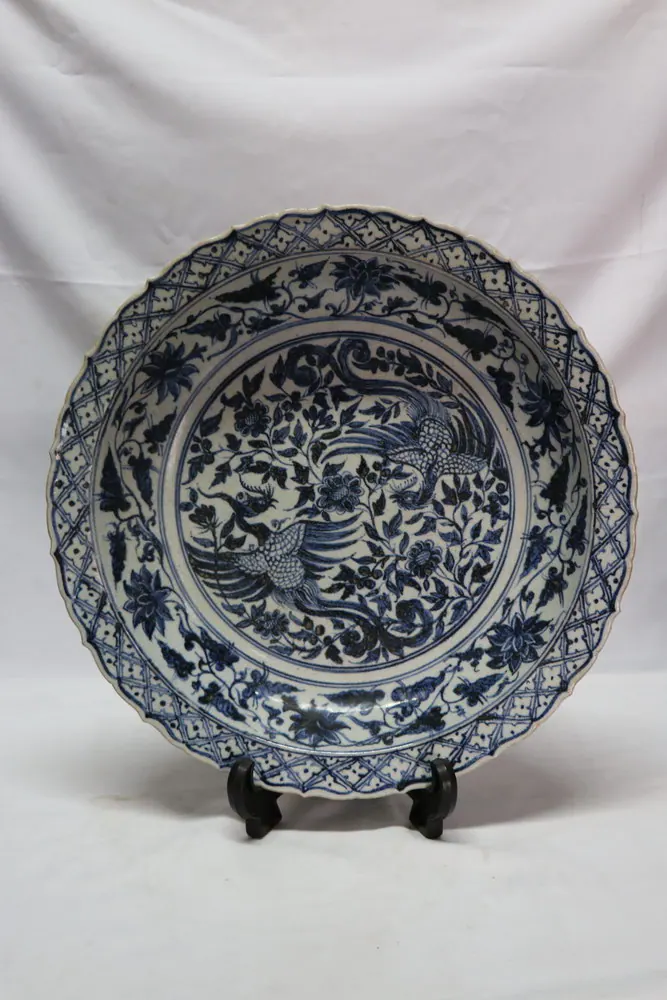
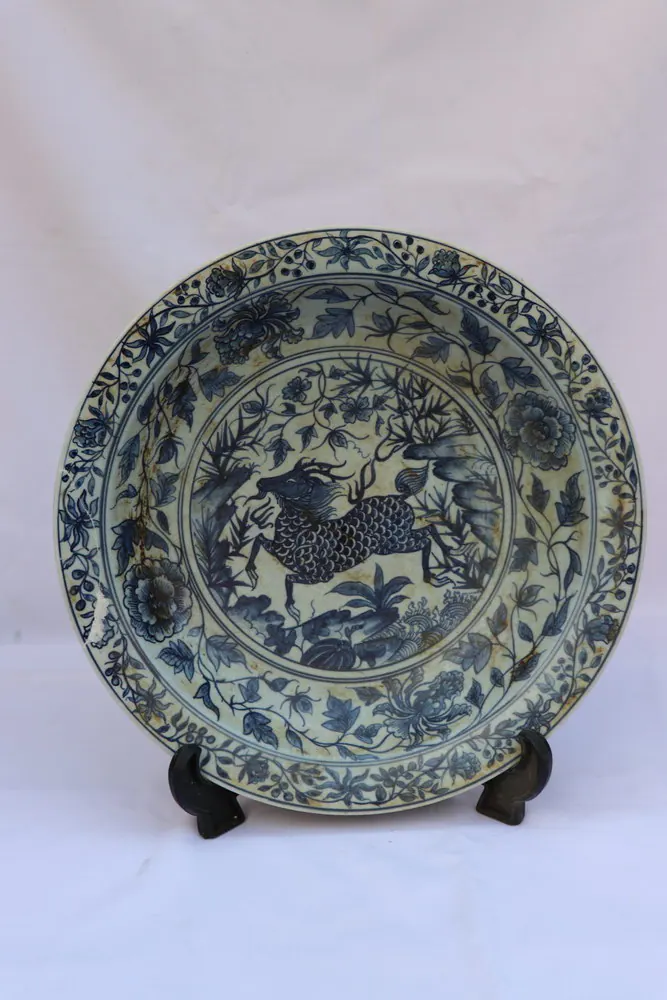
A charger is simply a very large dish. The great blue and white chargers of the Yuan, often more than 40 centimetres across, were made largely for buyers in the Middle East and Central Asia, where food was served from large shared dishes. The Topkapi Palace in Istanbul and the collection given to the Ardebil Shrine in Iran preserve famous groups, and early Ming potters went on making them.
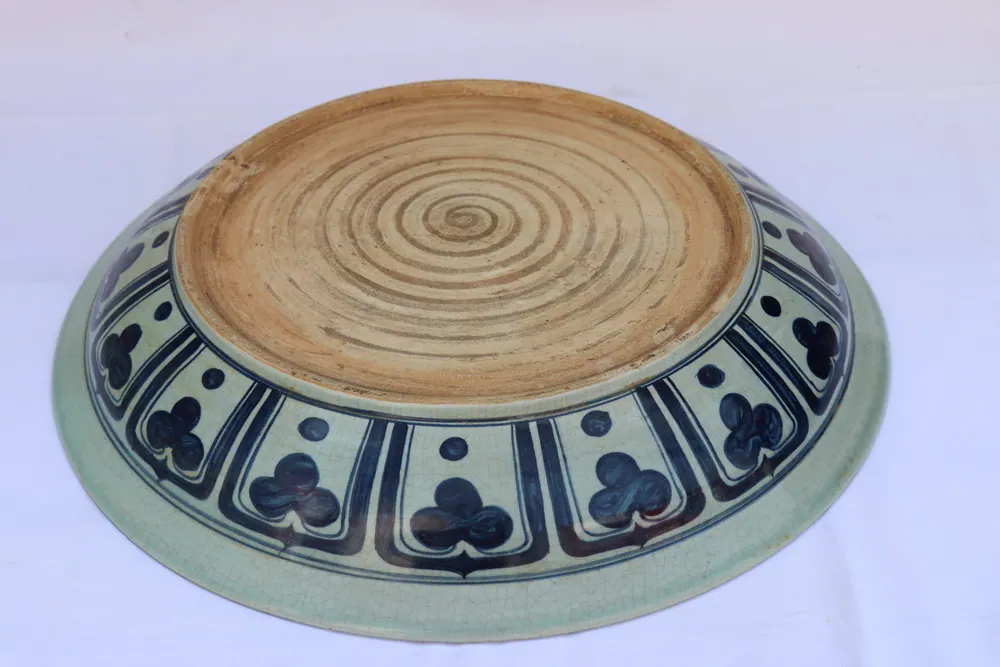
Their rims take two main forms. Some are flat and round; others are barbed, with the edge cut into small lobes and points in imitation of metal dishes, and the cavetto often moulded or painted in matching lobed panels. The rim usually carries a wave, diaper or scroll border, and the centre a main subject within a ring, as on a barbed-rim charger in our collection painted with a pair of phoenixes. Turn a Yuan charger over and the base is typically unglazed within a broad foot, the exposed body fired to an orange or reddish tone in places.
Later periods produced their own forms. Kraak dishes of the late Ming are thinly potted, their rims divided into radiating panels, and their bases often show radial chatter marks and sand adhering to the foot. Swatow wares from the kilns around Zhangzhou in Fujian are heavier and more freely painted, with coarse sand often fused to the base. Qing dishes are generally more evenly potted, with neatly finished foot rings and glazed bases.
Bowls and stem cups
Bowls are the commonest of all Chinese porcelain shapes, and their profiles changed as much as any vase. Song potters at the Ding kilns and the qingbai kilns of Jingdezhen favoured thinly potted conical and shallow bowls, many fired upside down, which left the rim unglazed. Ming bowls tend to have deeper, rounder sides; the fine deep bowls with gently flared rims made from the Chenghua to the Zhengde reigns are often called palace bowls. Late Ming export potters made the klapmuts, a bowl with a wide, flattened rim named after a Dutch cap, a shape suited to European tables.
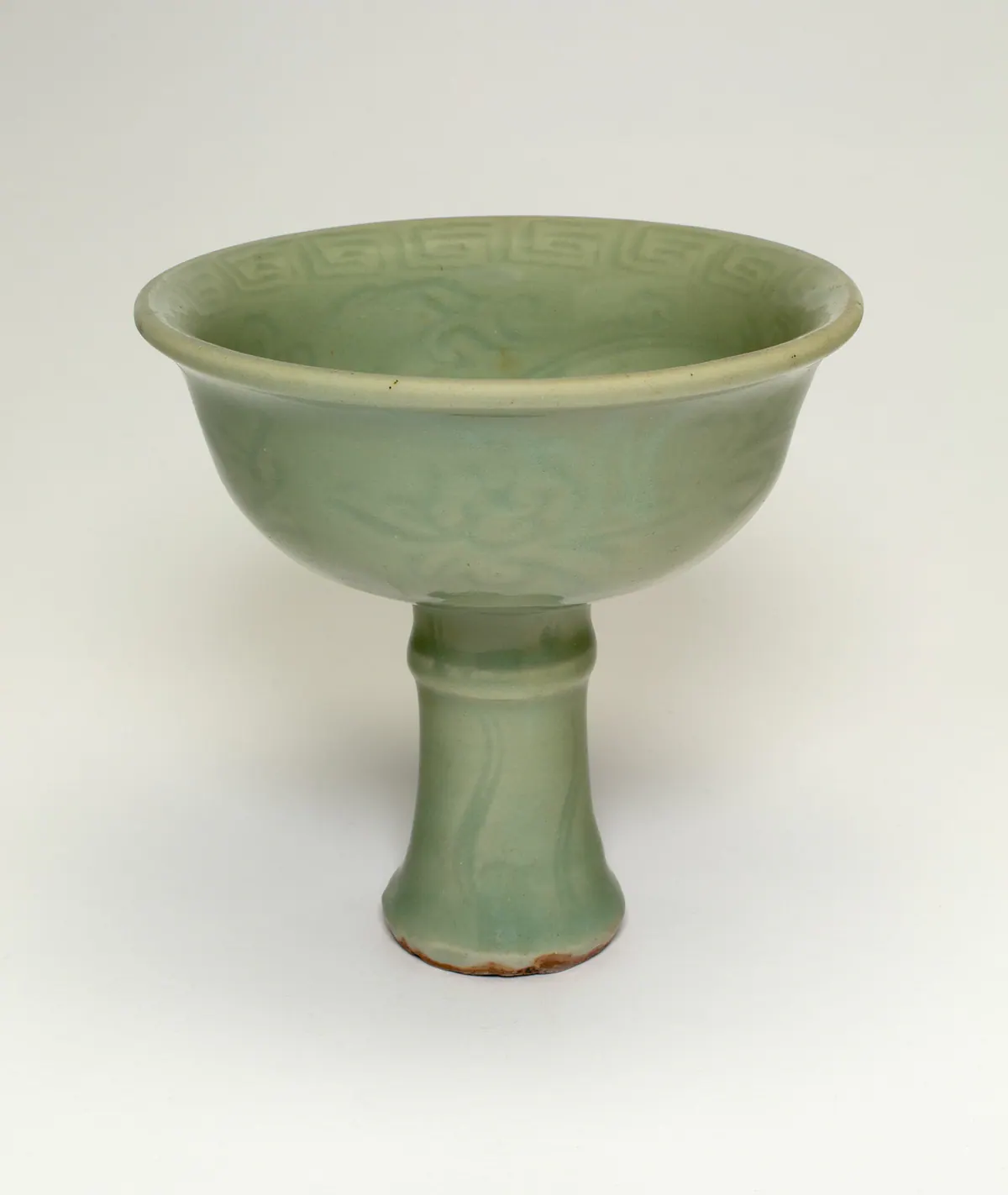
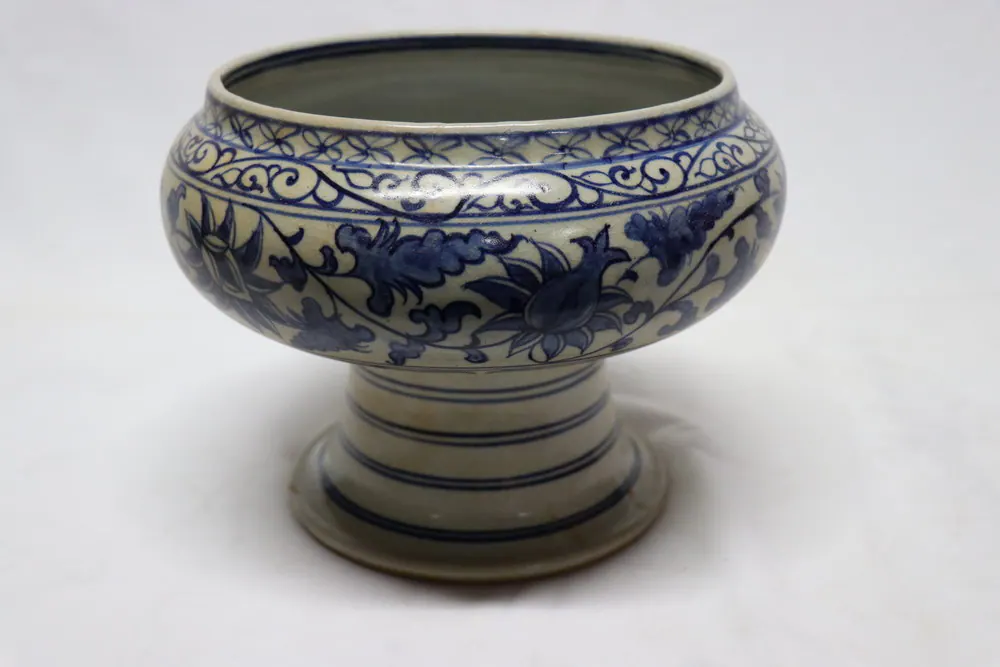
A stem cup is a small bowl raised on a tall hollow stem. It is common in the Yuan in blue and white, qingbai and other wares, and stayed popular through the Ming, used both for wine and on Buddhist altars. Xuande stem cups painted with three fish in copper red are among the classic forms of the early fifteenth century, and they were copied under Yongzheng. The stem may be plain, flared or ridged, and it was usually made separately and joined to the bowl. The inside of the bowl can be decorated as well as the outside, as on a blue and white stemmed bowl we sold, listed as a goblet, painted with a pair of birds among lotus inside and flowering scrolls outside.
Pouring vessels: ewers, the kendi and monk's cap jugs
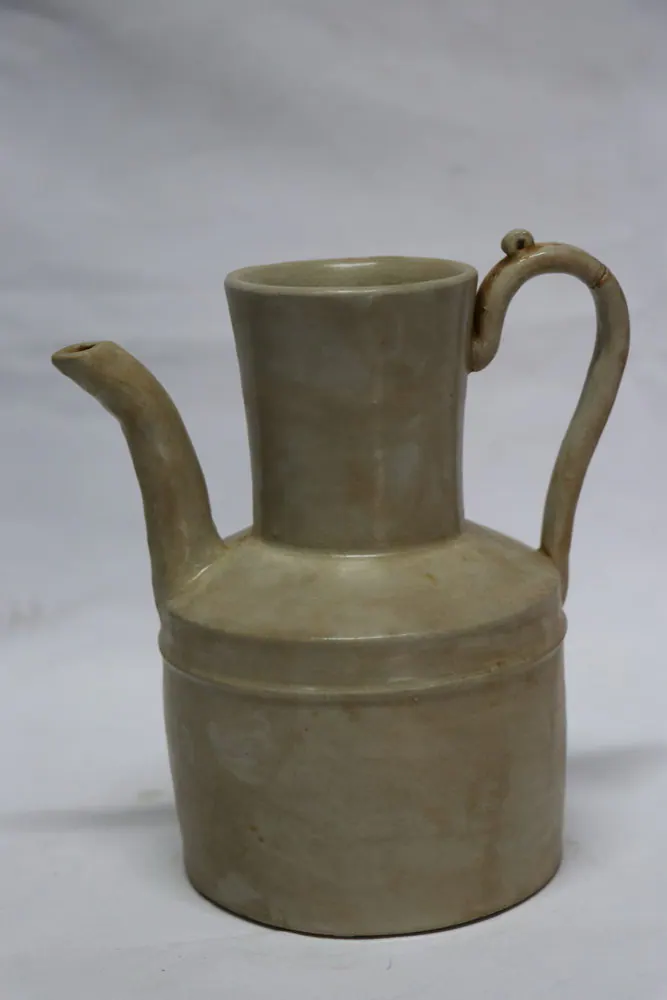
Ewers have a handle, a spout and often a cover. Song qingbai ewers were frequently made with lobed, melon-like bodies, and some stood in a matching bowl filled with hot water to keep wine warm. In the Yuan and early Ming the ewer took on a pear-shaped body close to the yuhuchunping, with a long curving spout braced to the neck by an S-shaped strut, a feature borrowed from Middle Eastern metalwork.
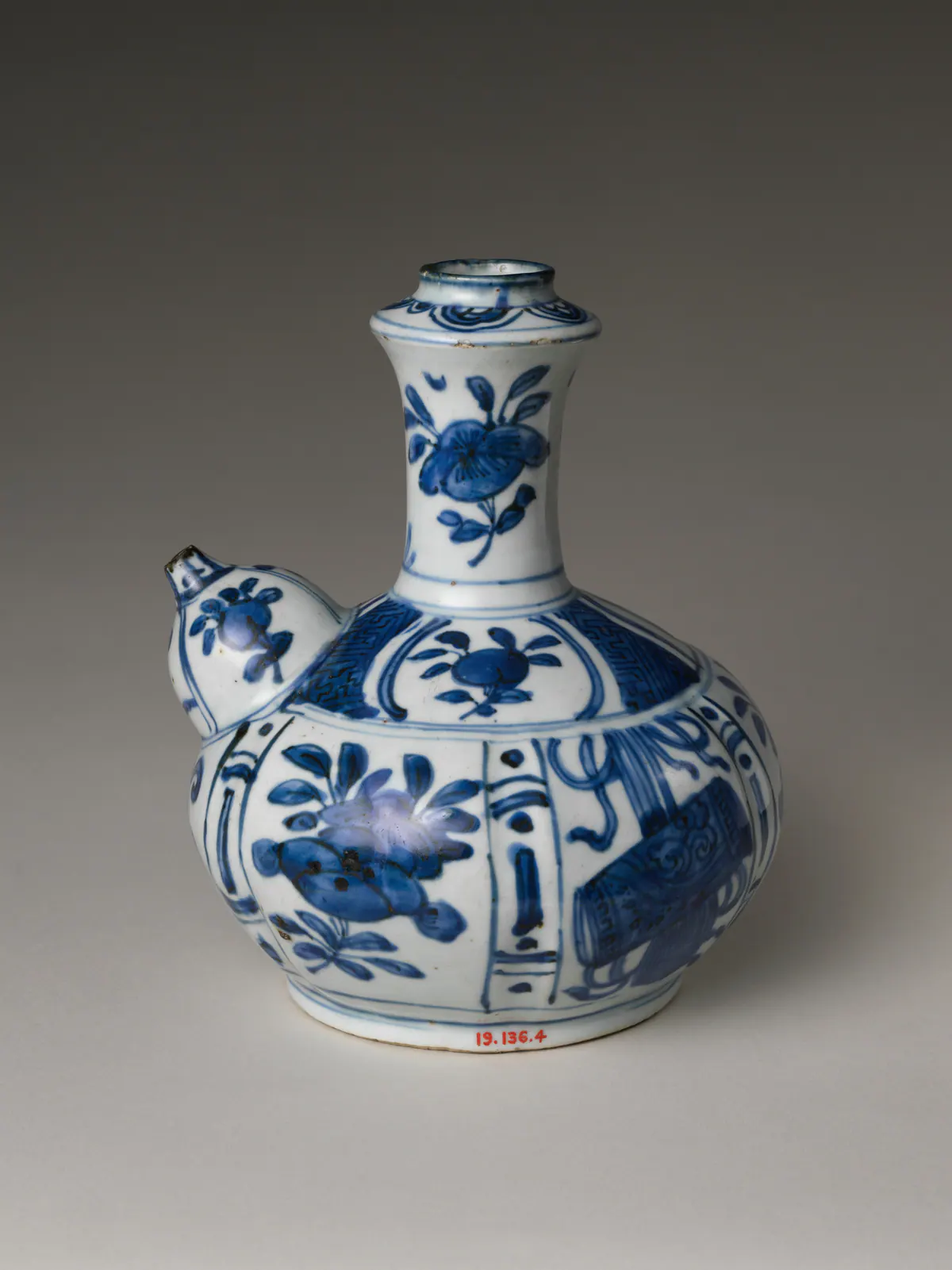
The kendi has no handle at all. It is a drinking and pouring vessel with a round body, an upright neck through which it was filled, and a spout on the shoulder; the water ran from the spout in a stream, so the drinker's lips never touched the vessel. Chinese kilns made kendis mostly for buyers in Southeast Asia, and our guide to the kendi follows the form from the Yuan to the Qing.
The monk's cap jug, sengmaohu, takes its name from its rim, which rises at the back in stepped tiers like the hat of a Tibetan monk and runs forward to a pointed pouring lip, with a strap handle behind. It was made at Jingdezhen in the Yongle and Xuande reigns after Tibetan metal vessels, and revived in the eighteenth century, when it was copied with great care. It is a good example of a shape whose dates are narrow and well documented.
How proportions shifted, and where copies go wrong
In broad terms, Yuan porcelain is heavy and robust: large vessels, thickly potted, often with unglazed bases, thrown and joined with strength rather than polish. Early fifteenth-century pieces keep much of that scale but are better finished. Mid-Ming wares for the home market are often smaller and lighter, and late Ming export porcelain is thin and light for its size. Kangxi potters introduced crisp new forms such as the rouleau, and under Yongzheng and Qianlong the imperial kilns copied Ming shapes with a precision the originals rarely had. Many nineteenth-century pieces look slacker in profile, with thicker walls and less tension in the curves.
Large vessels were thrown in sections and joined, usually at the widest point or at the waist. On an old piece the join often shows inside as a ridge or a break in the throwing rings, and sometimes outside as a slight step in the profile. Moulded or slip-cast copies may show no join at all, or an interior that mirrors the outside too exactly.
Copies most often go wrong in details that are hard to see in a photograph: a neck a little too long or too thick, a shoulder that slumps, a belly set too low, a foot ring cut too neatly or too heavily for its period. Weight is telling too. The foot and base deserve particular attention, and our guide to foot rings and bases shows what to look for. Shape is one piece of evidence among several: before a date can be relied on, it should agree with the body, the glaze, the painting and the age signs.