Guide
Ming Dynasty Reign Marks: A Chart from Hongwu to Chongzhen
This chart sets out the Ming reign marks from the first emperor, Hongwu, to the last in Beijing, Chongzhen: the characters of each mark, the years of each era name, and what collectors should know about each reign. It also explains which reigns left few or no marks, which marks were copied most, and how later copies differ.
What to look for
- Read the middle two characters: they give the era name, and so the reign the mark names.
- Check the form: accepted Yongle marks have four characters in seal script; later Ming marks usually have six in regular script.
- Remember that no Hongwu reign mark is accepted as genuine, and that court porcelain of 1436 to 1464 is unmarked.
- Check the last character: Longqing marks normally end in 造, not 製.
- Compare the calligraphy and the blue with documented pieces of the reign, taking particular care with Xuande and Chenghua marks.
- Date the piece by its body, foot, glaze and painting before you give weight to the mark.
How to use this chart
A standard Ming mark has six characters: 大明 (Da Ming, "Great Ming"), the two characters of the era name, and 年製 (nian zhi, "made in the period"). It is read in columns from top to bottom, starting on the right. Our guide to Chinese porcelain marks explains the reading in full.
Each entry below gives the era name, the characters of the mark, the years and a line on what matters to a collector. For reigns with no accepted mark, the entry gives the two characters of the era name instead. All dates are the years of the era name, which usually began with the new year after the emperor came to the throne, so they can differ by a year from the reign dates on the Ming emperors pages.
Collectors usually call an emperor by his era name, so the Xuande emperor is the emperor who reigned under the era name Xuande. Chinese histories more often use his temple name, Xuanzong, and his personal name was Zhu Zhanji. Only one Ming emperor used two era names: Zhu Qizhen reigned as Zhengtong, lost the throne after his capture in 1449, and returned in 1457 as Tianshun. Both appear in the chart.
The chart covers the era names used from the founding of the dynasty in 1368 to the fall of Beijing in 1644. The Southern Ming claimants who followed have their own pages among the emperors.
The chart records what each reign's marks look like. It cannot tell you whether a particular piece was made in that reign. Ming reign marks were copied from the sixteenth century to the present day, and a mark records what was written, not when.
The chart: Ming reign marks from Hongwu to Chongzhen
The table sets out every Ming era name in order; notes on each reign follow it.
| Reign | Mark | Dates | Note |
|---|---|---|---|
| Hongwu | 洪武era name | 1368 to 1398 | No accepted mark |
| Jianwen | 建文era name | 1399 to 1402 | No marked porcelain recognised |
| Yongle | 年製永樂 | 1403 to 1424 | Four characters, seal script |
| Hongxi | 洪熙era name | 1425 | No marked porcelain recognised |
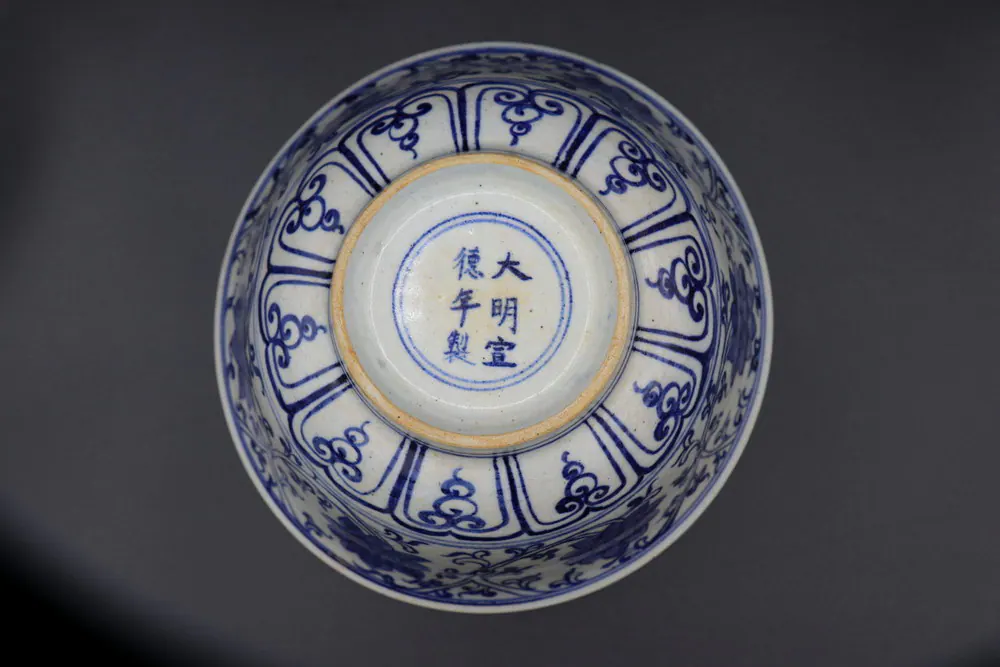
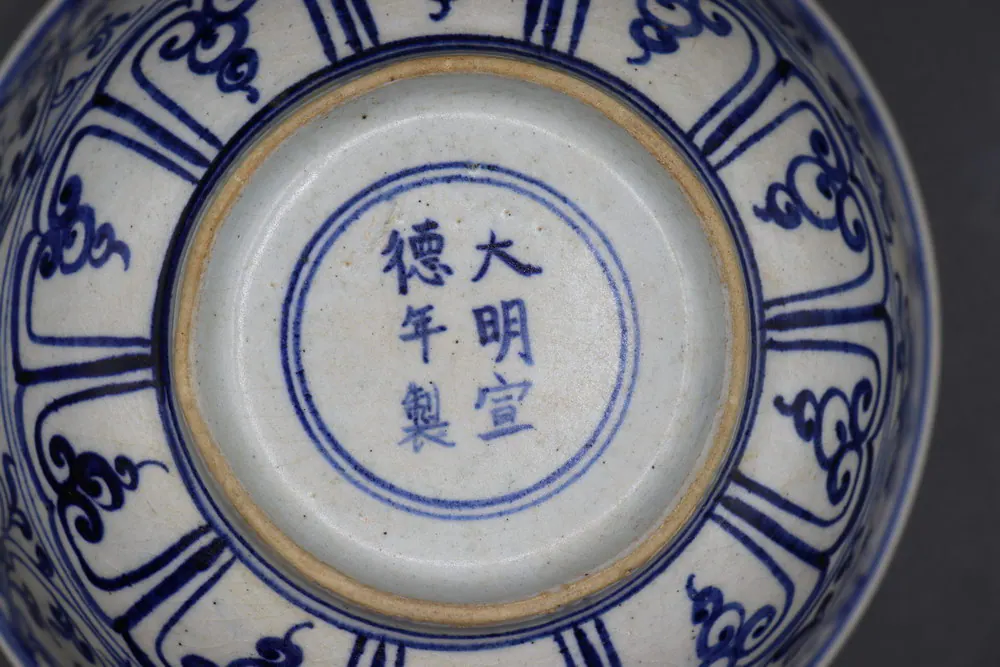
| Xuande | 德年製大明宣 | 1426 to 1435 | First reign to mark regularly |
| Zhengtong | 正統era name | 1436 to 1449 | Court porcelain unmarked |
| Jingtai | 景泰era name | 1450 to 1457 | Court porcelain unmarked |
| Tianshun | 天順era name | 1457 to 1464 | Court porcelain unmarked |
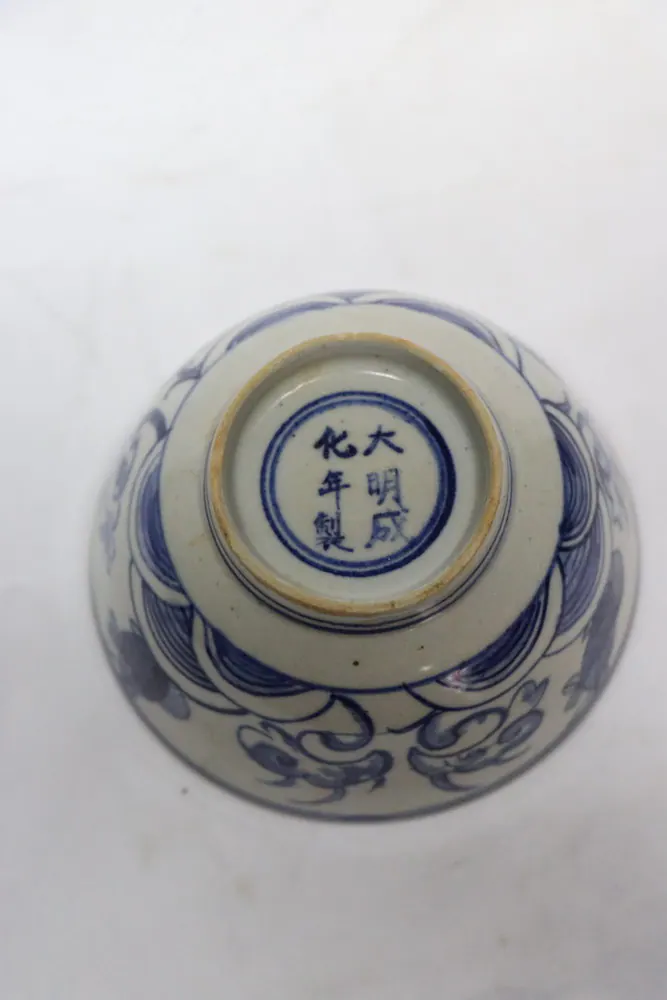
| Chenghua | 化年製大明成 | 1465 to 1487 | Among the most copied |
| Hongzhi | 治年製大明弘 | 1488 to 1505 | Close in style to Chenghua |
| Zhengde | 德年製大明正 | 1506 to 1521 | Usually six characters, sometimes four |
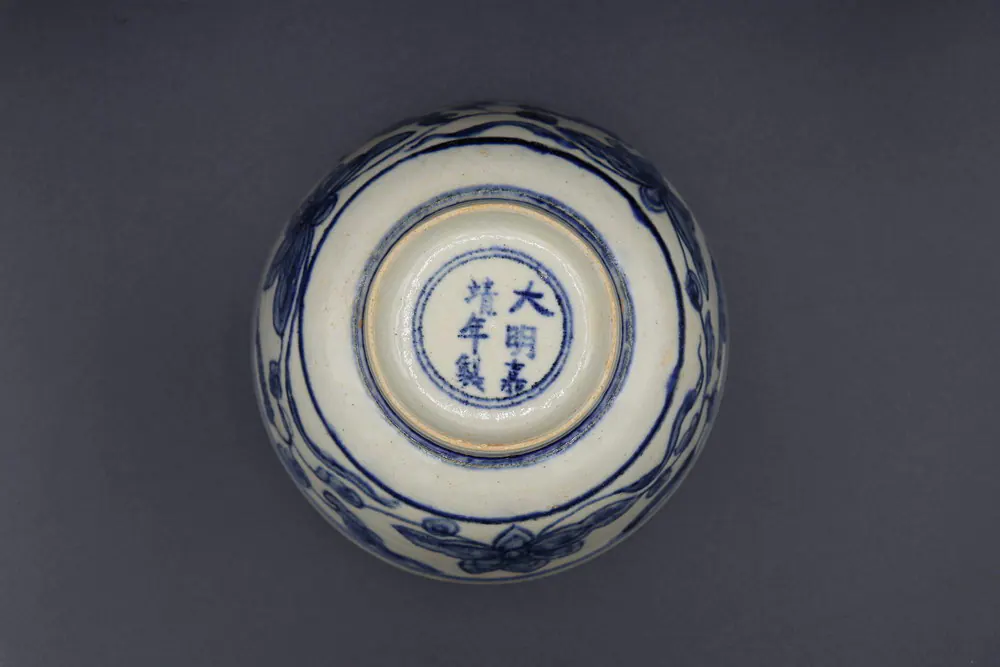
| Jiajing | 靖年製大明嘉 | 1522 to 1566 | Marked pieces relatively plentiful |
| Longqing | 慶年造大明隆 | 1567 to 1572 | Ends in 造, not 製 |
| Wanli | 曆年製大明萬 | 1573 to 1620 | One of the most common marks |
| Taichang | 泰昌era name | 1620 | No marked porcelain recognised |
| Tianqi | 啓年製大明天 | 1621 to 1627 | Mainly on private-kiln wares |
| Chongzhen | 禎年製大明崇 | 1628 to 1644 | Marked pieces rare |
Notes on each reign
- Hongwu. No Hongwu reign mark on porcelain is accepted as genuine. Court porcelain of the reign is unmarked and is dated by its style and by excavation.
- Jianwen. No reign-marked porcelain is recognised from this short reign, whose era name the Yongle emperor later abolished.
- Yongle. Accepted marks have four characters in seal script, mostly incised, impressed or in anhua on white wares, with a few in underglaze blue inside press-hand cups. No accepted period piece has a six-character mark.
- Hongxi. The reign lasted less than a year, and no reign-marked porcelain is recognised.
- Xuande. The first reign to mark imperial porcelain regularly, usually with six characters in regular script and sometimes with four. Marks appear on the base, below the rim, on the shoulder and inside.
- Zhengtong. Court porcelain of the reign is unmarked.
- Jingtai. Court porcelain of the reign is unmarked.
- Tianshun. The second era name of the Zhengtong emperor, restored in 1457. Court porcelain is again unmarked.
- Chenghua. Six characters in regular script, often in a double square on small cups and in a double ring on bowls and dishes. Among the most copied of all Ming marks.
- Hongzhi. Close in style to Chenghua marks, and found on refined yellow-glazed and blue and white court wares. Copied far less often.
- Zhengde. Usually six characters, sometimes four. Pieces with Arabic or Persian inscriptions belong to this reign's best-known group.
- Jiajing. A long reign with a large output, so marked pieces are relatively plentiful. The calligraphy is often freer than in the fifteenth century.
- Longqing. Unusually, the standard mark ends in 造 (zao) rather than 製 (zhi). A short reign, so marked pieces are scarce.
- Wanli. The longest Ming reign and one of the most common Ming marks, found on court wares and on good private-kiln porcelain.
- Taichang. The emperor reigned for about a month, and no reign-marked porcelain is recognised.
- Tianqi. Court orders had dwindled, and the mark is found mainly on private-kiln wares, often loosely written.
- Chongzhen. Marked pieces are rare. Much porcelain of the period is unmarked or carries a cyclical date instead.
Reigns with few or no marks
Several Ming reigns left no accepted marks, and knowing them saves a great deal of trouble.
Hongwu. The first Ming emperor did not mark his porcelain. His court wares, among them the large underglaze red and blue and white pieces of the late fourteenth century, are identified by style and by fragments excavated at the imperial kiln site in Jingdezhen. No Hongwu reign mark on porcelain is accepted as genuine.
Jianwen and Hongxi. Both reigns were very short. Jianwen's era name was struck from the record after the Yongle emperor seized the throne, and Hongxi reigned for less than a year.
1436 to 1464. The Zhengtong, Jingtai and Tianshun reigns, sometimes called the interregnum, produced no marked imperial porcelain. The kilns at Jingdezhen went on working, and wares of the period are attributed by style and excavation rather than by mark.
Taichang and the last reigns. Taichang reigned for a month. Under Tianqi and Chongzhen the court's orders declined, and much of the finest porcelain of the time, including the Transitional wares, is unmarked or dated by the sixty-year cycle.
The Ming marks most often copied
Four Ming marks account for most of the Ming reign marks a collector will see: Xuande, Chenghua, Jiajing and Wanli. Yongle marks were also copied from the late Ming onwards.
Xuande and Chenghua were admired as the classic reigns of Ming porcelain by the sixteenth century, and late Ming writers already recorded the high prices paid for Chenghua cups. Potters of the Jiajing and Wanli reigns wrote their marks on wares of their own day, and Kangxi potters did so on a large scale. The Qing court under Yongzheng and Qianlong commissioned careful copies of fifteenth-century pieces, some with the earlier mark. Japanese potters also used the Chenghua mark on their own porcelain.
Jiajing marks were copied in the Kangxi period, and both Jiajing and Wanli marks appear on porcelain of the late nineteenth and twentieth centuries.
Our guide to apocryphal marks explains why potters borrowed these names and how to date a piece that carries one.
Marks on private-kiln Ming porcelain
From the sixteenth century the private kilns at Jingdezhen marked a large share of their output, and most marked Ming porcelain on the market today comes from them rather than from the court.
Some private potters wrote the mark of the reign in progress. Jiajing and Wanli marks on private-kiln wares are common, and they range from careful to hasty. Others wrote the marks of admired earlier reigns, above all Xuande and Chenghua. Many used auspicious or dedication marks instead, such as 富貴佳器 ("a fine vessel for the rich and honoured") or 長命富貴 ("long life, wealth and honour"), or a simple emblem. Under Jiajing and Wanli some imperial orders were also placed with private kilns, which blurs the line between the two further.
On private-kiln porcelain a reign mark was a commercial convention, so it is weaker evidence than on court porcelain. The difference between court and private wares shows in the body, the painting and the finish far more than in the mark. Our guide to Ming folk kiln porcelain describes these wares.
How later copies of Ming marks differ
A later mark is written by a later hand, and that hand usually shows.
- Calligraphy. A copyist writes the characters of an earlier reign in the style of his own time. A Kangxi Chenghua mark tends to look like a Kangxi mark in its crisp, orderly strokes. Modern copies are often stiff, hesitant or unnaturally even, because the writer is following a model rather than writing freely.
- The blue. Early fifteenth-century cobalt often pooled into dark, almost black spots. Later copies are usually more even, and modern ones may imitate the spots with deliberate dabs that sit on the surface of the line. Our guide to cobalt blue describes the changes.
- The characters. Copyists sometimes miswrite a character, add or drop a stroke, or use a variant form. Checking each character against a documented mark of the reign catches many modern copies.
- Proportions. Each reign had conventions for the size of the characters in relation to the ring and the base. A mark that crowds its ring, or floats in it, deserves a second look.
- Form and border. A six-character Yongle mark, or a Chenghua mark in a border the reign did not use, belongs to later practice.
- The glaze and base. The glaze over the mark, the foot and the exposed body must all agree with the period. A good mark on the wrong base is still a later mark.
Marked pieces in our collection and how we describe them
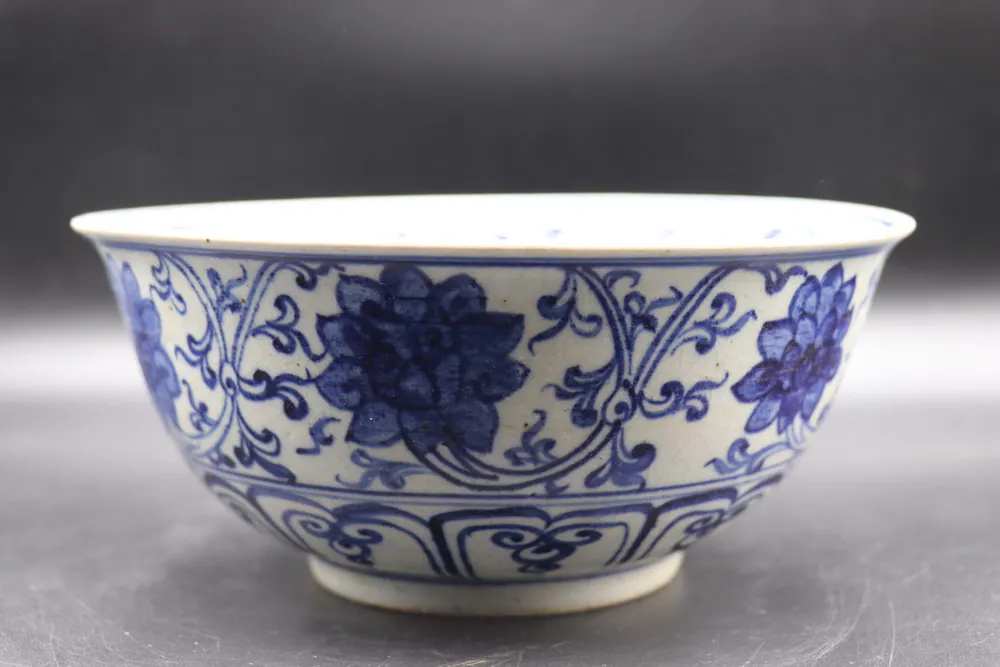
We describe every marked piece by what the mark says. A title such as a blue and white bowl with a Jiajing mark reports the inscription on the base. It is not in itself a claim that the bowl was made between 1522 and 1566.
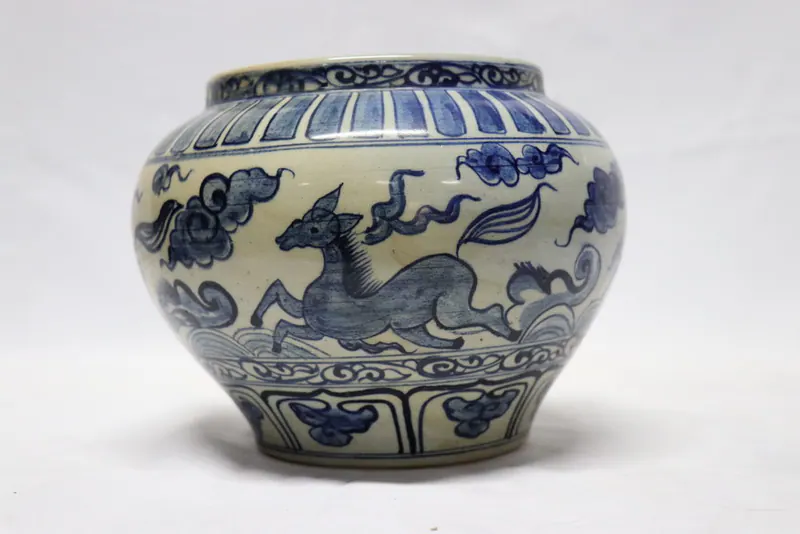
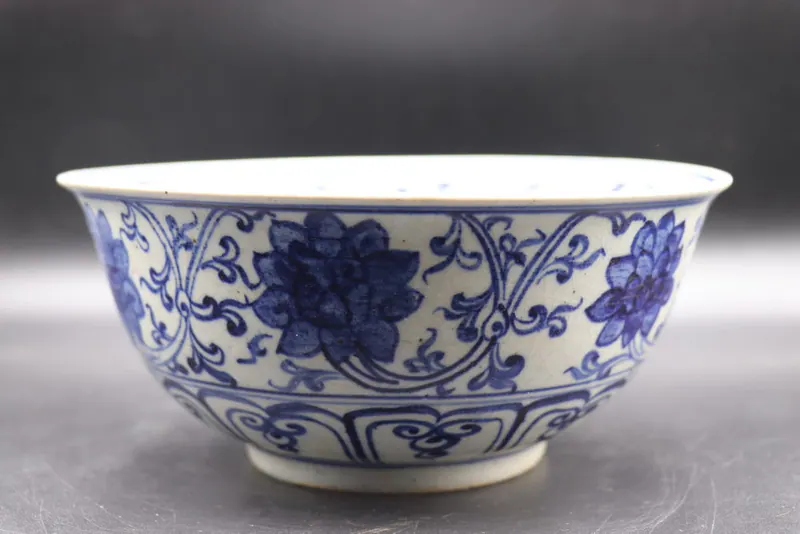
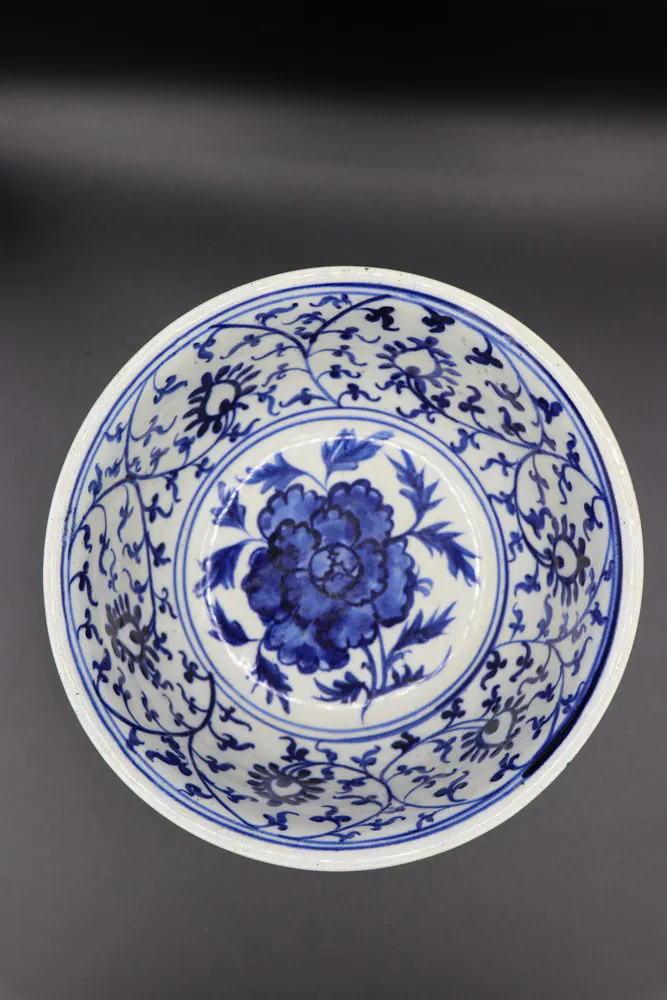
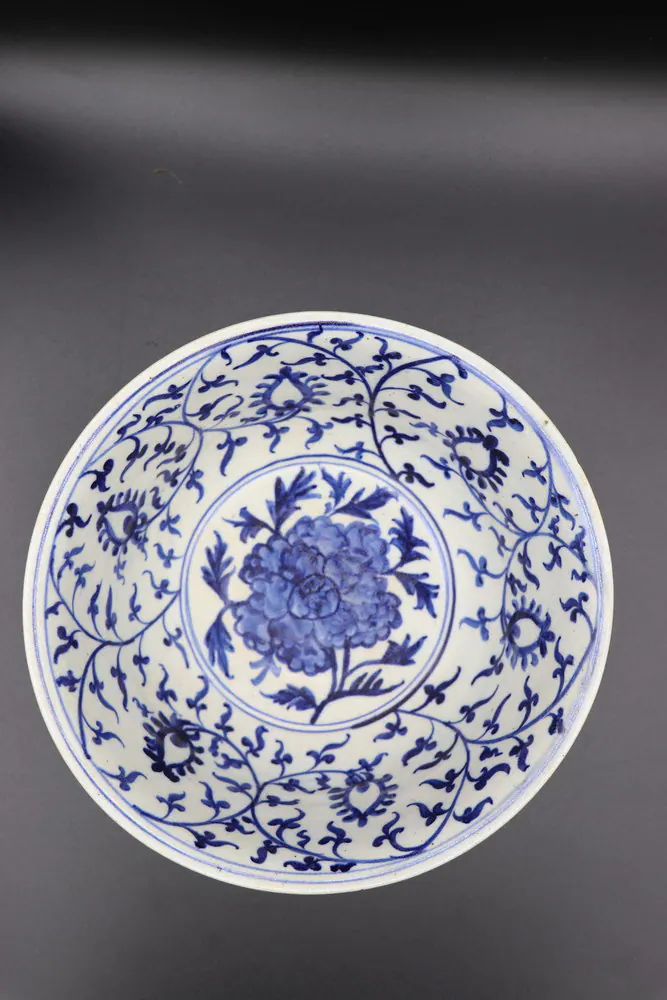
The collection currently includes a blue and white bowl with a Xuande mark, painted with lotus scrolls. Among pieces we have sold are a bowl with a Xuande mark and a bowl with a Chenghua mark, both shown on this page. Each listing includes photographs of the base, so you can see the mark for yourself, and you can ask about any piece through the inquiry form on its page.