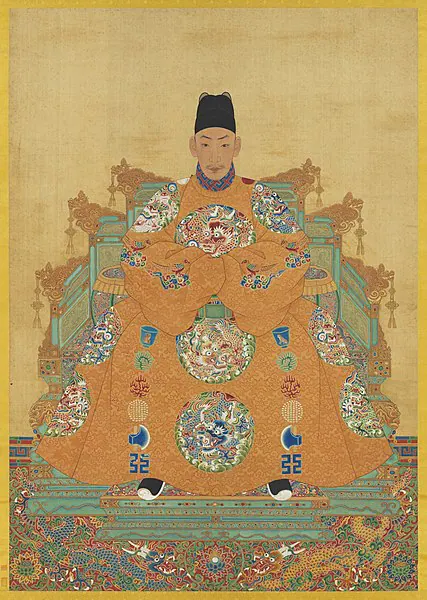
Portrait: public domain, via wikipedia.org

Ming Dynasty1505–1521

Zhengde Emperor

正德

Reign facts and reign mark
Reigned
1505–1521 (16 years)
Lived
1491–1521
Personal name
Zhu Houzhao 朱厚照
Temple name
Wuzong 武宗
Era name
Zhengde 正德 1506–1521
Reign markMade in the Zhengde reign of the Great Ming. How to read reign marks

Zhu Houzhao (1491–1521) was the tenth emperor of the Ming dynasty. He succeeded his father, the Hongzhi Emperor, in 1505 and ruled under the era name Zhengde, often translated as "rectification of virtue", from 1506 until his death in 1521. His temple name is Wuzong.

He is one of the most controversial of the Ming emperors. He neglected government, left the palace for long periods, allowed the eunuch Liu Jin to dominate the court, and pursued his own amusements with little regard for convention. His reign also saw two rebellions by imperial princes, and it produced a distinctive group of porcelains inscribed in Arabic and Persian.

Early Life

Zhu Houzhao was born in 1491, the eldest son of the Hongzhi Emperor and his only consort, Empress Zhang. He was named crown prince as a small child. Because his father took no concubines, he had no half-brothers to compete with, and his only full brother died in infancy.

He received a thorough Confucian education and was thought a quick and able pupil. Many of his father's ministers hoped he would prove as conscientious a ruler as Hongzhi. When Hongzhi died in 1505, Zhu Houzhao came to the throne at the age of thirteen.

The Zhengde Emperor as Ruler

In 1506 the emperor married Empress Xia, but he showed little interest in her or in the business of government. He rarely attended audiences, left memorials unanswered and preferred the company of eunuchs, soldiers, entertainers and favourites. Officials who protested were often punished.

The Leopard Quarter

From 1507 he lived for much of the time not in the Forbidden City but in a complex of buildings in the Imperial City to the west, called the Baofang or Leopard Quarter after the animals kept there. It housed his menagerie, his favourites and his entertainments, and became the real centre of his court.

Many stories were told of his behaviour. He is said to have had a mock market street built inside the palace, with eunuchs playing the parts of shopkeepers so that he could wander among them as an ordinary customer. He adopted more than a hundred men, among them officers and eunuchs, as his sons and gave them the imperial surname Zhu. In 1514 lanterns and gunpowder stored for the Lantern Festival set fire to the Qianqing Palace, the emperor's own residential hall, and it burned down; he is said to have watched the blaze and remarked on what a fine display of fireworks it made.

Liu Jin and the Eunuchs

From the beginning of the reign the young emperor was surrounded by a group of eunuchs who had served him as crown prince, later known as the Eight Tigers. Their leader was Liu Jin. In 1506 senior ministers petitioned for the eunuchs to be punished, but Liu Jin persuaded the emperor to side with them instead, and the leading grand secretaries were forced to resign. Among the officials punished for protesting was the philosopher Wang Yangming, who was flogged and banished to Guizhou.

For the next four years Liu Jin controlled access to the emperor and much of the government. He demanded payments from officials seeking appointment or favour, purged his opponents, and amassed an enormous fortune; the figures given in later accounts vary widely and cannot be taken at face value.

His fall came in 1510. The Prince of Anhua, a member of the imperial clan in the north-west, rebelled and denounced Liu Jin in his proclamation. The rising was put down within weeks, and the eunuch Zhang Yong, sent to deal with it, used the occasion to accuse Liu Jin of plotting against the throne. Liu Jin was arrested, his property was confiscated and he was executed by slow slicing.

The General Zhu Shou

The emperor was fascinated by soldiering. He gave himself the title of generalissimo under the invented name Zhu Shou, and in 1517 he travelled to the northern frontier, where he took personal command in a clash with Mongol forces near Yingzhou in Shanxi. The court celebrated it as a victory.

The Rebellion of the Prince of Ning

In 1519 Zhu Chenhao, Prince of Ning, rose in rebellion at Nanchang in Jiangxi. He was defeated within a few weeks by Wang Yangming, by then a senior official in southern Jiangxi, who captured him on Poyang Lake. The emperor nevertheless went ahead with a southern expedition of his own and spent much of 1520 in the south, including a long stay in Nanjing.

Foreigners at Court

Zhengde was curious about foreign peoples and customs. He kept Muslims, Tibetan monks and Central Asians among his companions. His interest in Islam is reflected in the porcelain made for his court, described below.

Death of the Zhengde Emperor

In the autumn of 1520, on his way back north, the emperor fell from a boat while fishing and was pulled from the water. He never recovered his health, and he died in the Leopard Quarter in April 1521, aged twenty-nine.

He had no children. The grand secretary Yang Tinghe and the empress dowager chose his cousin Zhu Houcong as his successor, who reigned as the Jiajing Emperor. Zhengde's leading favourite, the general Jiang Bin, was arrested and executed, and the Leopard Quarter was closed down.

Later historians have judged Zhengde harshly as a ruler who abandoned his duties. The state he left was nonetheless intact: the rebellions of his reign were quickly suppressed, and the machinery of government continued to function under capable officials.

Zhengde Porcelain for Collectors

Imperial porcelain of the reign is marked with the six-character mark Da Ming Zhengde nian zhi (大明正德年製), or with the four-character form Zhengde nian zhi, usually in regular script. Early Zhengde blue and white continues the softer style of the Hongzhi reign; the kilns also made yellow-glazed wares and pieces with dragons in green enamel.

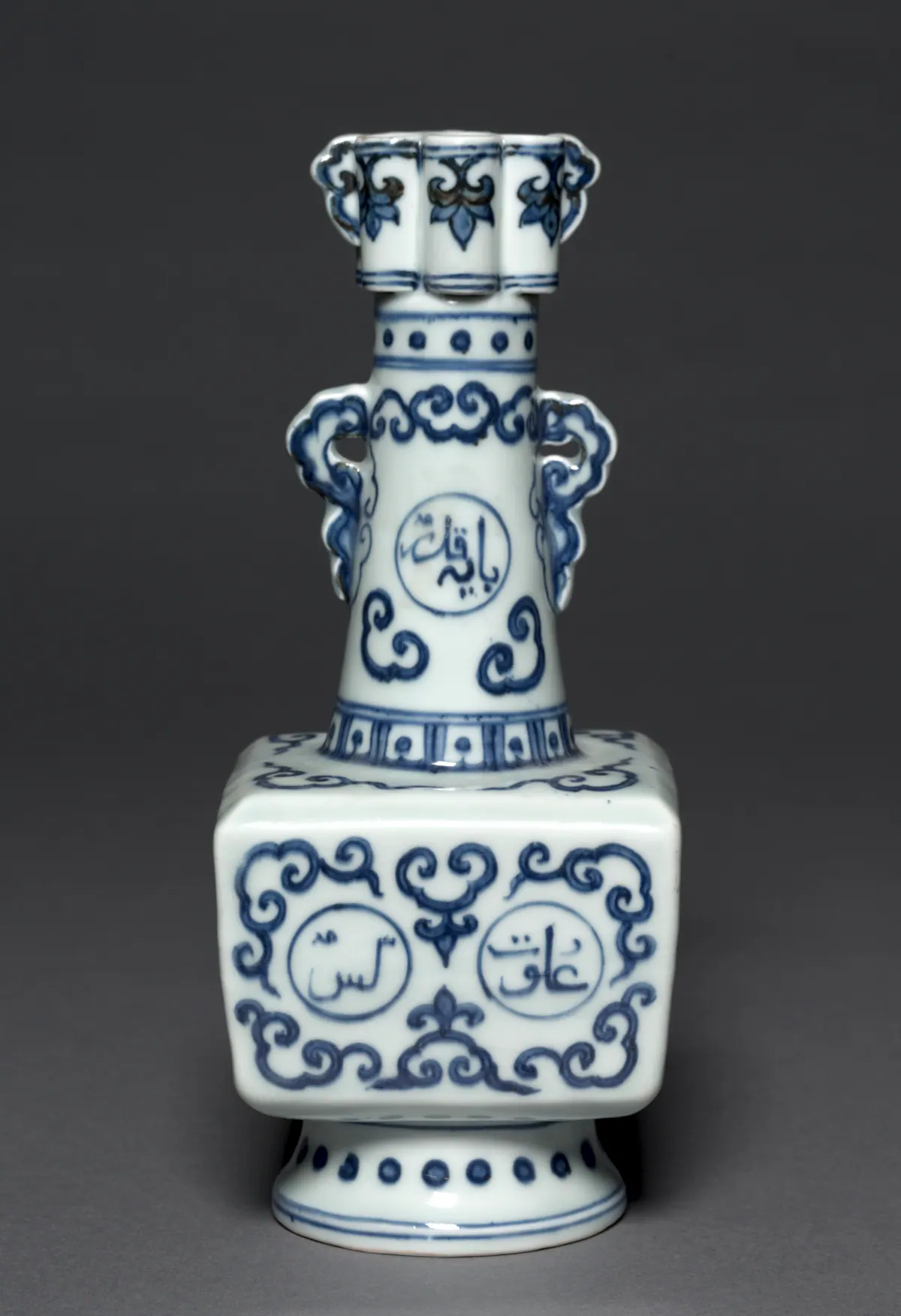
A Zhengde blue and white arrow vase with a square body, tall tapering neck and lobed mouth, painted with Persian script in roundels among scrolling motifs, with two handles on the neck.
Museum exampleAn arrow vase painted with Persian inscriptions in roundels, with the Zhengde mark and dated by the museum to the reign (1506–21).Cleveland Museum of Art, 1964.170. Public domain (CC0).

The best-known group from the reign is blue and white decorated with inscriptions in Arabic or Persian, usually set in panels or roundels. These are mostly objects for the writing table, such as brush rests, pen boxes, table screens and covered boxes, along with candlesticks and incense burners. They are thought to have been made for Muslim eunuchs and officials at court, and they are highly sought after. For the wider setting, see our page on the later middle Ming dynasty.

From the Ming Dynasty

View all Ming Dynasty PorcelainAsk about a piece

Be the first to see new pieces

Join our collectors' list for new arrivals, rare finds and private offers.