618–907
Tang Dynasty Art and Inventions
The Tang dynasty (618–907) produced some of China's greatest poetry, painting and metalwork, and scholars and craftsmen whose inventions, woodblock printing above all, outlasted the dynasty. For collectors of Chinese porcelain its ceramics matter most: in Tang kilns the white wares, celadons and painting under the glaze of later centuries first took shape. This page looks at Tang dynasty art and inventions with particular weight on the ceramics; the history of the dynasty itself is told on our Tang dynasty page.
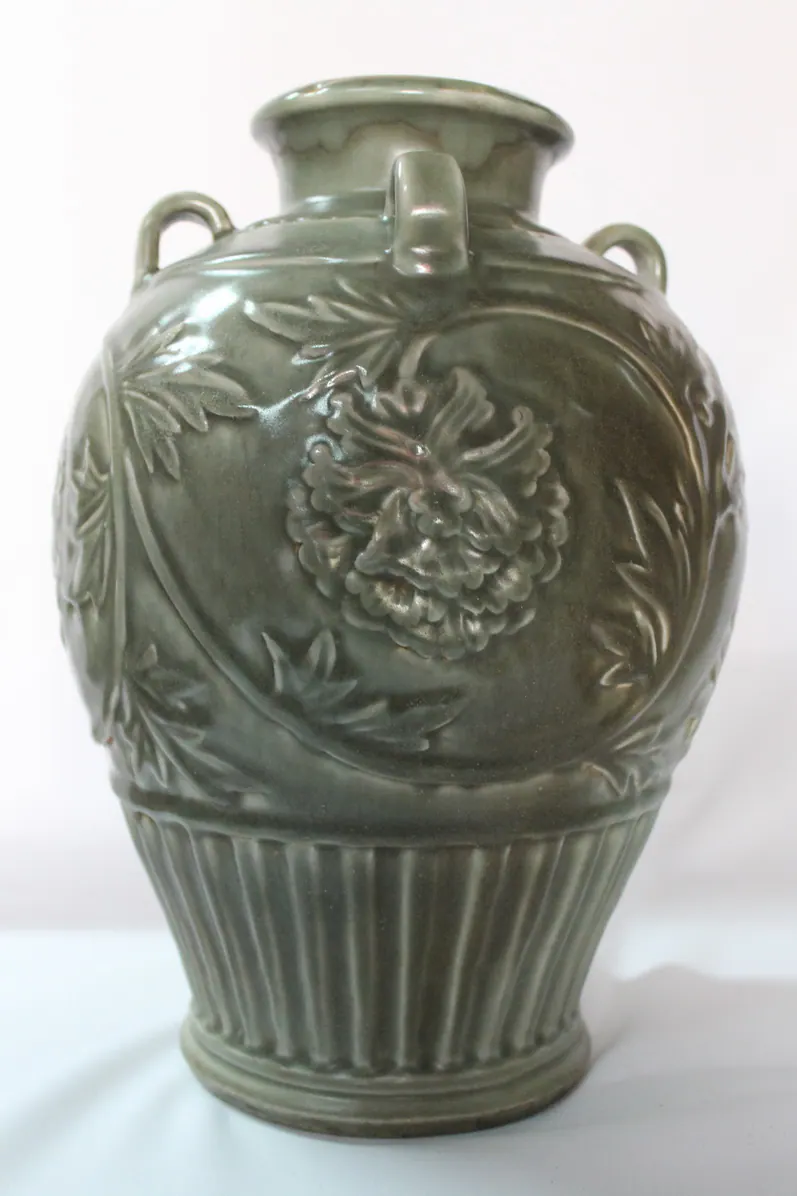
The celadon vase pictured, from our collection, is later than the Tang: it is catalogued as late Song to early Yuan, and its carved decoration and green glaze descend from the celadon tradition of the Tang kilns described below.
- Dates
- 618–907
- Capitals
- Chang'an, with Luoyang as a second capital
- Key wares
- Sancai, Xing white ware, Yue celadon, Changsha painted ware
- Arts
- Poetry, painting, calligraphy, gold and silver
- Inventions
- Woodblock printing; an escapement-driven celestial globe (725)
A cosmopolitan age, and what survives of it
The art of the Tang grew out of wealth and contact with the wider world. Chang'an and Luoyang drew merchants, monks and envoys from across Asia, and goods arrived overland along the Silk Road and by sea through Guangzhou and Yangzhou. Persian silver, glass from western Asia, and the music and dress of Central Asia all found eager buyers, and Tang craftsmen absorbed what they saw into styles of their own.
Much of what the Tang made has not survived. Few paintings on silk or paper can be firmly given to the period, and many famous compositions are known only from later copies. Our picture of Tang art comes instead from tombs, from Buddhist cave temples such as Dunhuang and Longmen, and from the Shōsōin at Nara in Japan, where objects given to the temple of Tōdai-ji in 756 are still kept, many of them made in China.
Ceramics are the exception: they survive in great numbers, from tombs, kiln sites and shipwrecks.
Tang dynasty art: poetry, painting and calligraphy
The eighth century, above all the reign of Emperor Xuanzong (712–756), set standards that later Chinese artists looked back to for a thousand years. Li Bai and Du Fu are still counted the greatest of Chinese poets: Li Bai for his free, exuberant verse, Du Fu for poems that record both the splendour of the court and the suffering brought by war. Their lives became subjects in their own right, and Ming and Qing porcelain painters often chose scenes such as Li Bai drunk beside a wine jar.
Wang Wei was both poet and painter, and later critics made him the founder of monochrome ink landscape. Wu Daozi, the leading painter at Xuanzong's court, was famed for the force and speed of his brushwork in Buddhist murals, none of which survives.
Calligraphy reached a classic form. Ouyang Xun, Yu Shinan and Chu Suiliang refined regular script in the seventh century, and in the eighth Yan Zhenqing gave it the broad, muscular structure that students still copy. Zhang Xu and the monk Huaisu took cursive script to its wildest. Music flourished too: Xuanzong founded the Pear Garden to train court musicians and performers, and Chinese actors were long afterwards called “disciples of the Pear Garden”.
Gold, silver and forms from the west
Tang gold and silver are among the finest metalwork made in China. Smiths hammered and chased vessels from thin sheet, gilded parts of the design and filled the ground with tiny punched rings, a technique learned from Sogdian and Persian work. Lobed cups, stem cups, ewers and dishes followed western shapes, decorated with scrolling vines, birds, animals and hunting scenes.
Two finds show the range. A hoard found in 1970 at Hejiacun, in the southern suburbs of Xi'an, held gold and silver vessels together with jade, gems, mineral medicines and coins from as far away as Persia and Japan. The crypt of the Famen Temple, west of Xi'an, sealed in 874 and opened in 1987, contained gilt silver utensils for preparing tea, glass from the Islamic world and a group of fine Yue celadons.
Potters followed the metalworkers closely. Ewers with the mouth formed as a phoenix head, lobed cups and stem cups were made in sancai and in white ware, often with the sharp edges and applied ornament of the silver they imitated. The habit of borrowing shapes from metal, and later from bronze and jade, runs through the whole history of Chinese porcelain.
Sancai: three-colour ware for the tomb
Sancai, “three colours”, is the Tang ware most people know. It is earthenware, not porcelain: a white or buff body fired first without glaze, then coated with lead glazes and fired again at a lower temperature. Iron gave amber and brown, copper gave green, and a clear glaze over the pale body read as cream. Blue, from imported cobalt, was used more sparingly and is especially prized. The glazes were allowed to run and mingle in the kiln, and potters guided them with incised lines, resist spots and moulded relief.
Most sancai was made for burial between the late seventh century and the middle of the eighth, chiefly at kilns at Gongxian in Henan and Huangbao in Shaanxi, for the tombs around Chang'an and Luoyang. Official regulations set the number and size of tomb figures according to the rank of the dead. The repertoire is familiar: armoured guardian kings and fierce earth spirits to protect the tomb, horses and camels with their foreign grooms, court ladies, musicians, and jars, ewers and dishes for the afterlife.
Production fell away after the An Lushan rebellion of 755 and the turmoil that followed. The technique lived on: lead-glazed three-colour wares were made under the Liao and the Song, and Ming and Qing potters applied low-fired coloured glazes to porcelain, some of which they also called sancai.
Railway building in Henan in the early twentieth century opened many Tang tombs, and sancai reached Western collections in quantity for the first time. Copies followed almost at once and have been made ever since, some of them very good, so the history of a piece matters as much as its appearance.
White in the north, green in the south: Xing and Yue
The high-fired wares of the Tang are the direct ancestors of later Chinese porcelain. Chinese ceramic historians sum up the period in a phrase, “green in the south, white in the north”, and the two great names behind it are Xing and Yue.
The Xing kilns, at Neiqiu and Lincheng in Hebei, made white ware with a fine white body under a clear glaze. The best of it is hard, thinly potted and, where thin enough, translucent: by any modern definition it is porcelain. Bowls with a rolled rim, cups, ewers and jars are typical, and some of the finest pieces have the character ying incised under the base, generally linked to the Daying storehouse of the imperial palace. White wares were also made at Gongxian in Henan and at Quyang in Hebei, the later home of Ding ware.
The Yue kilns of northern Zhejiang, around Shanglin Lake near Cixi, worked in a celadon tradition that went back to the Han. Their glaze is olive to grey-green, thin and smooth over a grey stoneware body, and bowls, ewers, boxes and jars were often fired on small spurs that left marks on the base. In his Classic of Tea, written in the eighth century, Lu Yu compared Xing ware to silver and snow and Yue to jade and ice, and preferred Yue because it made the tea look green.
The finest Yue was known as mise, “secret colour”, a term that puzzled scholars for centuries. The Famen Temple crypt settled the question: its inventory, sealed in 874, lists mise wares, and the bowls and dishes found with it are Yue celadons of exceptional quality.
Changsha painted ware and the sea trade
In the ninth century the Tongguan kilns near Changsha, in Hunan, did something new. Their potters painted designs under the glaze in iron brown and copper green: birds, flowers, clouds and small landscapes, and sometimes a line of verse or a proverb written with the brush. Ewers carried moulded reliefs of figures, lions or date palms under patches of brown glaze. The glaze is usually straw yellow or pale green over a greyish buff body.
Changsha ware was made in vast quantities for export, and pieces have been found across South-East Asia, in South Asia, around the Persian Gulf and in East Africa. The clearest picture comes from the Belitung shipwreck, an Arab-type sewn-plank ship that sank off Indonesia in the ninth century and was found in 1998. It carried some 60,000 objects, most of them Changsha bowls, one inscribed with a date equivalent to 826. Alongside them were northern white wares, Yue celadons and three small dishes painted in cobalt blue on a white ground, made at Gongxian: among the earliest Chinese blue and white known.
In Iraq, potters copied the Chinese white wares in tin-glazed earthenware and painted their copies in cobalt blue, the start of a long exchange between Chinese and Islamic ceramics that led, under the Yuan, to Jingdezhen blue and white painted with imported cobalt.
From Tang ceramics to Song porcelain and beyond
Almost every strand of later Chinese porcelain can be traced to Tang kilns. The northern white tradition passed to the Ding kilns at Quyang, which made the leading white ware of the Song and are counted among the five great kilns. The Yue tradition passed to Longquan, in the south-west of the same province, where Song potters developed the thick, jade-like glaze described in our guide to Longquan celadon.
Painting under the glaze, which Changsha had made commonplace, reappears in the north on Song Cizhou stoneware, and the Gongxian experiments with cobalt anticipate the blue and white that Jingdezhen perfected some five centuries later, a story told in our history of Chinese blue and white porcelain.
Our guide to Song dynasty ceramics follows these wares into their classic age. Tang ceramics fall outside what we offer, but the inheritance is plain in Song pieces such as a celadon vase in our collection, catalogued as late Song to early Yuan, with its decoration carved into the body under the glaze. More can be seen in our Song dynasty porcelain collection.
Tang dynasty inventions: printing, timekeeping, money and medicine
Woodblock printing developed during the Tang, first for Buddhist charms and texts. A copy of the Diamond Sutra found at Dunhuang and dated 868 is the earliest dated printed book to survive.
In 725 the Buddhist monk and astronomer Yi Xing, working with the engineer Liang Lingzan, built a water-driven celestial globe regulated by an early form of escapement, which also struck a bell and a drum to mark the time.
Merchants trading tea and salt could deposit cash in the capital and collect it in the provinces against a certificate known as “flying money”, a forerunner of the paper currency of the Song. Daoist alchemists of the ninth century warned that certain mixtures containing saltpetre and sulphur could flare up and burn the hands and face, the earliest written hint of gunpowder, although its use in war belongs to later centuries.
In 659 the government issued the Newly Revised Materia Medica, the first pharmacopoeia compiled by order of the state in China. Tang medical writers recorded the sweet urine of patients with diabetes, and treated goitre with preparations of thyroid gland from sheep and pigs.