The Reign of the Tianqi Emperor
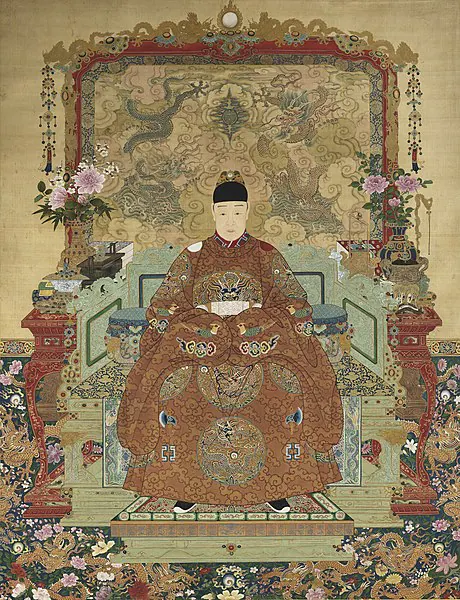
Zhu Youjiao was born in 1605, the eldest son of the future Taichang Emperor and grandson of the Wanli Emperor. Wanli had neglected the education of his son and grandson, and when both Wanli and Taichang died within weeks of each other in 1620, the fourteen-year-old prince came to the throne with little preparation for government.
The new emperor is said to have had little interest in formal study or in state affairs. He preferred to work with his hands, making furniture, models and lacquered pieces, and he was reputed to be a skilled carpenter and builder.
Wei Zhongxian and Madam Ke
Real power passed to two people: Madam Ke, the emperor's former wet nurse, to whom he remained deeply attached, and her associate Wei Zhongxian, a palace eunuch who had served in the household of the emperor's mother. With Madam Ke's support, Wei rose to high office in the Directorate of Ceremonial, the most powerful eunuch agency, and took charge of the Eastern Depot, the palace secret police.
Wei built up a network of informers and placed his followers in key posts. From 1626 officials across the empire competed to build shrines in his honour during his lifetime, an unprecedented distinction for a eunuch. Madam Ke dominated the inner palace and is said to have had at least one of the emperor's consorts starved to death.
The Persecution of the Donglin Officials
The Donglin faction, a group of officials and scholars who took their name from the Donglin Academy in Wuxi, stood for Confucian principle in government and opposed Wei's rule. In 1624 the censor Yang Lian presented a memorial accusing Wei of twenty-four crimes. Wei struck back. In 1625 and 1626 many of the Donglin leaders, including Yang Lian and Zuo Guangdou, were arrested and died under torture in prison, and the academy was destroyed.
War and Rebellion
In the north-east, the Jurchen leader Nurhaci, who had founded the Later Jin state in 1616, took Shenyang and Liaoyang in 1621 and much of Liaodong soon after. The Ming commander Yuan Chonghuan halted his advance at Ningyuan in 1626, the first serious check Nurhaci had suffered, and Nurhaci died later that year. His successor, Hong Taiji, would found the Qing dynasty.
In the south-west, the She-An rebellion of the Yi chieftains She Chongming and An Bangyan tied down Ming armies for years, and in Shandong a White Lotus rising broke out in 1622. On the coast, the Dutch occupied the Penghu Islands in 1622 and in 1624 moved to Taiwan, where they established a colony. The treasury, drained by Wanli's wars and the cost of defending the north-east, could not meet these demands.
The Wanggongchang Explosion
On 30 May 1626 the Wanggongchang armoury in Beijing, a gunpowder works, blew up. The explosion devastated a large area of the western city, and contemporary reports put the dead at around 20,000. The cause has never been established.
Many saw the disaster as a sign of heaven's displeasure with the emperor's rule. His only surviving son, an infant, is reported to have died after being badly frightened by the blast. The emperor issued an edict of self-reproach and released funds for relief.