Guide
Kraak Porcelain: The Late Ming Export Ware
Kraak porcelain is the blue and white that the private kilns of Jingdezhen made for export in the late Ming dynasty, from around the 1570s until the middle of the seventeenth century. Thinly potted, painted at speed and arranged in radiating panels, it was the first Chinese porcelain to reach Europe in large quantities. This guide explains the name, how to recognise kraak ware, how it changed over time, and how to tell it from later copies and Japanese versions.
What to look for
- A border of radiating panels, usually alternating wide and narrow, around a central scene.
- A thin body for the size, often with small frits along the rim where the glaze has flaked away.
- Kiln grit on the foot ring and radial chatter marks on the base from trimming.
- Quick, confident painting in outline and wash, in a blue that varies from bright violet to grey.
- No spur marks on the base: small scars from clay supports usually point to a Japanese dish.
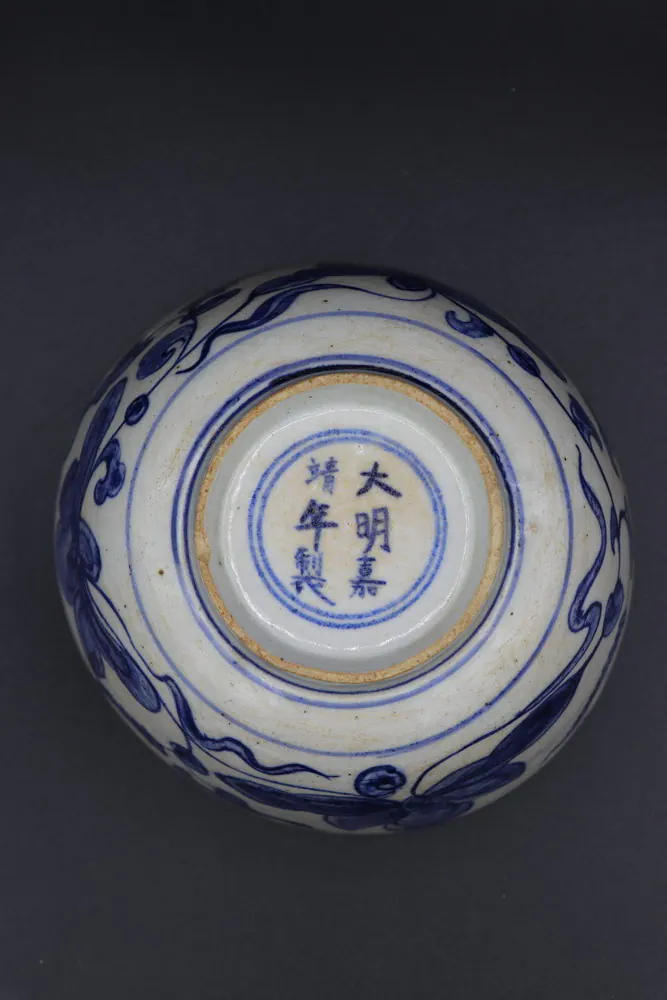
- No reign mark on most pieces, as befits a private kiln export ware.
Where the name comes from: Portuguese carracks and Dutch prizes
The Portuguese had been bringing Chinese porcelain to Lisbon since the early sixteenth century, but in small amounts. That changed in the first years of the seventeenth century. In 1602 the Dutch captured the Portuguese carrack San Tiago, and in 1603 the Santa Catarina, both carrying large cargoes of Chinese porcelain. The goods were sold in the Netherlands, and buyers from across Europe came to see them.
The Dutch called this porcelain kraakporselein, and the usual explanation is that the word comes from kraak, their name for the Portuguese carrack. Other derivations have been proposed, including one from a Dutch verb meaning to break, but the link with the carracks is the most widely accepted, which is why the ware is also called carrack porcelain in English. Chinese scholars today use a transliteration of the Dutch word.
The Dutch East India Company was founded in 1602, and within a few years it was buying porcelain in Asia directly. Kraak ware soon became something that prosperous households across northern Europe could own.
Kraak dish identification: panels, bracketed rims and thin bodies
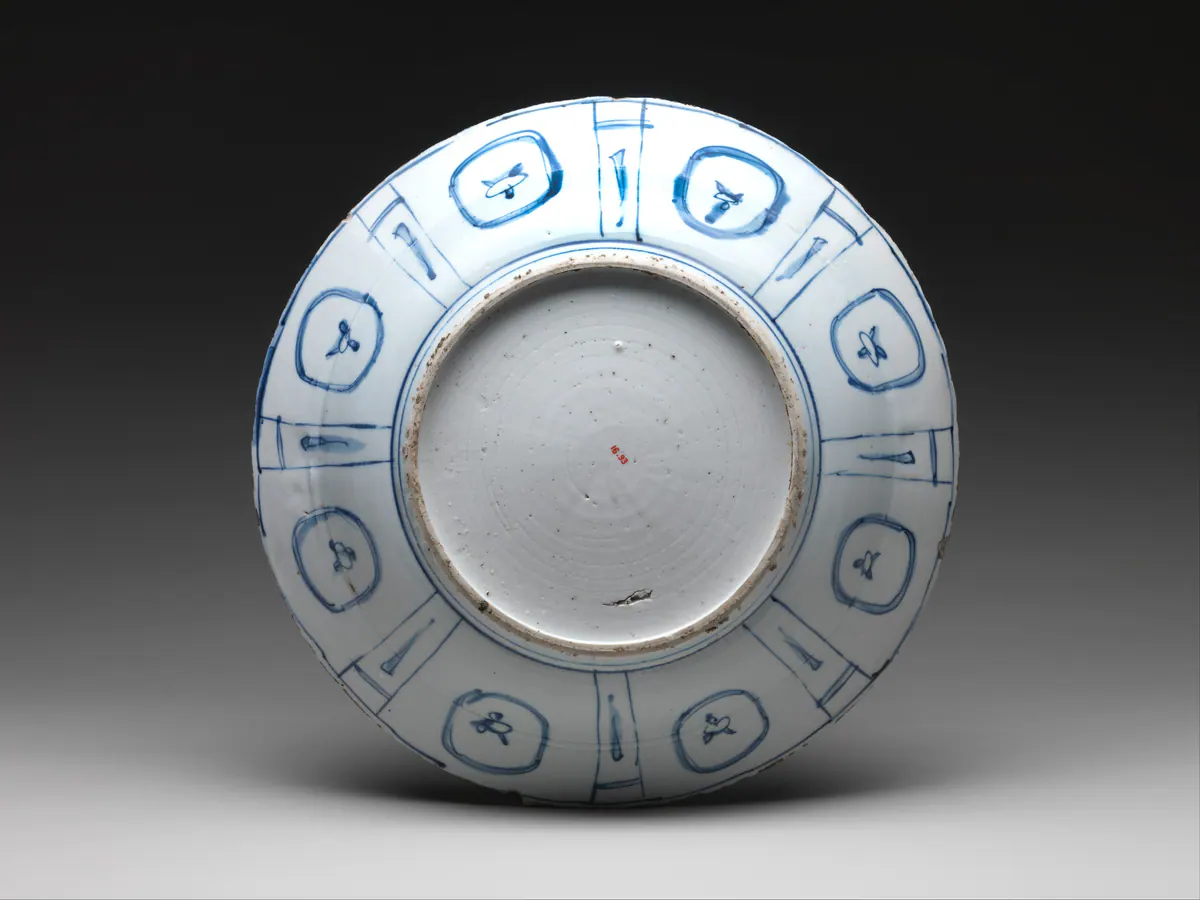
The most recognisable kraak pieces are dishes, from small saucers to large chargers. The border is divided into panels that radiate from the centre, usually alternating wide and narrow. The wide panels hold flower sprays, fruit or auspicious emblems; the narrow ones often hold hanging tassels, strings of beads or simple scrolls. In the centre, a medallion shows a scene such as birds on a rock, deer in a landscape, ducks on a pond, insects among plants or a vase of flowers on a terrace. On many dishes the rim is bracketed or lobed to follow the panels, and the panels may be moulded in the body.
The potting is thin, especially for the size of the dish. Because the glaze is thinnest at the edge, the rims of kraak pieces often show small frits where it has flaked away, a feature collectors expect rather than a sign of later damage. Bases usually show radial chatter marks left when the foot was trimmed, and kiln grit fused to the foot ring. The painting is done in outlines filled with washes of blue, quickly and with confidence. Turn a dish over and the underside usually carries a simpler, sketchier version of the border panels, painted in a few strokes. The glaze on both sides often has a faint bluish tint.
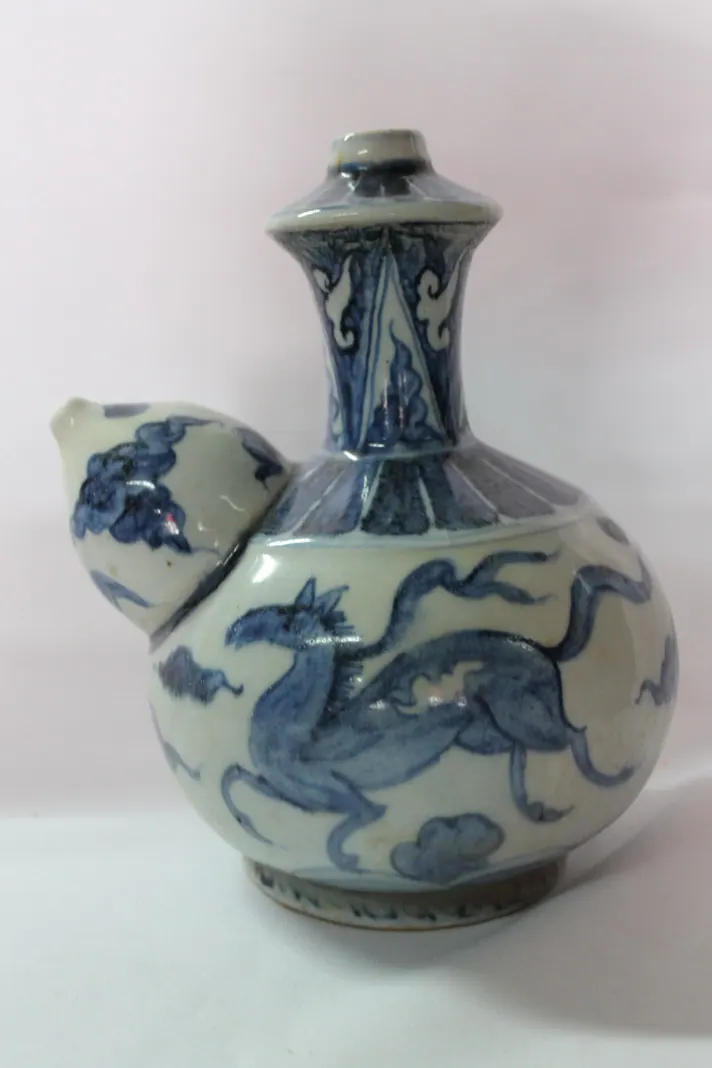
Kraak shapes go beyond dishes. There are deep bowls, bottles, ewers, small cups and the kendi, a pouring vessel made mainly for Southeast Asia. A shape made largely for the Dutch market is the klapmuts, a bowl with a broad, flattened rim named after a Dutch woollen cap. The broad rim is often said to have given European diners somewhere to rest a spoon.
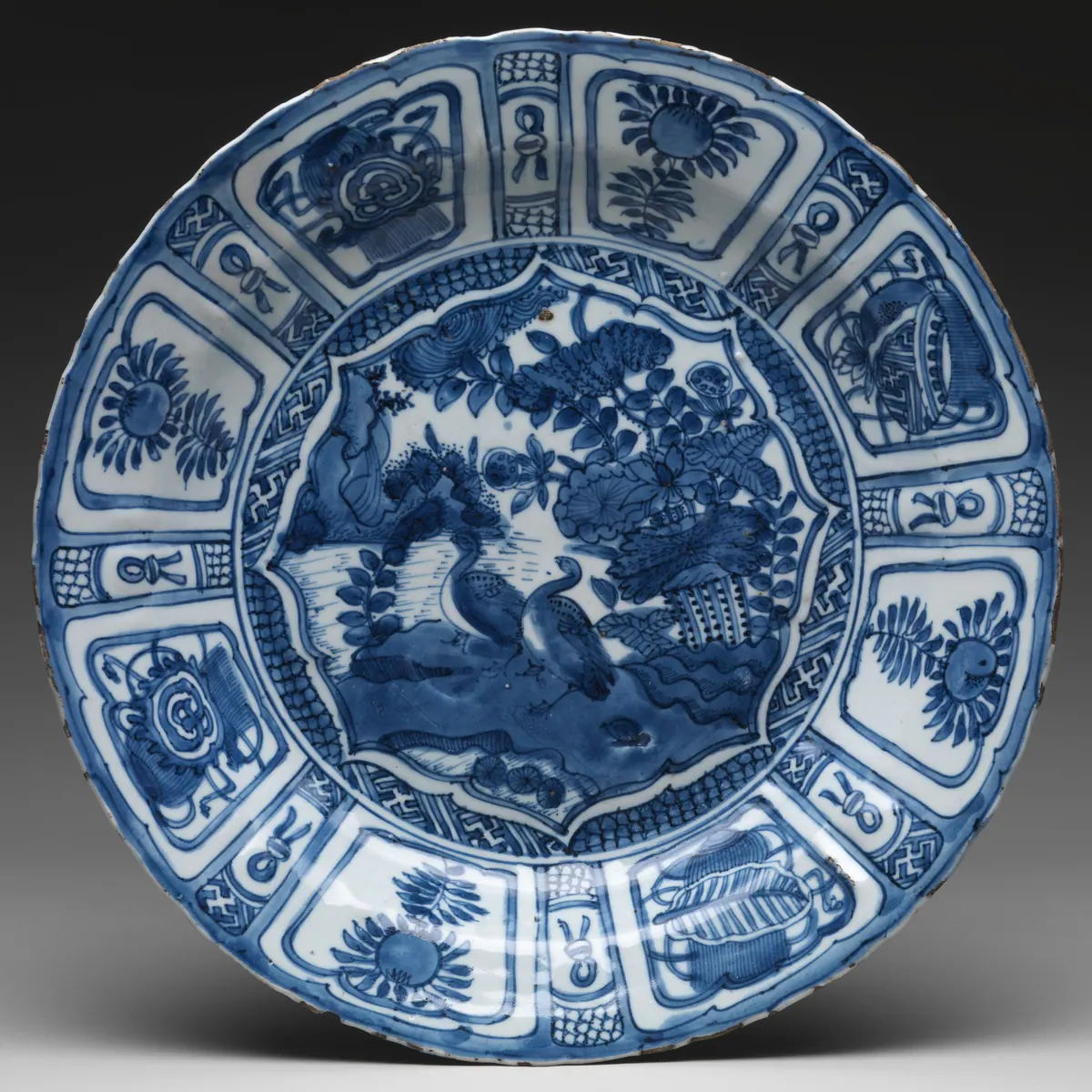
- Central medallion geese by a lotus pond, inside a lobed frame
- Diaper and fret band scale diaper broken by panels of fret, ringing the medallion
- Wide panel a flower and a leafy spray in a frame with indented corners
- Narrow panel a tassel tied with ribbon, with diaper at each end
Wanli, Tianqi and Chongzhen: how kraak changed
Kraak belongs above all to the reign of the Wanli Emperor (1572–1620), when trade through Macau, Manila and the southern Chinese ports brought Jingdezhen more foreign buyers than ever before. The best Wanli pieces are carefully potted and painted, with a bright blue and a clear, orderly arrangement of panels. Specialist studies have grouped kraak borders into types and dated them against shipwreck cargoes, which allows many dishes to be placed within a few decades.
Production continued under Tianqi (1621–1627) and Chongzhen (1628–1644), but the ware grew more uneven. Much later kraak is thinner in the glaze, more hastily drawn and greyer in tone, while at the same time Jingdezhen was developing the freer, more pictorial style now called Transitional porcelain. Some late pieces show the two side by side, with a panelled border around a centre painted in the new manner.
The fall of the Ming in 1644 and the long struggle that followed disrupted the kilns and the coastal trade. When the Qing ordered the evacuation of the south-eastern coast in 1661, exports from China were cut still further, and by then the Dutch had already turned to Japan for porcelain in the kraak style.
Kraak in Southeast Asia, the Middle East and Europe
Europe was only one market. In Southeast Asia, kraak dishes and kendi were used at feasts and in ceremonies, and in parts of Indonesia and the Philippines they were kept as heirlooms for generations. In Japan, where the panelled style is known as fuyōde, kraak ware was imported and later copied.
In the Middle East, large kraak dishes suited communal meals. Safavid Iran was an important buyer: the collection that Shah Abbas I gave to the Ardebil Shrine early in the seventeenth century includes kraak pieces, and Persian potters imitated the style on their own soft fritware body.
In Europe, kraak dishes appear on the tables of Dutch still-life paintings of the early seventeenth century, often beside fruit, glass and silver, a sign of how quickly they became part of the furnishing of a well-off household. Potters at Delft and elsewhere copied the panelled borders in tin-glazed earthenware for buyers who could not afford the real thing.
Kraak also crossed the Pacific. From the 1570s the Manila galleons carried Chinese porcelain to Mexico, and fragments of kraak dishes have been found at Spanish colonial sites in the Americas, some of the clearest evidence of how far a single Jingdezhen export ware could travel.
Shipwreck cargoes and what they taught us
Much of what is known about kraak comes from wrecks that sank at known dates. The San Diego, a Spanish ship lost off Manila in 1600, and the Witte Leeuw, a Dutch East India Company ship that sank at St Helena in 1613, both carried kraak porcelain. A further large cargo, known as the Wanli wreck, was recovered off the east coast of Malaysia and is usually dated to around the 1620s.
Cargoes like these show which shapes and patterns were in production at a given moment, which is how the border types came to be dated. They also show that a single consignment could contain fine and coarse pieces side by side, so quality alone does not date a kraak dish. And they explain the condition of many pieces on the market: porcelain that has spent centuries under the sea often has a dulled or stained glaze, eroded blue and traces of marine growth, quite different from a dish that has hung on a wall in Europe since the seventeenth century.
Telling kraak from later copies and from Japanese versions
When Chinese supply broke down, the Dutch ordered porcelain from Arita in Japan, and from the late 1650s Japanese potters made dishes in the kraak manner. These are usually thicker, with a glaze that can look bluish or grey and a blue that is more even and often darker. The drawing tends to be careful rather than quick. The surest sign is on the base: large Japanese dishes were often fired on small clay spurs, which leave round scars inside the foot ring. Our guide to telling Chinese, Japanese and Vietnamese blue and white apart covers these tests in more detail.
Kilns around Zhangzhou in southern Fujian made panelled blue and white in a similar spirit at the same time. These pieces are Chinese and of the period, but they are heavier than Jingdezhen kraak, with a thicker glaze and a good deal of sand stuck to the base. Persian and Delft imitations are easier: neither is porcelain, and an unglazed edge or chip shows a soft body.
Later Chinese copies, from the nineteenth century to the present, need more care. Warning signs include a body that is heavy for its size, a glassy, bubbly glaze or one dulled all over by acid, a flat and uniform blue, stiff or hesitant drawing, and grit or staining on the foot that looks applied rather than fired on. As with all Chinese blue and white, a piece is right only when its body, glaze, painting, shape and base all tell the same story.