Guide
Rust Spots
"Rust spots" are the dark iron spots that appear in the cobalt blue of early Chinese blue and white porcelain, and the small brown specks of iron found in the body and glaze of many older wares. Both form in the kiln, and both are among the features collectors examine most closely. This guide explains where they come from, how they look on genuine pieces and how imitations differ.
What to look for
- Check where the spots sit: genuine iron spots gather where the cobalt lay thickest, in dense shading and at the ends of brushstrokes.
- Tilt the piece to the light: early iron spots often have a metallic or silvery sheen and sink slightly into the glaze.
- Look at the colour: blackish-brown to black, shading into the blue around it rather than sitting on top.
- Be wary of evenly spaced dots laid along outlines, the method of 18th-century imitations and later copies.
- Compare the spotting with the style and mark: heavy iron spots belong with Yuan and early 15th-century painting.
- Remember that brown specks on the base or interior come from iron in the clay; they form in firing and do not grow with age.
What rust spots are
Iron is present in almost every Chinese clay and in most cobalt ores. In the heat of the kiln, where it is concentrated, it can come out of solution and form dark crystals in or just beneath the glaze. Collectors call the result rust spots or iron spots.
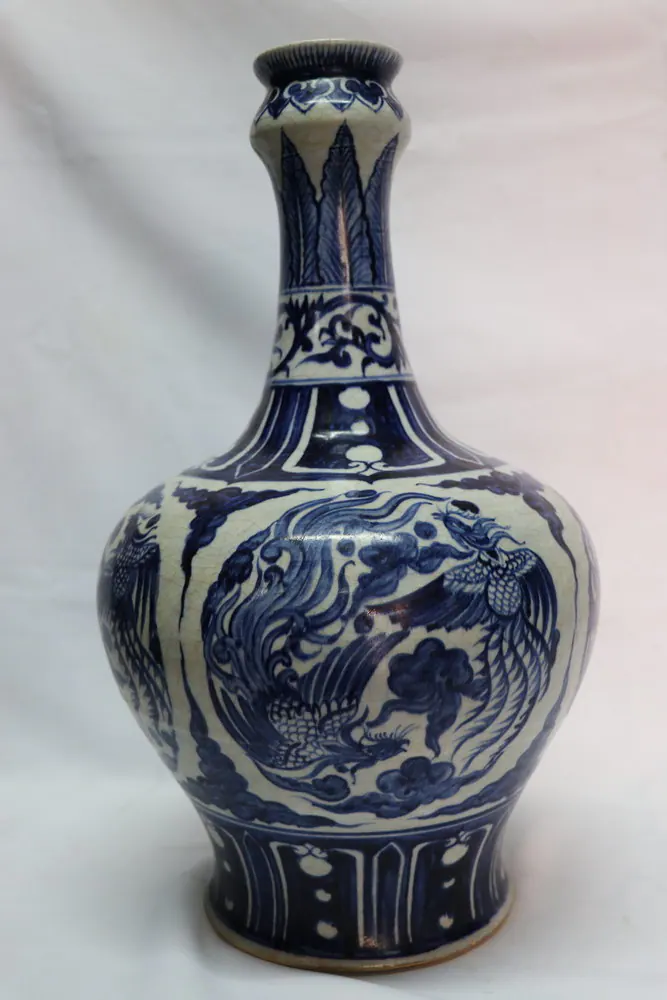
Two kinds matter to the collector. The first appears in the painted blue itself: dark, almost black spots in the cobalt of 14th and early 15th-century blue and white, often described as "heaping and piling". The second is a scatter of small brown or black specks in the body or the clear glaze, caused by iron impurities in the clay. They form in the same way but tell different stories.
Neither kind grows or rises to the surface over the centuries. What you see was fixed when the piece left the kiln; age adds only wear and dirt.
Why early blue and white has them
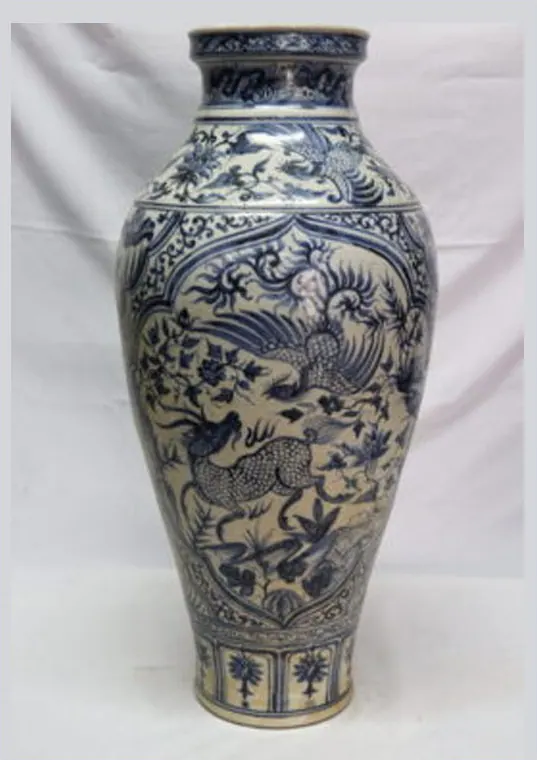
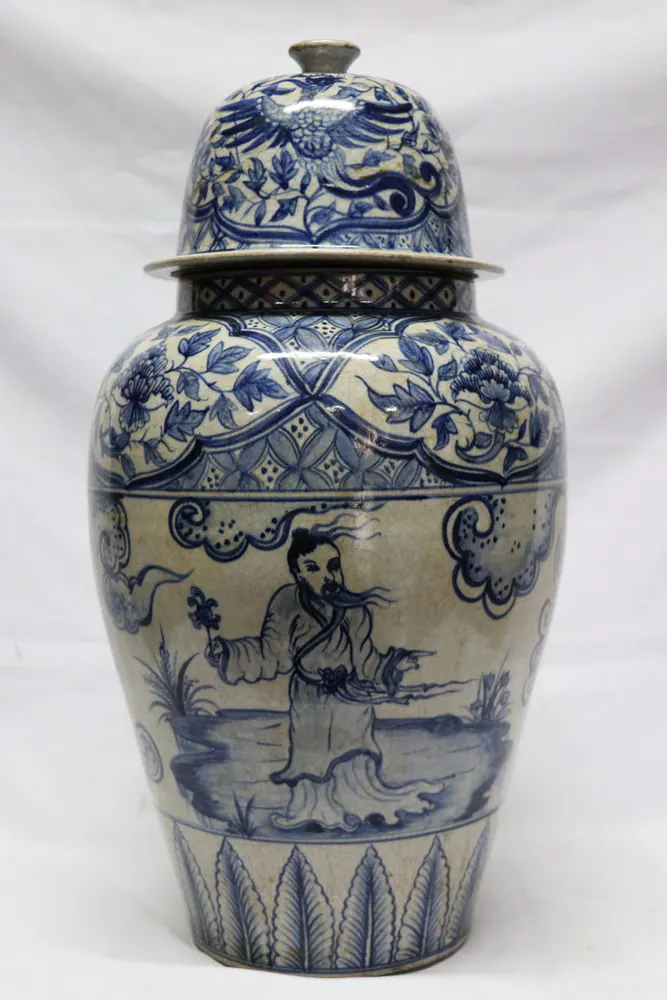
The blue and white porcelain of the Yuan dynasty and the early Ming was painted largely with cobalt imported from the Middle East, traditionally said to be from Persia. This cobalt was rich in iron and low in manganese. Where the painter loaded the brush heavily, the iron crystallised during firing into dark spots, sometimes with a silvery, metallic sheen, and the glaze above them often dipped into small hollows.
The effect is strongest on pieces of the Yuan and of the Yongle and Xuande reigns in the early 15th century, where the deep blue and the dark spotting within it are a defining feature of the style. From the middle of the 15th century Jingdezhen relied more on Chinese cobalt, which is lower in iron, and the blue became softer and more even, with little or no spotting.
Iron specks in the body and glaze
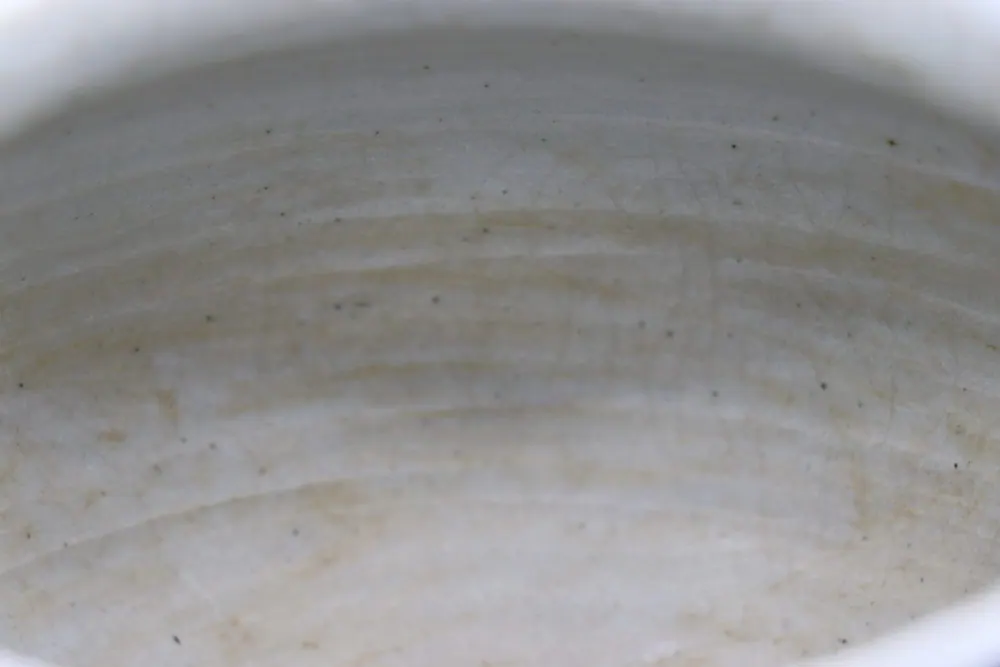
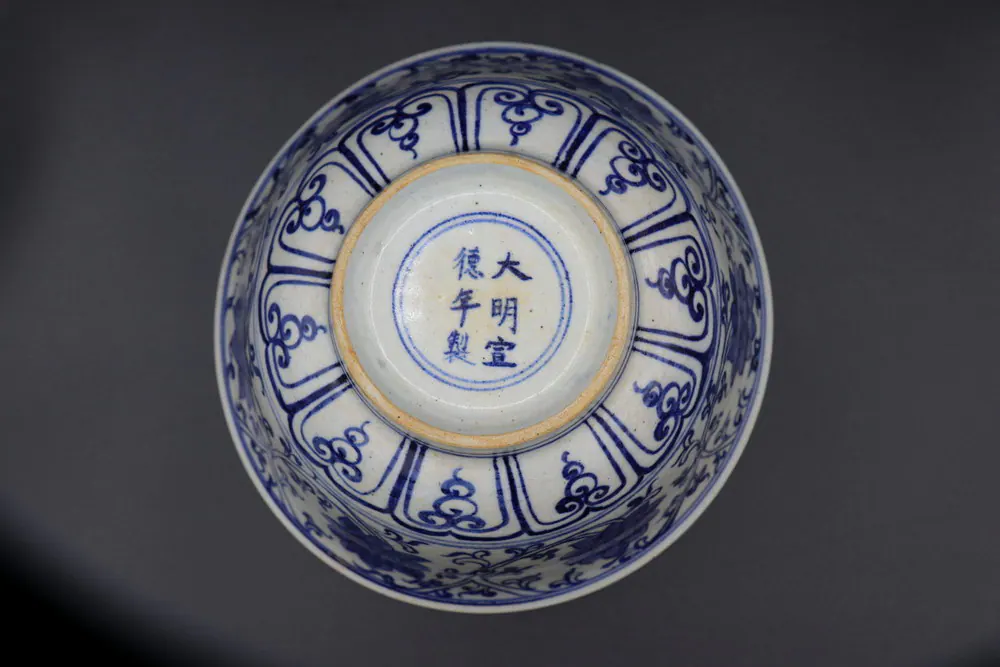
The second kind of rust spot has nothing to do with the painting. Small particles of iron in the clay or glaze fire to brown or black specks, most visible where the glaze is clear and thin: on the base, inside the foot, and on the plain interiors of jars and bowls. Provincial kilns, which refined their clay less carefully than the imperial factory, show them far more often.
Specks of this kind are normal on genuine Yuan and Ming wares and help build a picture of the kiln. They also appear on modern pieces made with unrefined clay, so they support an attribution but cannot prove one.
How imitations differ
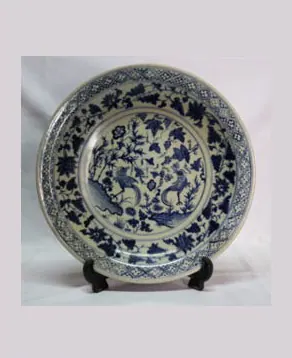
Later potters admired the early Ming style and copied it, iron spots included. Under the Yongzheng and Qianlong emperors in the 18th century, the imperial kilns made fine versions of Yongle and Xuande blue and white, many bearing the mark of their own reign. Their potters used a purer Chinese cobalt and imitated the heaping and piling by adding dots of darker pigment by hand. These dots tend to sit neatly along the outlines and at regular intervals, and they lack the crystalline sheen and sunken surface of the originals.
Modern copies go further, often with an early Ming mark. Their spots may be painted in a flat black that sits on the surface, spread evenly across the design with no relation to how heavily the blue was applied, or grouped in a way that looks planned. Spots that are all the same size and density are a warning sign.
How to examine a piece yourself
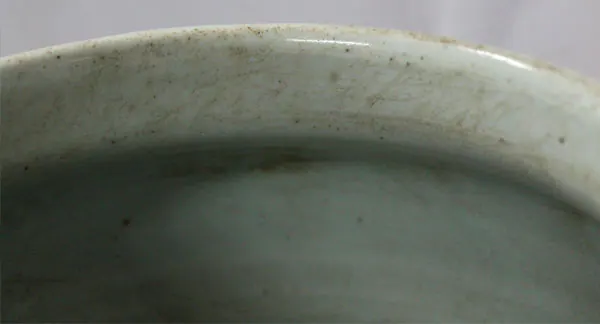
Look at the painted blue under a strong light and then tilt the piece slowly. Genuine early iron spots catch the light with a metallic glint and often lie in shallow dips in the glaze. With a 10x loupe you can see whether the dark colour grows out of the blue around it or sits on top as a separate dab.
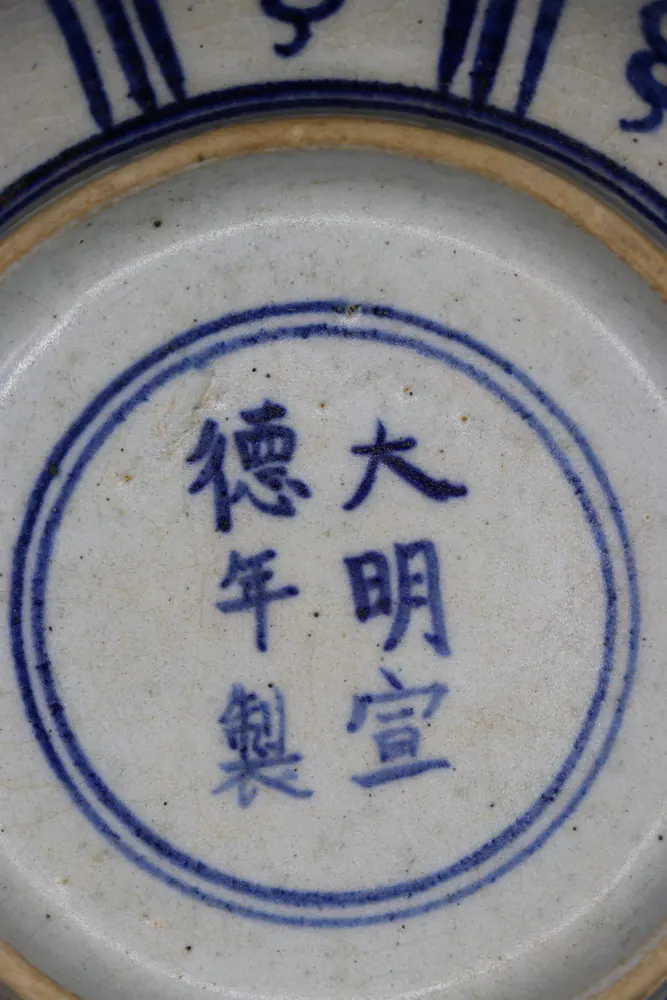
Follow the brushwork. On a genuine piece the darkest spots gather where the pigment pooled: the ends of strokes, the centres of flowers, dense areas of shading. Then turn to the base and interior and look at any iron specks and at the colour of the unglazed foot. The close-up of the base of the Xuande-marked bowl in our collection, at the top of this page, shows scattered specks of this kind around the mark.
Rust spots are one piece of evidence among several. Read them together with glaze contractions, crackle and wear before reaching a view.