Guide
Longquan Celadon: A Collector's Guide to China's Green Ware
Longquan celadon is the green-glazed ware of south-western Zhejiang, made for more than five centuries and shipped from Japan to East Africa. This guide explains how the green is made, how Southern Song, Yuan and Ming Longquan differ, what the base can tell you, and how later copies give themselves away.
What to look for
- Look into the glaze: fine Southern Song Longquan is thick, semi-opaque and full of tiny bubbles, not thin and glassy.
- Check the edges and ridges, where the glaze should thin gradually and turn paler over the body.
- Turn it over: exposed body usually fires orange to reddish brown, while a chip shows pale grey clay inside.
- Match weight and potting to the period: Southern Song pieces are finely potted, Yuan and Ming ones heavier.
- Look for wear where use would put it, on the foot rim, the mouth and the high points of any decoration.
- Treat crackle and staining with caution; both are easy to add to a new piece.
What celadon is: iron, reduction and the green
Celadon is a European name for Chinese green-glazed wares and for the Korean, Thai and other wares that followed them. It is usually traced to Céladon, a shepherd dressed in pale green in a seventeenth-century French romance. In Chinese these are qingci, green or blue-green wares, and Chinese celadon has a history reaching back well before the Song.
The colour comes from iron. A glaze with a small amount of iron oxide, typically one to three per cent, turns green or blue-green when fired in reduction, that is, in a kiln starved of oxygen, which keeps the iron in its ferrous form. Fire the same glaze with too much oxygen and it comes out yellowish, olive or brown.
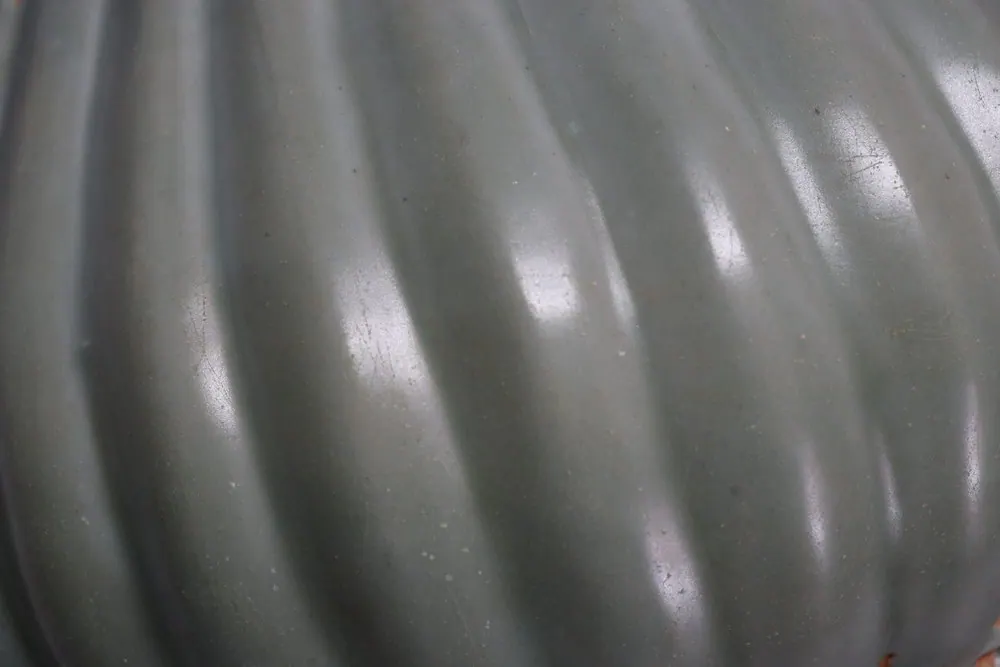
The exact shade depends on the glaze's thickness and make-up, the body beneath it and the course of the firing. Titanium in the materials pushes the tone towards olive, as in the northern celadons of Yaozhou; purer materials and a strong reduction give the cool blue-green prized at Longquan. Southern Song Longquan potters also changed their glaze recipe, using more potash and less lime, which gave a viscous celadon glaze that could be built up thickly without running. Fired so that it did not melt completely, the glaze kept countless tiny bubbles and undissolved particles that scatter light and give the soft, jade-like depth of the best pieces.
The Longquan kilns and their rise under the Southern Song
Longquan lies in the hills of south-western Zhejiang, where there was wood for fuel, good clay and rivers leading to the coast. Potters there worked in the tradition of the Yue celadons of northern Zhejiang, and by the Northern Song they were producing green wares in quantity, many with carved or combed decoration under a thin, glassy glaze.
The move of the Song court to Hangzhou in the twelfth century transformed the kilns. With the capital close by, a wealthy new market and, it is generally thought, the example of the official Guan wares, Longquan potters refined both body and glaze. By the late twelfth and thirteenth centuries they were making some of the finest celadons in China. Hundreds of kiln sites have been recorded in the area, with the most important groups around Dayao and Jincun. Firing took place in long "dragon kilns" built up the hillsides, which could hold thousands of pieces at a time.
Two kinds of body were used. Most Longquan has a pale grey or whitish body. A smaller group has a thin, dark body under a crackled glaze, close in appearance to Guan ware, and it has fed the long debate about the origins of Ge ware, which our guide to the Five Great Kilns explains. For the wider setting, see our guide to Song dynasty porcelain and ceramics.
Colours: kinuta, tenryuji and what they signal
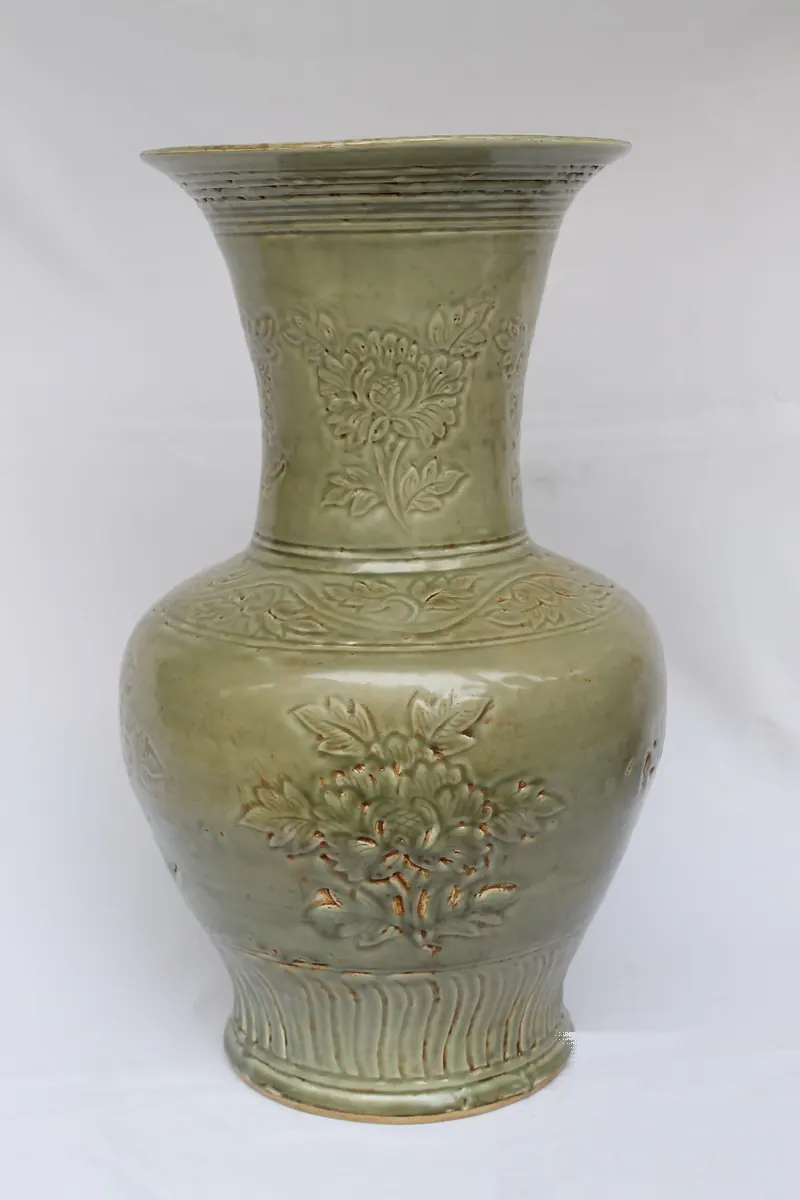
Chinese writers distinguish shades such as fenqing, a soft "powder blue-green", and meiziqing, "plum green", a deeper and brighter green. Japanese collectors, who have prized Longquan since the Song, gave the trade its best-known terms.
- Kinuta celadon is the bluish green of the finest Southern Song pieces. The word means "mallet" and comes from the mallet-shaped vase, a classic Longquan form.
- Tenryuji celadon is a more olive or yellowish green, associated with the Yuan and early Ming. The name comes from the Tenryu-ji temple in Kyoto.
- Shichikan celadon is a paler, more transparent green, often crackled, associated with later Ming wares.
These terms describe colour families, not dates. A Yuan kiln could produce a bluish glaze and a Southern Song firing could turn out olive, because the colour depended on where a piece stood in the kiln and how the firing went. Collectors use them as a first guide, then look to form, potting and the base.
Colour still matters to value. An even, well-developed blue-green is the most sought after, but a well-potted olive piece in good condition is a better thing to own than a fine colour on a clumsy or damaged pot.
Forms and carved, moulded and applied decoration
Southern Song Longquan depended on shape and glaze. Many forms were borrowed from ancient bronzes and jades: the tripod incense burner in the shape of the bronze li, the trumpet-mouthed gu vase, and the square-sectioned vase modelled on the Neolithic jade cong. Others were newer: mallet vases with phoenix or fish handles, bowls carved on the outside with overlapping lotus petals, and dishes with a pair of moulded fish in the well. Decoration, where there was any, was kept shallow so as not to break the surface of the glaze.
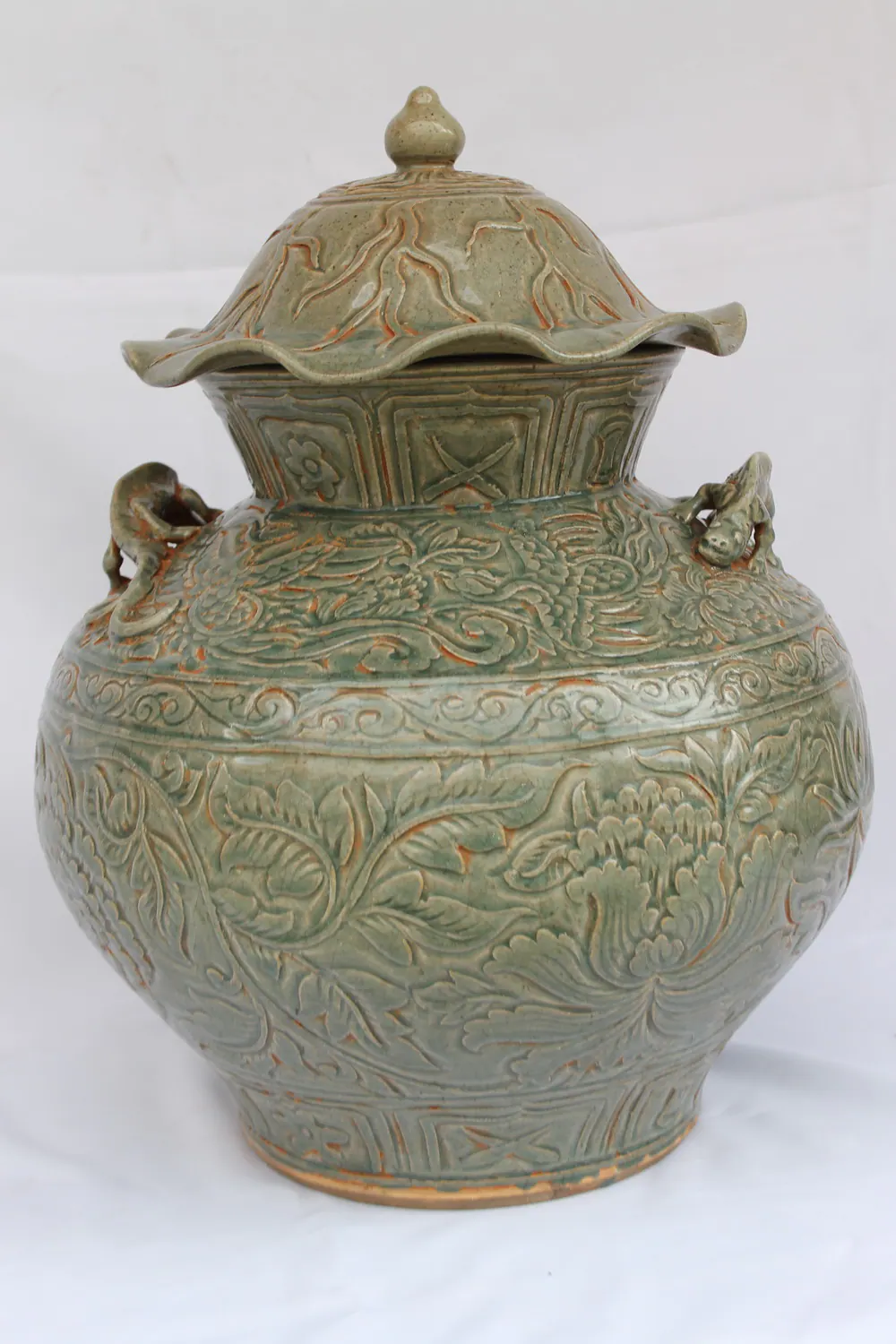
From the Yuan onwards decoration became bolder. Potters carved peony and lotus scrolls deeply into the body, pressed designs from moulds and applied separately moulded ornaments such as dragons, flowers, figures and fish. Some ornaments were left unglazed so that they fired a warm orange against the green, a technique known as biscuit reserve. Iron-brown spots were splashed on other pieces, which Japanese collectors call tobi seiji, "flying spot" celadon. Characteristic Yuan and Ming forms include large jars with covers shaped like lotus leaves, pear-shaped vases, stem cups and the massive dishes described below.
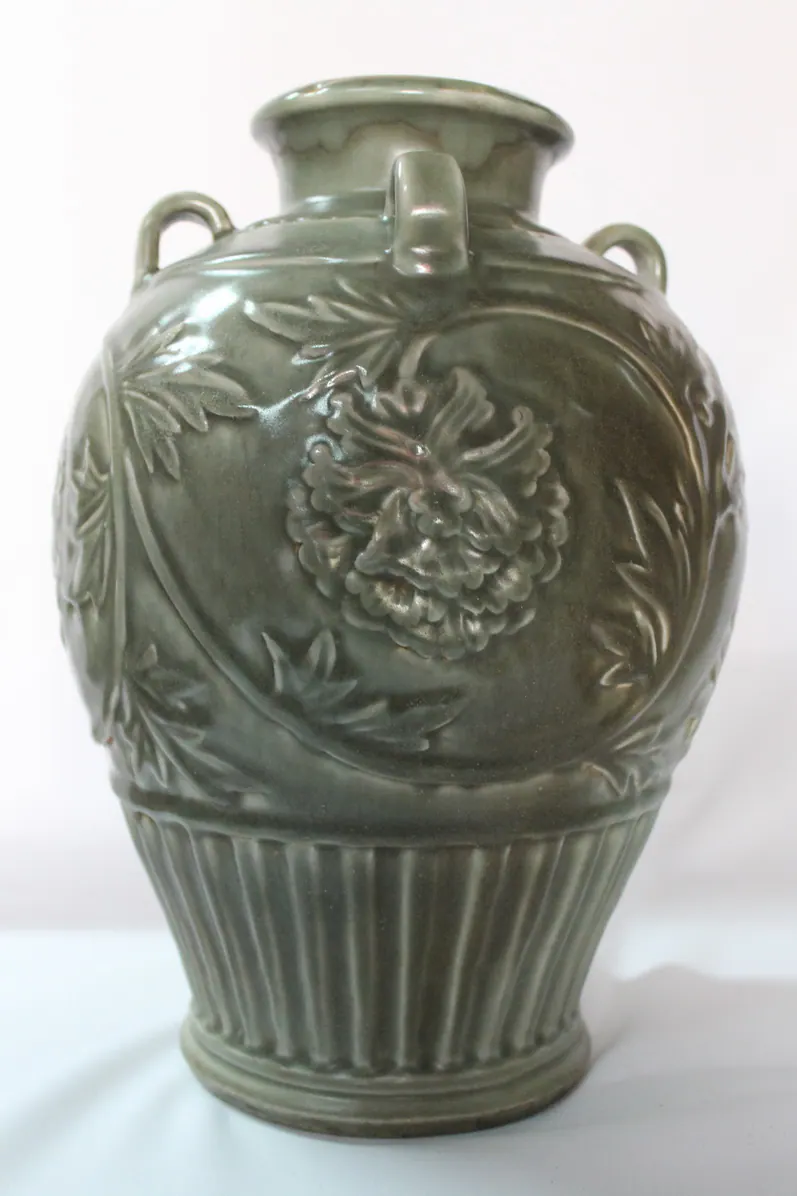
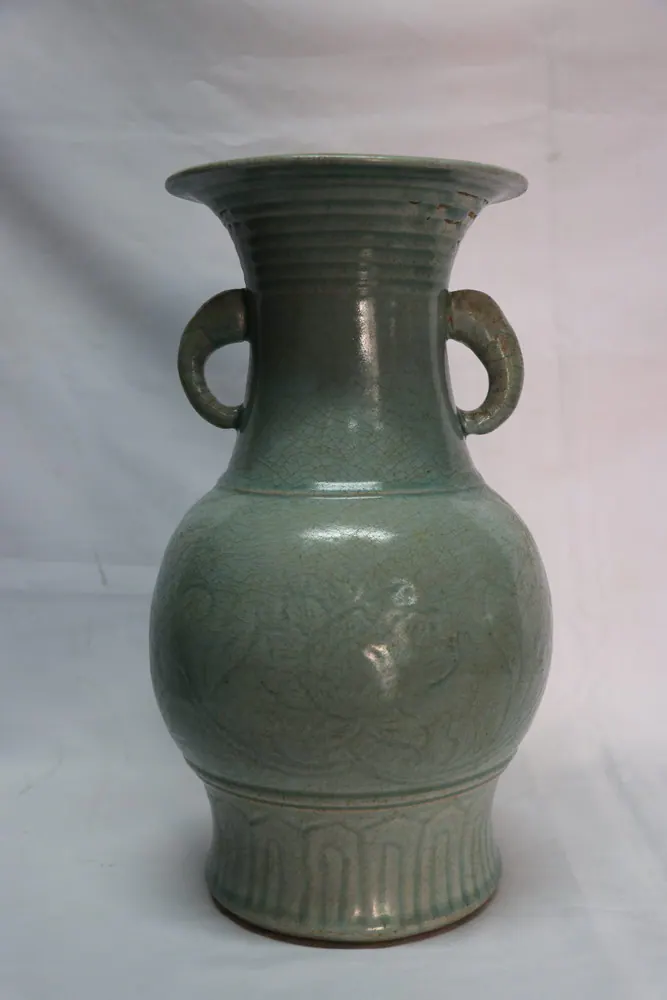
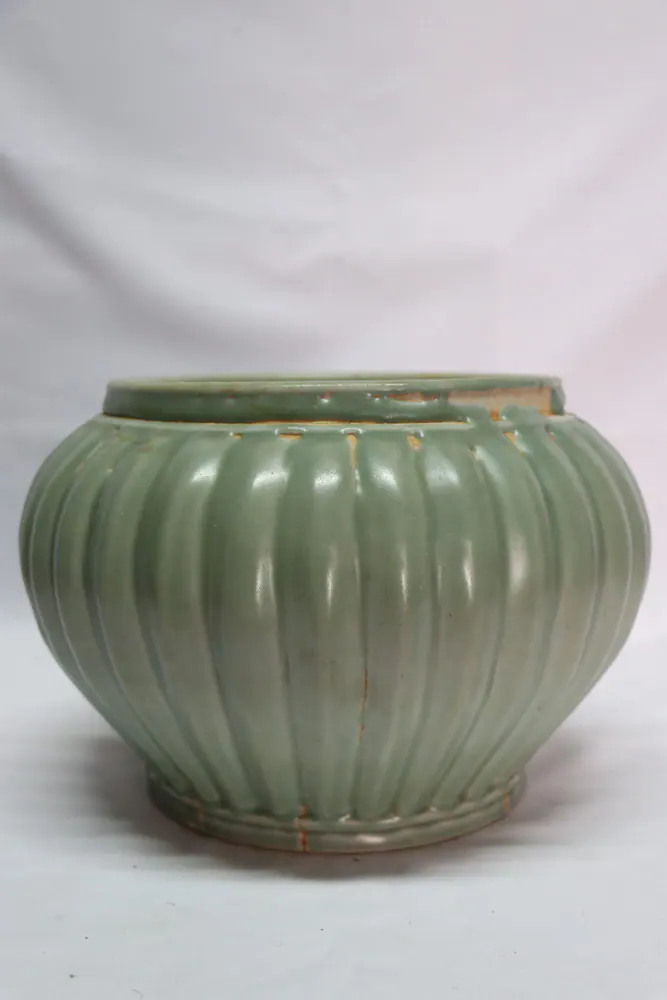
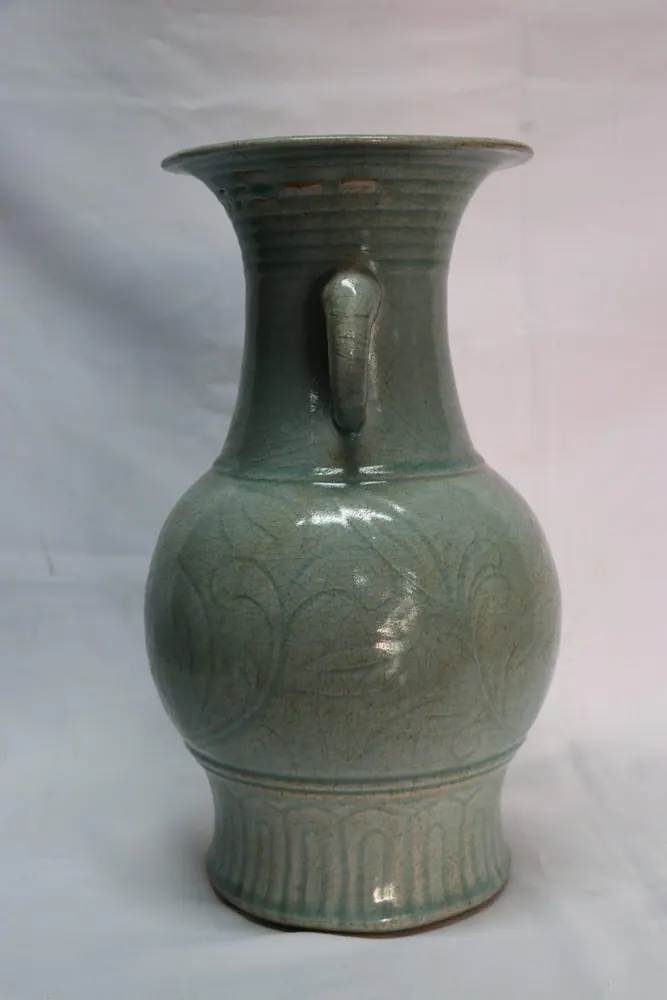
Carved and moulded flowers under a green glaze are found on celadons from many Song kilns, not only Longquan. Our collection includes a Song celadon vase with two curved handles at the neck and carved flowers on the body, and a Song celadon jar with an olive-green glaze over a grooved body. Their listings describe them as Song celadon and do not name a kiln, and we do not attribute them to one here.
Yuan and early Ming Longquan celadon
Longquan production grew under the Mongol Yuan dynasty (1271–1368), driven by overseas trade. Pieces became larger and heavier, with thicker walls and broader feet, and big dishes forty centimetres or more across were made for markets in South-East Asia, India and the Islamic world, where they were used for serving communal meals. The historic collections of the Topkapi Palace in Istanbul and the Ardebil Shrine in Iran include many of them.
The Sinan shipwreck, a trading ship that sank off the south-west coast of Korea in or soon after 1323 on its way from China to Japan, gives a dated view of the trade: more than half of the twenty thousand or so ceramics recovered from it were Longquan celadons.
In the early Ming, Longquan still made fine, massive wares, and some kilns supplied the court with large dishes and vases to official designs. Later in the fifteenth century quality declined as Jingdezhen porcelain took over the market, and by the late Ming the great Longquan kilns had largely faded, though celadon went on being made in the region on a smaller scale.
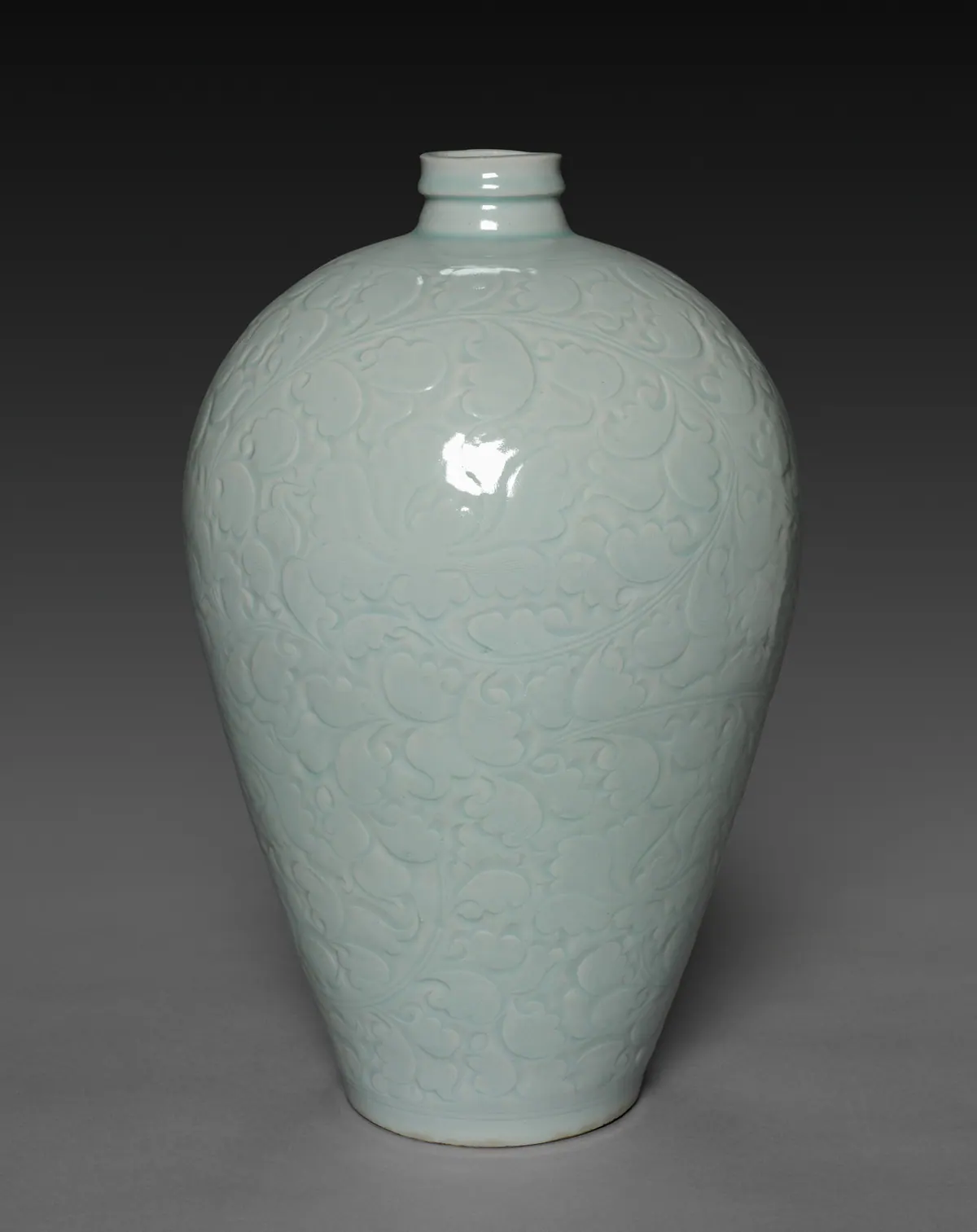
Pieces from the years around the change of dynasty can be hard to place. A celadon vase with a carved peony medallion in our collection is catalogued as late Song to early Yuan; like our other celadons, its listing does not name a kiln.
Bases, orange-red foot rims and firing supports
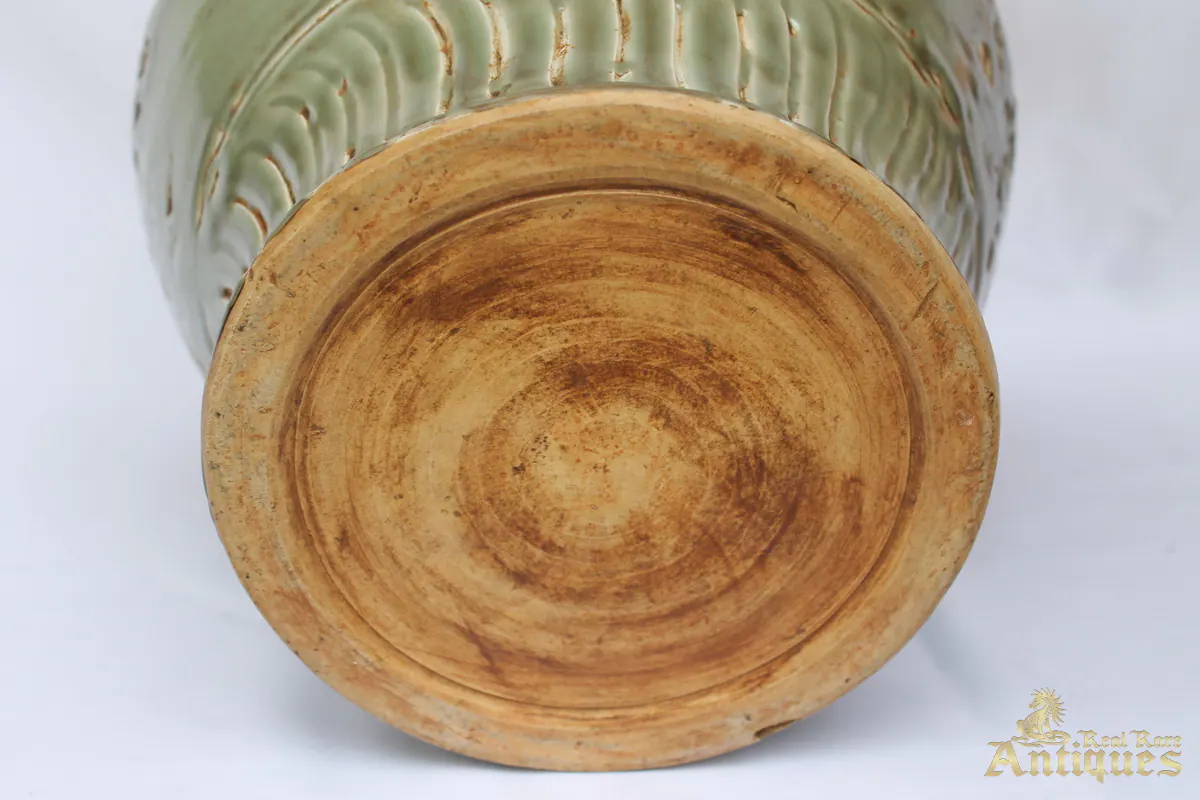
The underside of a Longquan piece says a great deal about when and how it was made. The body contains enough iron that where it is left bare and exposed to air as the kiln cools, it fires orange to reddish brown. Collectors look for this warm tone on the foot rim and on any unglazed area of the base. Inside a chip, the same body is pale grey or off-white.
Southern Song potters usually wiped the glaze from the foot rim, or fired pieces on a round clay pad set under the base, which left a matching unglazed ring or circle. The finest pieces are neatly finished underneath, with a narrow, carefully trimmed foot.
Yuan and Ming pieces tend to have broader, heavier feet. Large dishes often have an unglazed ring on the base where they sat on a ring-shaped support, and that ring usually fired a strong orange-brown. Some bases were left entirely unglazed. Not every piece used a support at all: according to its listing, a Song celadon vase we sold was fired on the kiln floor and shows no stand mark on its base. Look at how the glaze meets the bare body: on old pieces the edge is often slightly uneven, with a brownish line where the glaze thinned out.
Firing features were shared across the southern celadon kilns, so they support a date but do not on their own prove a Longquan origin. Our guide to foot rings and bases covers the subject across Chinese porcelain as a whole.
Copies and how they differ
Longquan has been imitated for as long as it has been admired. In the Song and Yuan, kilns in Fujian, Jiangxi and elsewhere made cheaper green wares in the Longquan manner, much of it for export, and celadon was also made in Korea, Thailand and Vietnam, each with its own character. Such pieces are genuine antiques, but not Longquan.
Jingdezhen potters of the Ming and Qing produced Longquan-type glazes on a white porcelain body. These are usually easy to separate: the body is whiter and finer, the glaze thinner and more even, and the exposed foot lacks the typical orange. Some carry Qing reign marks.
Modern copies are the real difficulty. Celadon production was revived at Longquan in the 1950s, and today's workshops use local clay to make faithful versions of Southern Song and Yuan forms. Artificial ageing follows: acid to dull the glaze, stains rubbed into the crackle (our guide to crackle and crazing explains what genuine crazing looks like) and iron oxide painted on the foot to imitate the natural orange firing. Warning signs include a glaze that is too bright or too uniform, stiff or mechanical carving, a foot that is sharp and unworn, and brown colour that sits on the surface of the clay rather than in it.
The best protection is to handle as many genuine pieces as possible and to buy from a dealer who describes each piece plainly. Our Song dynasty porcelain collection shows every piece in several photographs, and buying is by private inquiry through the Request price form on each piece page, with fully insured shipping.