Guide
Kiln Firing Faults
Every piece of antique Chinese porcelain went through a wood- or coal-fired kiln whose heat and atmosphere no potter could fully control. The small faults that firing left behind are among the most useful signs for anyone judging a piece. This guide explains the common faults, what they look like on genuine pieces, and how to tell a firing fault from later damage.
What to look for
- Look for kiln grit fused to the foot rim; it should be part of the surface, not stuck on top.
- Check unglazed areas for an orange-red firing blush where the body met the flame.
- Find pinholes, specks and small glaze skips; old kilns rarely produced a perfect surface.
- Run a light along any crack: glaze flowed into rounded edges means it formed in the kiln.
- Be wary of a piece that is flawless everywhere, or whose faults look added.
Why firing faults happen
Chinese kilns were fired with wood or coal. In the south, long dragon kilns climbed a hillside, and the firing was carried up the slope by stoking through side holes along the kiln. In the north, compact horseshoe-shaped kilns burned wood and, from the Song dynasty, increasingly coal. At Jingdezhen, the kilns of the Ming and Qing, including the great egg-shaped kilns that came into use from the late Ming, burned pine wood.
None of these kilns heated evenly. Temperature and the balance of oxygen and smoke varied from the front of a kiln to the back, and from one firing to the next. Pieces were usually protected inside clay boxes called saggars, but ash, grit and sudden changes in temperature still reached them. The result was a steady rate of small faults, and a large number of pieces that did not survive at all.
Where standards were highest, rejects were destroyed. At the Ming imperial factory at Jingdezhen, flawed porcelain was broken up and buried, and excavations there have recovered it in great quantities. Pieces made for the market kept faults the court would not have accepted.
Faults in the glaze
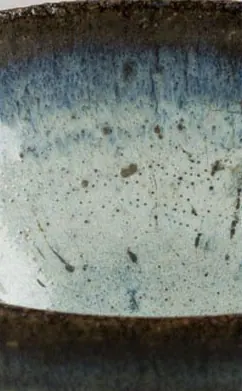
Pinholes and blisters. Gases escape from the body and glaze as they heat. If the glaze is thick, or the kiln is heated or cooled too fast, the bubbles do not heal: they leave pinholes, blisters, or small craters where a blister burst.
Glaze skips. Where the glaze pulled away from dust or grease on the body, or shrank as it dried, it left bare patches, often with rounded, rolled edges. Our guide to glaze contractions covers these in detail.
Crazing and shivering. A glaze that contracts more than its body on cooling is left under tension and crazes into a network of fine cracks, described in our guide to crackles and crazing. The opposite fault, shivering, occurs when the body contracts much more than the glaze: the glaze is squeezed until it flakes away, usually at rims and edges.
Specks. Iron impurities in the body or glaze burn through as dark spots, and flecks of ash or kiln debris settle on the molten glaze. Our guide to rust spots explains how iron spots appear on older blue and white.
Faults in the body and shape
Warping and sagging. Porcelain softens at the peak of firing. Large dishes sag, tall vases lean, and mouths and foot rims go out of round. A slight distortion is very common on large Ming and Yuan pieces.
Firing cracks and dunting. Uneven drying, uneven thickness or too rapid heating and cooling can crack a piece in the kiln. Dunting is cracking caused by cooling too fast, for example when a kiln was opened too early.
Black coring and bloating. When the kiln is starved of oxygen too early, carbon and sulphur in the clay cannot burn out. The body develops a dark core, visible only where a piece is broken, and trapped gases can swell the surface into bloats.
Exploding. Clay that still holds water turns it to steam if heated too fast, and the piece can burst in the kiln. Such pieces simply did not survive.
Marks left by the kiln
Some traces of firing are not faults at all but a record of how a piece was made, and they are among the most telling signs for a collector.
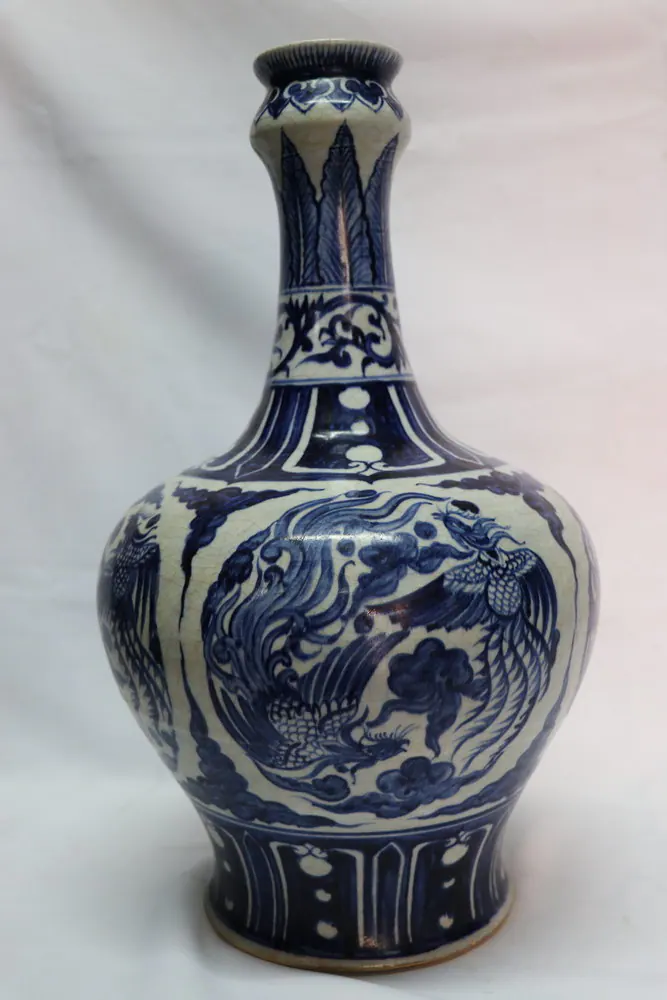
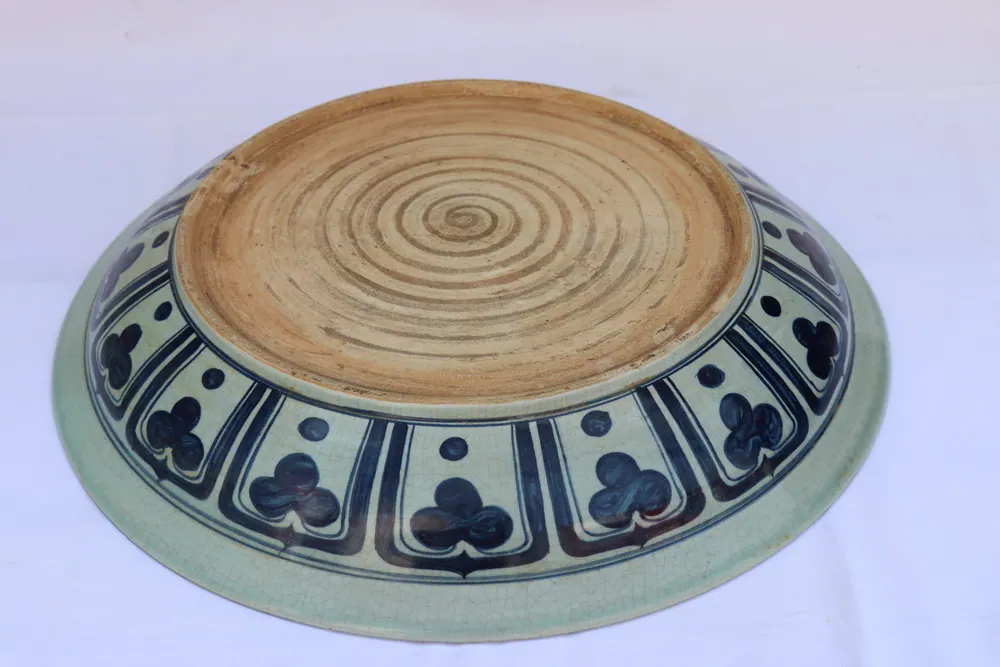
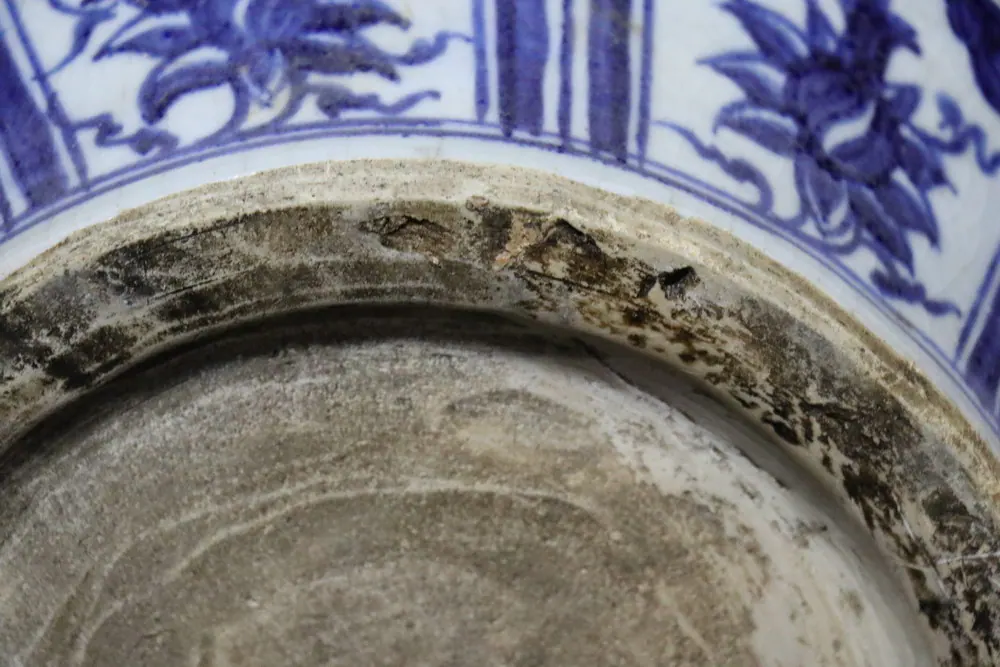
Kiln grit. Many Ming and Qing pieces were fired standing on sand or grit, and particles fused into the foot rim. Firing blush. Where the body was left unglazed, iron in the clay often turned orange-red in the kiln, a colour seen on the foot rims and bases of many Yuan and Ming pieces. Smoke could also leave dark firing marks on bare clay, as on the foot of the Yuan double gourd vase shown at the top of this page. Stacking and support marks. Bowls stacked in the kiln often have an unglazed ring in the well; Ru ware stood on small spurs that left tiny unglazed points on the base; Ding ware was often fired upside down, leaving an unglazed rim that was later bound with metal.
Each kiln and period had its own methods, so these marks help to place a piece as well as to judge its age.
Firing fault or later damage
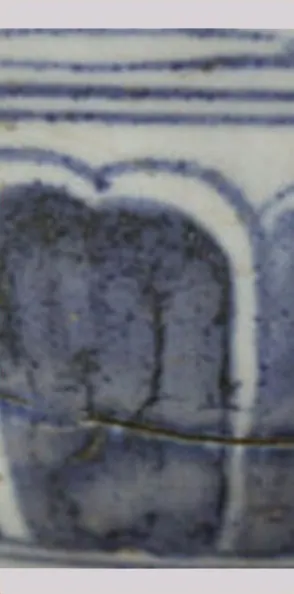
The most important question with any crack or chip is whether it happened in the kiln or afterwards. A firing crack opened while the glaze was still soft, so glaze has usually flowed into it and its edges are rounded and glossy. A crack that happened later has sharp edges, bare body inside and, if it is old, dirt in the opening.
The same test applies to chips and missing glaze. A glaze skip has smooth, rolled edges; a chip has a fresh, angular break. Our guide to hairlines, glazelines and cracks explains how to assess cracks in more detail.
What copies do differently
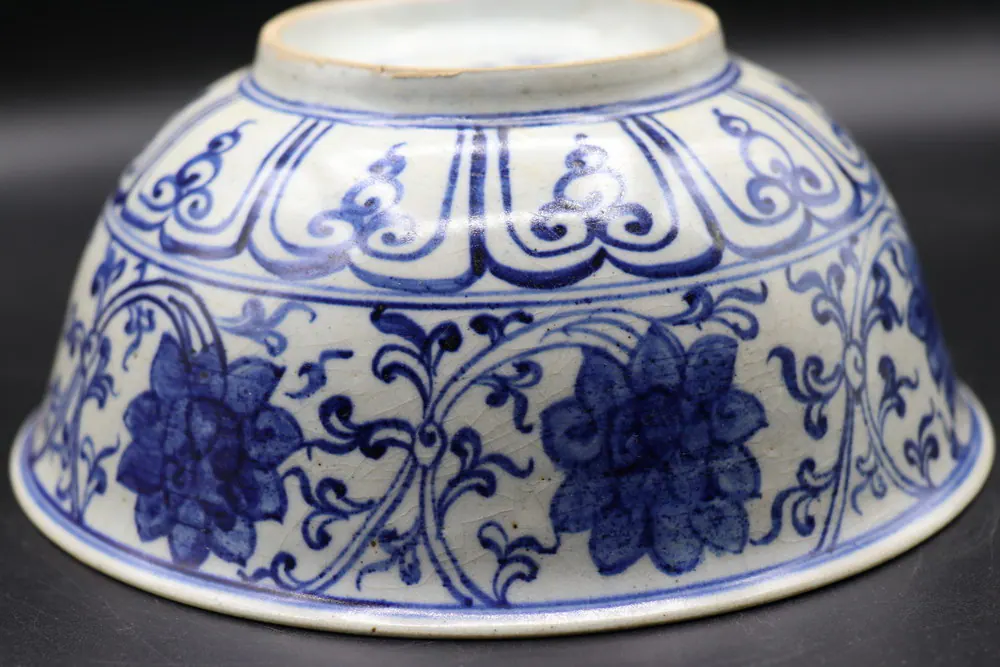
Modern gas and electric kilns fire cleanly and evenly, so recent pieces tend to be free of the small irregularities of old firing: the glaze is smooth and even, the foot is clean, and the body shows little or no blush. Some copyists add faults on purpose. Grit may be glued to a foot rim, where it sits on the surface rather than being fused into it; a firing blush may be painted on with iron-red colour, which lies evenly on the surface rather than shading into the body.
No single fault proves age, and a genuine piece can be almost flawless. Firing faults are best read together with wear, glaze and decoration, as our guide to detecting fakes explains. Examine the foot, base and interior with a loupe under good light. If you have a question about a piece in our collection, ask us and we can send further photographs of these areas.