No contemporary portrait survives

Southern Ming1646–1662

Prince of Gui

永曆

Reign facts
Reigned
1646–1662 (16 years)
Lived
1623–1662
Personal name
Zhu Youlang 朱由榔
Temple name
Zhaozong 昭宗
Era name
Yongli 永曆 1647–1662
On this page
  1. Early Life of Zhu Youlang
  2. Enthronement of Emperor Yongli
  3. Withdrawal to the South and West
  4. Refuge in Burma
  5. End of Reign
  6. Porcelain in the Years of the Southern Ming

Zhu Youlang (1623–1662), Prince of Gui, was the last emperor of the Southern Ming, the loyalist courts that held out in the south after the fall of Beijing in 1644. He was proclaimed emperor at Zhaoqing in Guangdong at the end of 1646 and reigned under the era name Yongli, so he is usually called the Yongli Emperor. Loyalists later gave him the temple name Zhaozong.

His reign of some sixteen years was the longest of any Southern Ming ruler. For most of it his court was on the move, driven westward across southern China by the Qing armies. It ended in Burma, where he had taken refuge, and he was put to death in Kunming in 1662.

Early Life of Zhu Youlang

Zhu Youlang was born in 1623, a grandson of the Wanli Emperor. His father, Zhu Changying, was Prince of Gui, with his fief at Hengzhou in Hunan. As a younger son of a provincial prince, Zhu Youlang could expect a quiet life of privilege far from the court.

The rebellions of the late Ming ended that. In 1643 the rebel armies of Zhang Xianzhong overran Hunan, and the family fled south into Guangxi. In 1644 another rebel leader, Li Zicheng, took Beijing, and the Chongzhen Emperor took his own life. Within weeks the Manchus had defeated Li Zicheng and occupied the capital, and they proclaimed that their Qing dynasty now ruled China.

Zhu Changying died in 1644, and Zhu Youlang later inherited his title of Prince of Gui. Meanwhile, Ming loyalists in the south set up a series of rival courts. The Hongguang Emperor at Nanjing fell to the Qing in 1645, and the Longwu Emperor in Fujian in 1646.

Enthronement of Emperor Yongli

When news came that the Longwu Emperor had been captured and killed, officials in Guangdong and Guangxi turned to Zhu Youlang, one of the last surviving grandsons of Wanli. In November 1646 he was named guardian of the state at Zhaoqing. In December he took the throne, with the era name Yongli from the following year.

A rival appeared almost at once. At Guangzhou, a short distance away, Longwu's younger brother was proclaimed the Shaowu Emperor, and the two courts went to war with each other. The quarrel ended in January 1647, when the Qing took Guangzhou and Shaowu took his own life.

The new emperor relied heavily on his father's principal widow, Empress Dowager Wang. The sources describe her as well read and shrewd in her judgement of affairs. She supported his accession and remained his chief adviser in the early years of the reign.

The Yongli court was also unusual for its links with Europe. Jesuit missionaries made converts among its members, and several women of the imperial family were baptised, the empress dowager among them. In 1650 she wrote to Pope Innocent X asking for prayers and help for the Ming cause. The Polish Jesuit Michał Boym carried her letter to Rome.

Withdrawal to the South and West

The Qing advance forced the court to leave Zhaoqing within weeks. For the next few years it moved between Guangxi, Hunan and Guangdong, as the fortunes of war changed. In 1648 two Qing commanders, Li Chengdong in Guangdong and Jin Shenghuan in Jiangxi, changed sides. For a time the Ming cause held much of southern China, and the emperor returned to Zhaoqing.

The revival did not last. The Qing retook Jiangxi in 1649, and in 1650 they captured both Guangzhou and Guilin. At Guilin the loyal minister Qu Shisi was taken and later executed. The emperor fled to Nanning and then out of Guangxi altogether.

From 1652 the court depended on the armies of Sun Kewang and Li Dingguo. Both had been generals of the rebel leader Zhang Xianzhong and had gone over to the Ming cause after his death. Sun Kewang kept the emperor at Anlong in Guizhou, under his close control, for several years.

Li Dingguo was the ablest soldier of the late resistance. In 1652 he retook Guilin and won a series of victories that cost the Qing two of their princes, Kong Youde and Nikan. From 1653 the Qing entrusted the whole southern front to Hong Chengchou, a former Ming official who served as governor-general of five provinces.

The alliance between the two generals broke down. In 1656 Li Dingguo brought the emperor to Kunming in Yunnan. In 1657 Sun Kewang, defeated in a war with Li, went over to the Qing. Three Qing armies, one of them led by Wu Sangui, advanced into the south-west in 1658, and early in 1659 they took Kunming.

Refuge in Burma

As Kunming fell, the emperor and his court fled west. In 1659 they crossed into Burma and asked the king, Pindale Min, for refuge. The king allowed them to settle at Sagaing, across the Irrawaddy from his capital at Ava, but only after the emperor's followers had given up their arms. The court lived there in poverty, in effect as captives.

War around Ava

Li Dingguo and another loyalist general, Bai Wenxuan, remained in the border country with their troops. In 1660 and 1661 they marched into Burma several times, trying to recover the emperor, and the Burmese saw their armies as a threat to the kingdom. The fighting laid waste the country around Ava. The city held, defended in part by gunners of Portuguese descent in the king's service.

The strain brought down the king. In 1661 his brother, Pye Min, deposed him and took the throne. The new government then summoned the Chinese men of the emperor's following to swear an oath of loyalty, surrounded them and killed nearly all of them. The emperor and his family were spared.

By then the Qing had lost patience. At the end of 1661 an army under Wu Sangui reached the outskirts of Ava and demanded that the emperor be handed over. Wu was the general who had opened Shanhai Pass, on the Great Wall, to the Manchus in 1644.

End of Reign

In January 1662 the Burmese delivered Zhu Youlang and his family to Wu Sangui's camp. He was taken back to Kunming as a prisoner, and there, in 1662, he was put to death together with his son. Li Dingguo, still in the borderlands, died later the same year.

His death ended the line of Southern Ming emperors. Zheng Chenggong (Koxinga), who had taken Taiwan from the Dutch early in 1662, also died that year. Under his son Zheng Jing and then his grandson, the Zheng government on Taiwan went on dating its documents by the Yongli era until it surrendered to the Qing in 1683. Wu Sangui was rewarded with the rule of Yunnan, and in 1673 he rebelled against the Qing himself.

Porcelain in the Years of the Southern Ming

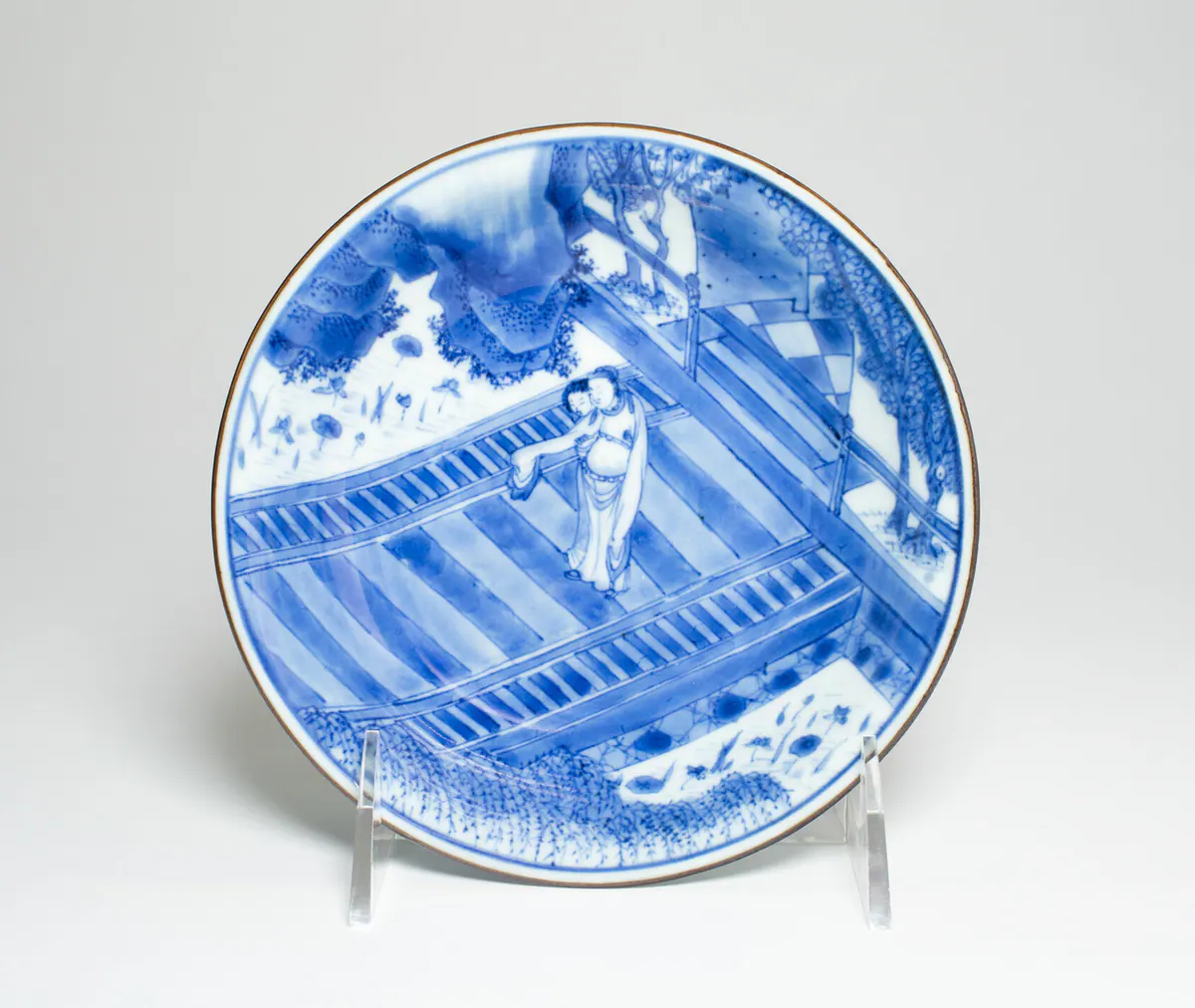
The Southern Ming courts, constantly on the move, are not known to have ordered porcelain from Jingdezhen. Imperial orders there had already dwindled in the last decades of the Ming. The private kilns of Jingdezhen were making what collectors call Transitional porcelain, produced from about the 1620s until the kilns were reorganised under the Kangxi Emperor in the 1680s.

A shallow blue and white bowl seen from above on a stand, painted with two women on a railed terrace beside rocks, trees and a garden pond, under a brown-dressed rim.
Museum exampleA blue and white bowl with a scene from the Romance of the Western Chamber, dated by the museum to about 1655–65, which includes the last years of the Yongli court.Art Institute of Chicago, 1941.568. Public domain.

These wares are prized for their confident, freely painted figure subjects and landscapes. Our Transitional porcelain guide looks at them in more detail. The reigns that came before Yongli are set out on our Ming Dynasty Emperors page.

From the Ming Dynasty

View all Ming Dynasty PorcelainAsk about a piece

Be the first to see new pieces

Join our collectors' list for new arrivals, rare finds and private offers.