No contemporary portrait survives

Southern Ming1645–1653

Prince of Lu (Zhu Yihai)

朱以海

Reign facts
Reigned
1645–1653 (uncertain) (8 years)
Lived
1618–1662
Personal name
Zhu Yihai 朱以海

Zhu Yihai (朱以海, 1618–1662), Prince of Lu, led one of the loyalist regimes of the Southern Ming after the fall of Beijing. From 1645 to 1653 he governed as regent of the state (jianguo), first from Shaoxing in Zhejiang and later from the islands off the coast. He never took the title of emperor and proclaimed no era name of his own.

His princely title is not the same as that of the other Southern Ming Prince of Lu, which is written with a different Chinese character.
Early Life of the Prince of Lu

Zhu Yihai was born in 1618, in the 46th year of the Wanli Emperor's reign. He was a ninth-generation descendant of Zhu Tan, the first Prince of Lu and a son of the Hongwu Emperor. The princes of Lu had their residence at Yanzhou in Shandong.

In 1643 Qing forces raiding Shandong stormed Yanzhou. The reigning Prince of Lu, Zhu Yihai's elder brother Zhu Yipai, took his own life as the city fell.

In 1644 the Chongzhen Emperor confirmed Zhu Yihai as the new Prince of Lu. That same year Li Zicheng's rebel army captured Beijing, and the prince fled south.

Regent of the State

With the fall of Beijing the Ming central government collapsed. In 1645 the Qing crossed the Yangtze and took Nanjing, ending the first Southern Ming court. Loyalist officials in Zhejiang, among them Qian Sule, Zhang Guowei and Zhang Huangyan, then turned to the Prince of Lu.

At their invitation he accepted the title of regent at Shaoxing in 1645 and took command of the resistance in eastern Zhejiang.

Rival Courts and Retreat to the Sea

At almost the same moment another Ming prince, Zhu Yujian, the Prince of Tang, was proclaimed emperor at Fuzhou as the Longwu Emperor, with the backing of the powerful Zheng Zhilong. The two courts refused to recognise each other, and their rivalry weakened the loyalist cause at a critical moment.

In 1646 Qing armies crossed the Qiantang River and took Shaoxing, and the Prince of Lu escaped by sea. Loyal commanders, among them Zheng Cai, Zhang Mingzhen and Zhang Huangyan, gathered the forces that remained, and for several years he held out along the coasts of Zhejiang and Fujian, later making his base on the Zhoushan islands.

When Zhoushan fell to the Qing in 1651, he fled south to the Xiamen and Kinmen area and placed himself under the protection of Zheng Chenggong (Koxinga), Zheng Zhilong's son, who then controlled much of the southeast coast.

Giving Up the Regency and His Death

In 1653 Zhu Yihai gave up the title of regent. He died of illness on Kinmen in 1662.

A long-standing story held that Zheng Chenggong had him drowned at sea. The discovery of his tomb on Kinmen in 1959 has largely discredited that account.

Ceramics of the Reign

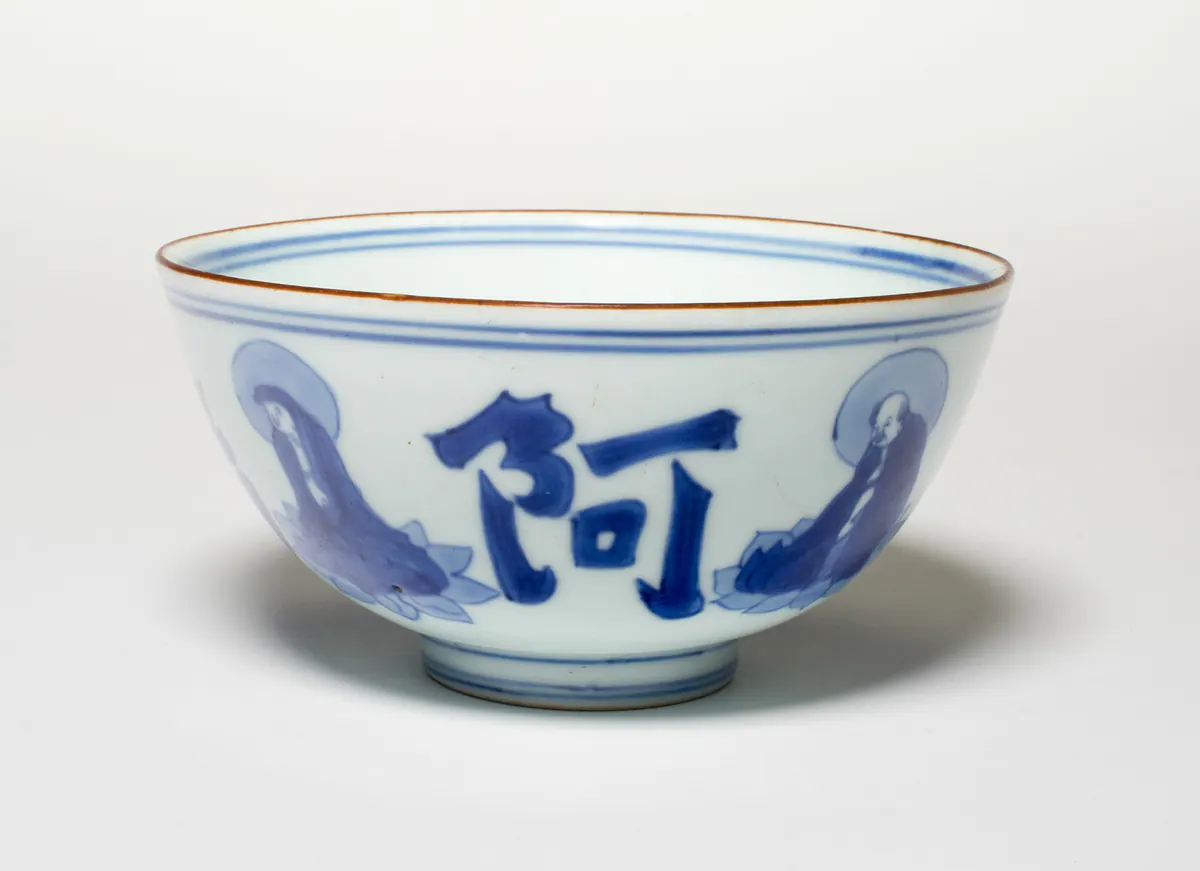
No ceramics can be connected with the Prince of Lu's court, which spent most of its existence on the move. His years as regent coincide with the first decade of the Qing, when Jingdezhen was recovering from the wars of the change of dynasty and worked mainly for private and export buyers. The blue and white of the Shunzhi period (1644–1661) continues the Transitional style, with figures in landscapes, Buddhist and Daoist subjects and inscriptions, painted in a strong blue. Some pieces carry cyclical dates, which help scholars to date the group.

A blue and white bowl with a brown-edged rim, painted with haloed luohans seated on lotus pads between large calligraphic characters, with double blue lines at the rim and foot.
Museum exampleA blue and white bowl with seated luohans and an invocation to Amitabha, dated by the museum to the Shunzhi period (1644–61), covering his years as regent.Art Institute of Chicago, 1941.570. Public domain.

Fighting in Jiangxi and along the coast disrupted exports around 1650, and in 1659 the Dutch East India Company turned to the kilns of Arita in Japan to fill the gap.

From the Ming Dynasty

View all Ming Dynasty PorcelainAsk about a piece

Be the first to see new pieces

Join our collectors' list for new arrivals, rare finds and private offers.