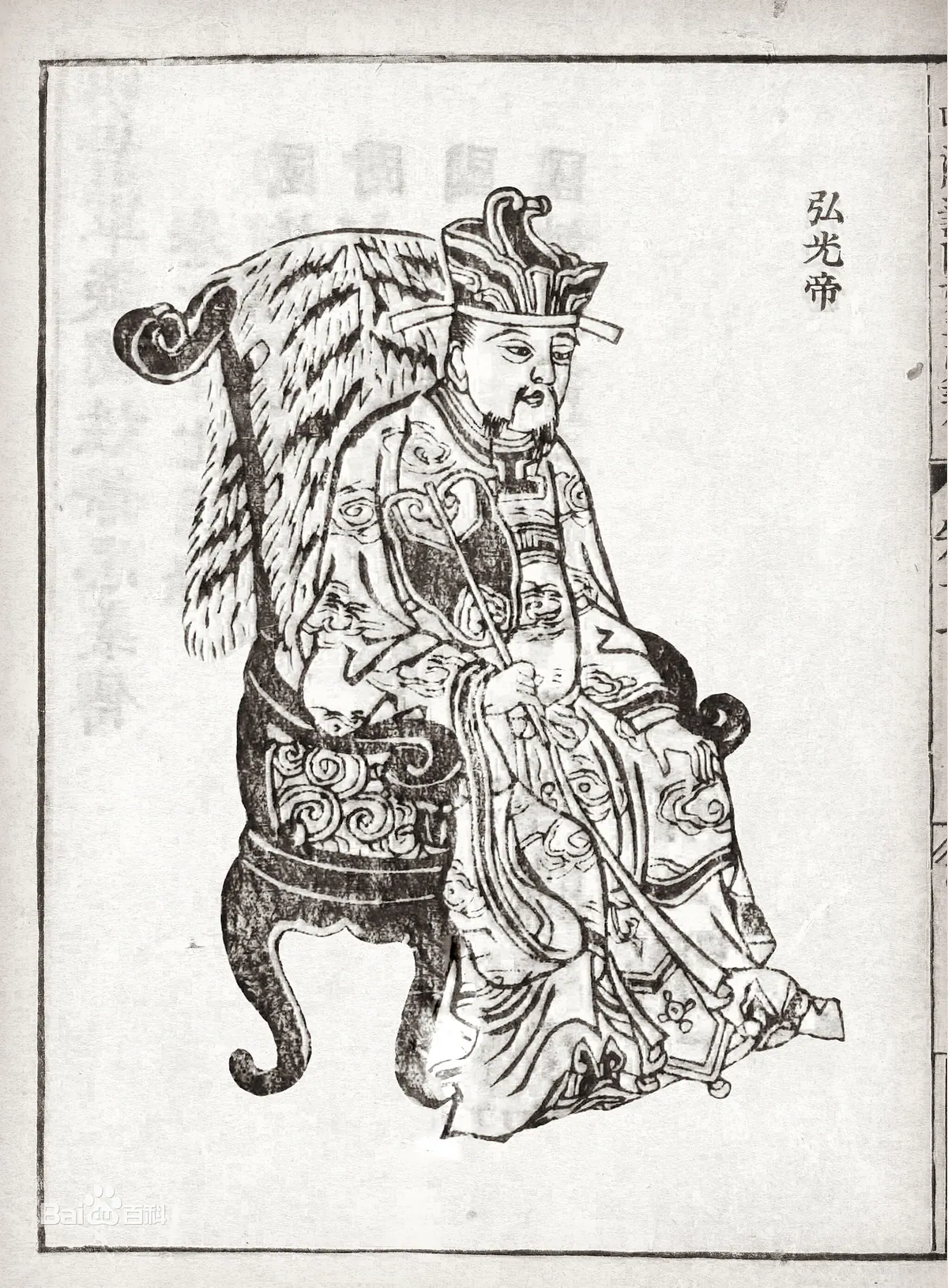
Woodblock-printed illustration of Zhu Yousong, the Hongguang Emperor, seated on a throne in court robes
Portrait: public domain, via commons.wikimedia.org

Southern Ming1644–1645

Prince of Fu

弘光

Reign facts
Reigned
1644–1645 (1 year)
Lived
1607–1646
Personal name
Zhu Yousong 朱由崧
Temple name
Anzong 安宗
Era name
Hongguang 弘光 1645

Zhu Yousong (1607–1646), Prince of Fu, was the first ruler of the Southern Ming, the loyalist regimes that carried on the Ming cause in southern China after the fall of Beijing. Enthroned at Nanjing in 1644, he reigned under the era name Hongguang until his capture in 1645. His temple name, Anzong, was given to him later by the Southern Ming.

He was the eldest son of Zhu Changxun, the first Prince of Fu, and a grandson of the Wanli Emperor. In 1614 he went with his father to the family's fief at Luoyang, where he was given the title Commandery Prince of Dechang.

From Prince to Emperor

In 1641 Luoyang fell to the rebel army of Li Zicheng. Zhu Yousong escaped, but his father was killed, and in 1643 he succeeded to his father's title as Prince of Fu.

When the rebels advanced again in 1644, he fled to Weihui, the seat of his kinsman Zhu Changfang, Prince of Lu, and from there to Huai'an, in the company of other refugee princes.

The Succession Crisis

In April 1644 Li Zicheng took Beijing and the Chongzhen Emperor took his own life. When the news reached Nanjing, the Ming's southern capital, its senior officials met to decide how to respond. The fate of Chongzhen's sons was unknown, and some argued it was too soon to name a new emperor, but most agreed that the loyalist cause needed an imperial figure to rally around.

By descent, the Prince of Fu had the strongest claim. The Taichang Emperor's surviving sons, the Tianqi and Chongzhen emperors, had left no heirs who could be found, so the choice passed to the sons of the Wanli Emperor. Zhu Changxun had been the eldest surviving brother of Taichang, and Zhu Yousong was his eldest son.

Some officials preferred the Prince of Lu, whom they thought more capable. The matter was settled by the military governor Ma Shiying, who backed the Prince of Fu and brought troops to Nanjing. Zhu Yousong was enthroned there in June 1644, and it was decided that the Hongguang era would begin with the following lunar year.

Reign of the Hongguang Emperor

The Hongguang court was divided from the start. Ma Shiying, who held real power, relied on men associated with the faction of the late eunuch Wei Zhongxian, while officials sympathetic to the Donglin movement, among them the commander Shi Kefa, found themselves sidelined.

At the front, the generals who were meant to defend the Huai River line quarrelled among themselves and plundered the civilians they were supposed to protect. Chinese historians have judged the emperor harshly, portraying him as a ruler who left government to Ma Shiying and gave his time to pleasure.

Meanwhile the Manchus, having been invited through the Shanhai Pass by the Ming general Wu Sangui to drive Li Zicheng out of Beijing, had occupied the capital and proclaimed the Qing dynasty there. The Hongguang court sent an embassy north with gifts of silver and silk in the hope of reaching a settlement, but the talks came to nothing.

Capture and Death

In 1645 the Qing armies moved south. Yangzhou fell after a short siege, Shi Kefa was killed, and Nanjing surrendered soon afterwards. The emperor fled, but was handed over to the Qing by generals who had defected to them.

He was taken to Beijing and executed in 1646. Ming loyalist resistance continued under other princes, including the Prince of Tang, Zhu Yujian, until the last Southern Ming claimant was put to death in 1662.

Ceramics of the Reign

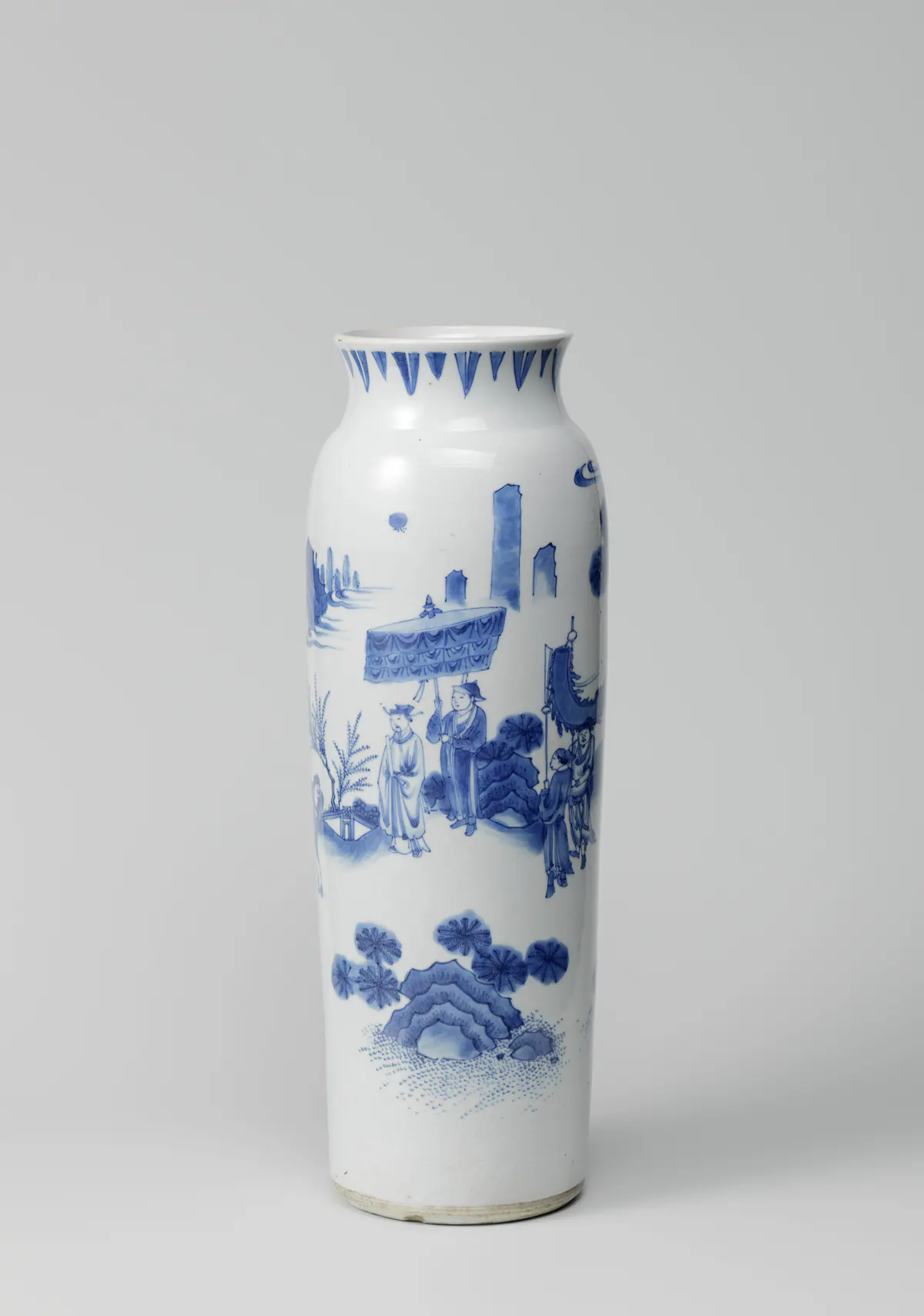
The Hongguang court's single year falls in the middle of what collectors call the Transitional period, usually dated from the death of the Wanli Emperor in 1620 to the early 1680s. As imperial orders to Jingdezhen dwindled, the potters worked for private buyers at home and for merchants abroad. They painted in a bright violet-blue on a fine white body, with figures from novels and dramas, landscapes with drifting clouds, and lightly incised scrolls near the rim and foot. Tall cylindrical sleeve vases, like the one shown here, were a characteristic form.

Transitional blue and white sleeve vase, a tall straight cylinder with a flared mouth, painted with an official under a canopy, attendants with a banner, tall rocks and a moon in the sky.
Museum exampleA Transitional blue and white sleeve vase with an official and attendants, dated by the museum to about 1635–50, a span that includes his year on the throne at Nanjing.Rijksmuseum, AK-NM-6670. Public domain.

The Dutch East India Company bought this porcelain in great quantities in the 1630s and 1640s, until the wars of the change of dynasty cut supplies in the following decade.

From the Ming Dynasty

View all Ming Dynasty PorcelainAsk about a piece

Be the first to see new pieces

Join our collectors' list for new arrivals, rare finds and private offers.