
220–589
The Six Dynasties
Between the fall of the Han in 220 and the reunification of China under the Sui in 589, the country was divided for nearly four centuries, apart from a brief reunification under the Jin. It was an age of war, but also one of the most creative periods in Chinese history: Buddhism took root, calligraphy and painting found their classic forms, and the potters of Zhejiang made the green-glazed stoneware that led to the later celadons. This page explains the rival states and what they left behind.
- Dates
- 220–589
- Capital
- Jiankang (modern Nanjing), for all six southern dynasties
- Known for
- Buddhism, Wang Xizhi's calligraphy, the earliest surviving pagoda
- Key wares
- Yue ware celadon, funerary jars, Buddhist sculpture
An age of division
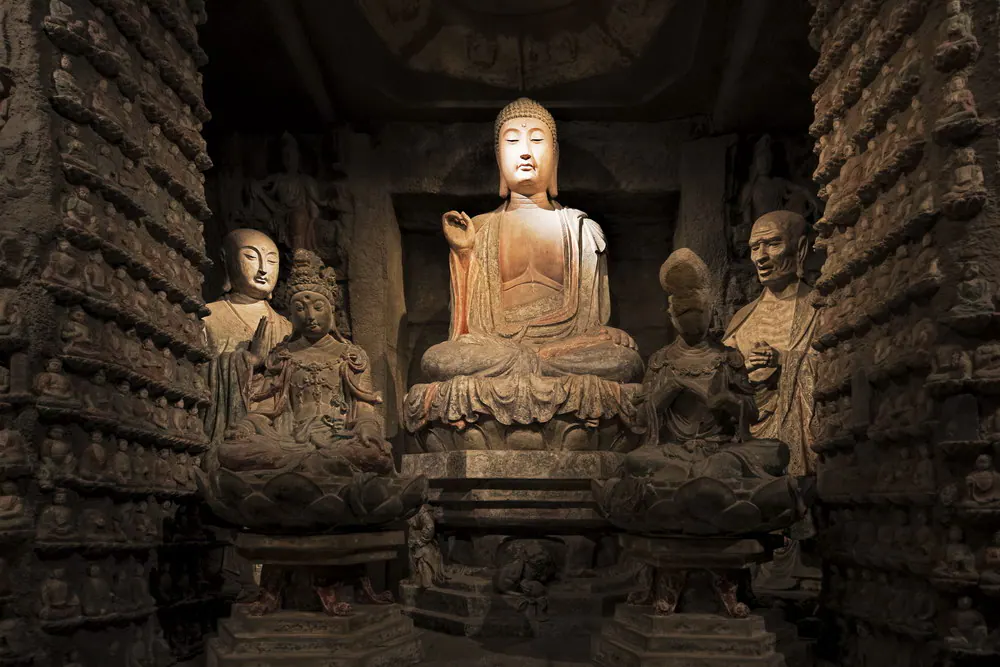
The Six Dynasties are the six successive dynasties that ruled southern China from their capital at Jiankang (modern Nanjing, called Jianye under the Wu): the Eastern Wu, the Eastern Jin, the Liu Song, the Southern Qi, the Liang and the Chen. For much of this time the north was held by rival states, first the Sixteen Kingdoms and later the Northern Dynasties. The name is also used loosely for the whole period between the Han and the Sui.
Some historians, drawing a comparison with Europe, have called these centuries China's Dark Ages. The term is misleading. Poetry, literary criticism, painting and calligraphy all flourished, and science advanced: in the 3rd century Pei Xiu set out the principles of scale mapmaking, and in the 5th century the mathematician Zu Chongzhi calculated pi to seven decimal places. It is sometimes called China's Age of Faith instead, for the spread of Buddhism and Daoism.
The Three Kingdoms
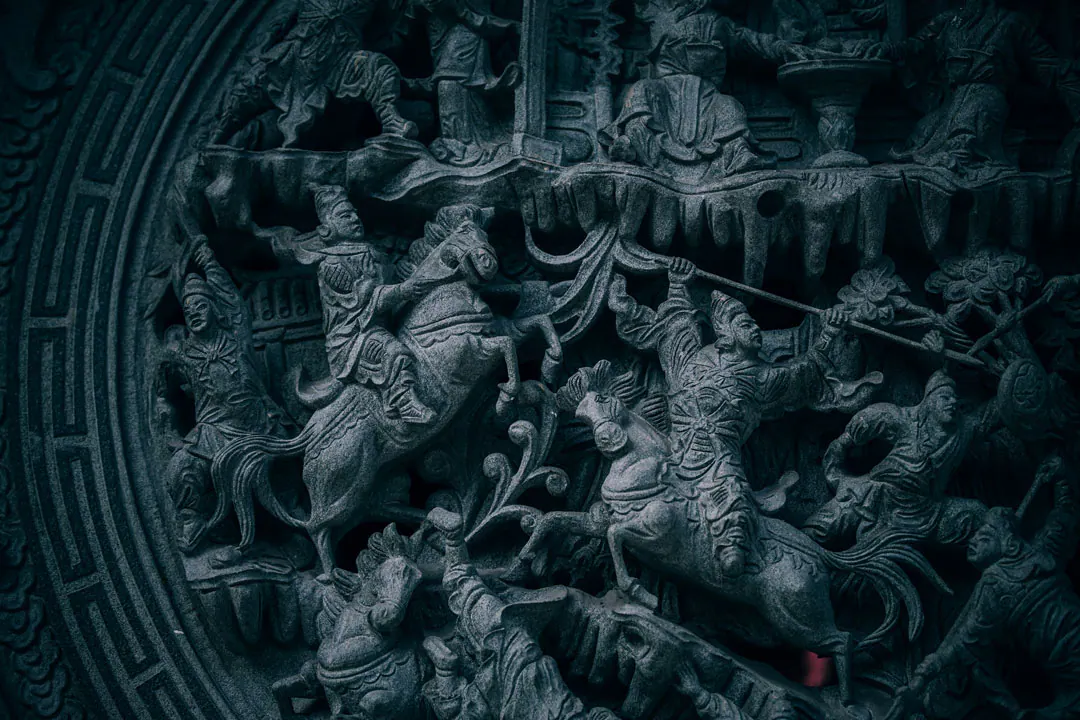
The Three Kingdoms period (220–280) takes its name from the states that divided China after the fall of the Han: Wei in the north, Shu in the south-west and Wu in the south-east. The name is not strictly accurate, since each ruler claimed the title of emperor and the right to rule all China, but it has become standard. The period was one of the bloodiest in Chinese history. A census taken in 280, after the Jin reunification, recorded 16,163,863 people in 2,459,840 households, against more than 50 million under the Han. The count was certainly incomplete, but it gives some idea of the scale of loss.
War did not stop invention. Zhuge Liang, chancellor of Shu, is credited with the "wooden ox", a device for carrying army supplies that appears to have been an early wheelbarrow, and with improvements to the repeating crossbow. In Wei, the engineer Ma Jun built a water-powered mechanical puppet theatre for Emperor Ming, improved the square-pallet chain pumps used for irrigation, and reconstructed the south-pointing chariot, a geared, non-magnetic device that kept a figure pointing south whichever way the chariot turned.
Warfare itself changed. Armour was almost all lamellar, made of small plates laced together, and tomb figures of the early 4th century give some of the earliest evidence for the stirrup, which made heavily armoured cavalry far more effective.
The Jin dynasty
The Jin dynasty (266–420) was founded by Sima Yan, son of Sima Zhao, the regent who had controlled the Wei state. Sima Yan inherited his father's title of Prince of Jin and in 266 took the throne from the last Wei emperor. In 280 the Jin conquered Wu and ended the Three Kingdoms period.
The Western Jin, ruling from Luoyang, soon fell into civil war among the imperial princes. Revolts followed among the non-Chinese peoples settled in the north, known as the "Five Barbarians", whose leaders founded their own states in the Yellow River valley and opened the era of the Sixteen Kingdoms. Many of these northern peoples went on to adopt Chinese customs and institutions.
After the north was lost, Sima Rui re-established the dynasty in the south in 317 as the Eastern Jin, with its capital at Jiankang. It lasted about a century, until the general Liu Yu seized the throne in 420.
The Southern Dynasties and reunification
From 420 to 589 the south was ruled by four short-lived dynasties, while a series of Northern Dynasties held the north:
- Liu Song (420–479). Founded by Liu Yu, one of the finest generals of the age. His son Emperor Wen's Yuanjia era (424–453) is remembered as a relative golden age, but later rulers were violent or incompetent, and Emperor Ming killed many of his brothers and nephews.
- Southern Qi (479–502). After the capable emperors Gao and Wu, the throne was seized by Xiao Luan, a cousin of Emperor Wu, who had the male descendants of Gao and Wu put to death. The cruelty of his son Xiao Baojuan provoked the rebellion that ended the dynasty.
- Liang (502–557). Its founder, Emperor Wu (Xiao Yan), reigned for almost half a century and was a devout patron of Buddhism. His reign ended in the rebellion of the general Hou Jing, which devastated Jiankang.
- Chen (557–589). Founded by Chen Baxian, previously Prince of Chen, on a weakened fragment of the Liang territory. Emperors Wen and Xuan restored its strength, but its last ruler, Chen Shubao, was self-indulgent and ineffective.
In 577 the Northern Zhou conquered the Northern Qi and united the north. In 581 Yang Jian replaced the Northern Zhou with his own Sui dynasty, reigning as Emperor Wendi, and in 589 his armies took Jiankang. China was united again for the first time in nearly three centuries.
Buddhism and Daoism
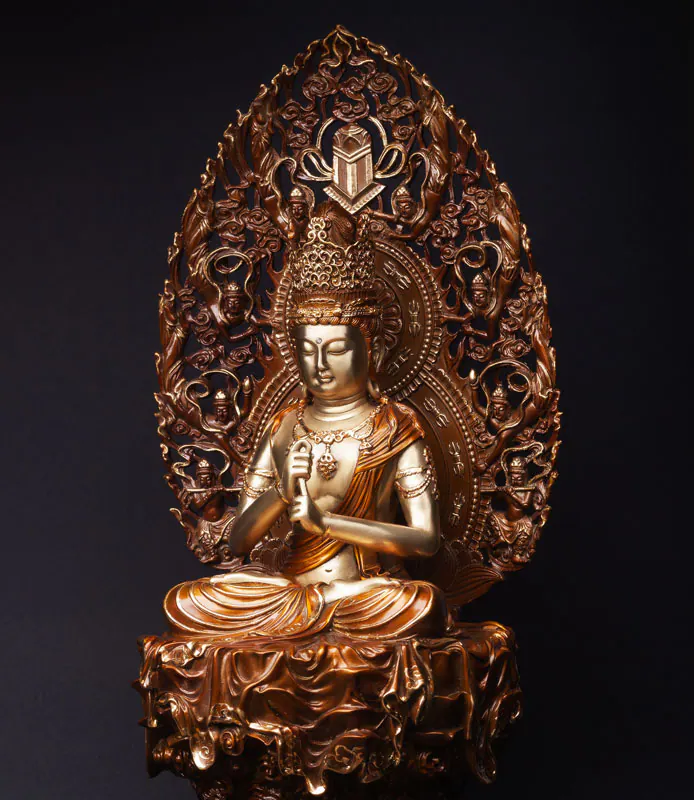
Buddhism had reached China in the 1st century AD, but it was in these unsettled centuries that it won a wide following. Monasteries multiplied in both north and south, scriptures were translated into Chinese, and rulers such as Emperor Wu of Liang became lavish patrons. In the north, the rulers of the Northern Wei sponsored the great cave temples at Yungang and Longmen.
Daoism flourished too. Daoist movements had driven the great peasant revolts at the end of the Han, so the Jin emperors both suppressed Daoist groups and tried to make use of them. Daoist teaching nonetheless drew followers among merchants, landowners and commoners, and among army officers and leading clans. Confucianism remained the philosophy of officials and the aristocracy, while Buddhists and Daoists competed for followers.
Pagodas and temples
Buddhism transformed Chinese architecture. Multi-storey towers already existed, but the pagoda developed in this period from the Indian stupa, a rounded mound built to hold relics. Chinese builders turned it into a tall tower, with the sacred relics kept at its core.
The Songyue Pagoda in Henan, built in 523 under the Northern Wei, is the oldest surviving brick pagoda in China, and its brick construction is one reason it has lasted. Its twelve-sided, almost circular plan and gently curving profile combine Chinese building traditions with forms from Indian and Central Asian Buddhist architecture.
In the south, many of the great monasteries were founded in this period. Lingyin Temple at Hangzhou traces its foundation to 328, under the Eastern Jin.
Calligraphy, painting and literature
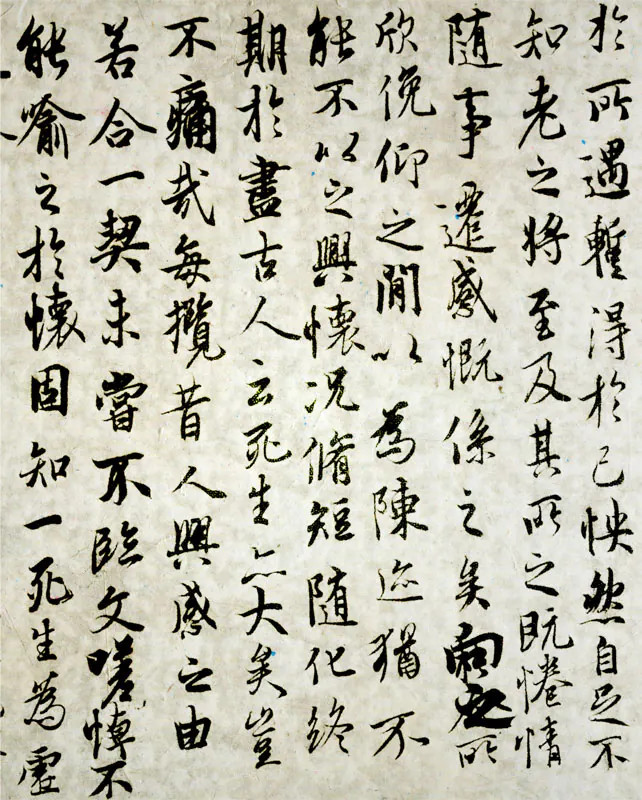
Free of the strict Confucian patterns of the Han, the culture of the Six Dynasties was inventive and varied. At court, calligraphy and painting were the most highly regarded arts, practised above all by scholar-officials and aristocrats who had the leisure to perfect their brushwork.
The greatest calligrapher of the age, and for many of any age, was Wang Xizhi of the Eastern Jin, known as the Sage of Calligraphy. His most famous work is the Lanting Xu, the preface he wrote in 353 for poems composed by friends gathered at the Orchid Pavilion near Shaoxing. He mastered every script and is especially admired for his running script. Emperor Taizong of Tang was a devoted collector of his work, and its influence reaches as far as Japanese calligraphy today.
This was also when Chinese criticism of the arts began. Liu Xie's The Literary Mind and the Carving of Dragons set out a theory of literature, the Liang crown prince Xiao Tong compiled the anthology Selections of Refined Literature, and Xie He's six principles of painting shaped the judgement of Chinese painting for centuries. Gu Kaizhi, the most celebrated painter of the period, worked under the Eastern Jin.
Yue ware and early celadon
For collectors of ceramics, the Six Dynasties is the age of Yue ware. By the end of the Han, kilns in northern Zhejiang, around Shangyu and Shaoxing, were making high-fired stoneware with a thin greenish or olive glaze, and in the following centuries their output grew enormously. This is the direct ancestor of the later Chinese celadons.
Typical forms change in ways that help with dating. Third-century funerary jars, known as hunping, are crowded with modelled buildings, figures and birds, and some carry small Buddha figures. Vessels were modelled as rams, lions and frogs, and Western Jin pieces often carry impressed bands of lattice pattern. The chicken-head ewer, with a spout in the form of a bird's head, grows taller and more elaborate from the Jin to the Southern Dynasties, and from the Eastern Jin potters often dabbed brown iron spots on the glaze. Many pieces are dated by the tombs in which they were found, some of which contain inscribed bricks giving a year.
In the north, tombs of the Northern Qi (550–577) have produced some of the earliest Chinese white wares, a first step towards porcelain. A Song dynasty celadon jar in our collection shows where the green-glazed tradition led.