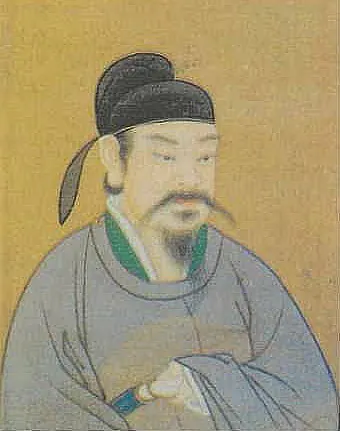
Portrait: public domain, via wikipedia.org

Tang Dynasty710–712

Emperor Ruizong (Second Reign)

景雲 · 太極 · 延和

Reign facts
Reigned
710–712 (2 years)
Lived
662–716
Personal name
Li Dan 李旦
Temple name
Ruizong 睿宗
Era names
Jingyun 景雲 710–711Taiji 太極 712Yanhe 延和 712

Emperor Ruizong's Second Reign, Tang Dynasty

Li Dan (李旦, 662–716), known by his temple name Ruizong, was the youngest son of Emperor Gaozong and Empress Wu, later Wu Zetian. He sat on the throne twice. His first reign, from 684 to 690, was nominal: his mother held all real power, and in 690 she set him aside, took the throne herself and proclaimed her own Zhou dynasty. Li Dan was reduced to heir and made to take her surname, Wu.

His second reign followed the death of his elder brother, Emperor Zhongzong, in 710. Zhongzong's widow, Empress Wei, tried to seize power, and in a coup led by Li Dan's son Li Longji and his sister Princess Taiping she was killed. Li Dan was restored to the throne. This second reign, from 710 to 712, was shorter still, and it was dominated by the rivalry between his sister and his son.

The Second Reign

The first question Ruizong faced on his return was the succession. By Confucian custom the title of crown prince belonged to his eldest son, Li Chengqi, but Li Chengqi declined in favour of his younger brother Li Longji, whose leadership had won the coup. Ruizong made Li Longji crown prince.

Ruizong reversed many of Zhongzong's measures and posthumously restored the honours of a number of people who had died during Wu Zetian's rule.

Princess Taiping and Li Longji

Ruizong was a mild and retiring ruler, and his court soon divided between two factions, one led by Princess Taiping and the other by the crown prince. When chancellors brought proposals to the emperor, he would ask whether they had consulted the princess and the crown prince, and he acted only when they had.

Finding that Li Longji would not bend to her influence, the princess began spreading rumours against him in the hope of having him removed as heir. In 711 some of the chancellors tried to ease the tension by proposing that she be sent away to Pu Prefecture, and that the princes with a stronger claim to the throne than Li Longji be sent out of the capital as prefects.

The Abdication

In 712 the princess arranged for astrologers to tell the emperor that the heavens foretold a change on the throne, expecting him to suspect the crown prince of plotting against him. Instead Ruizong offered to pass the throne to Li Longji, reasoning that an orderly handover would fulfil the omen.

Princess Taiping opposed the plan and Li Longji at first declined, but Ruizong insisted, and his son took the throne as Emperor Xuanzong. At the princess's suggestion, however, Ruizong kept most of the imperial authority as retired emperor, including control of senior appointments, and his edicts still carried more weight than those of Xuanzong.

Retired Emperor

As retired emperor, Ruizong remained the channel through which Princess Taiping governed. Most of the chancellors were her associates: Xiao Zhizhong, Dou Huaizhen, Cui Shi and Cen Xi all owed their posts to her. Lu Xiangxian was also appointed on her recommendation, but he did not belong to her faction.

Late in 712 the general Zhang Wei and the official Liu Youqiu, with Xuanzong's approval, planned to use the imperial guards to kill several of these chancellors. Zhang confided the plan to the censor Deng Guangbin, and it was quickly discovered. Liu was arrested and condemned to death, but Xuanzong interceded with his father, and Liu, Zhang and Deng were exiled instead.

The Fall of Princess Taiping

By 713 the princess and her allies among the officials and generals were plotting to depose Xuanzong. It was even said that they planned to have a lady-in-waiting, Lady Yuan, poison a tonic that the emperor regularly took.

Xuanzong struck first. In the seventh month of 713 he sent Wang Maozhong with several hundred troops to the camp of the imperial guards, where the generals Chang Yuankai and Li Ci were beheaded. Xiao Zhizhong, Cen Xi, Jia Yingfu and Li You were then arrested and executed.

When Ruizong heard of the fighting, he climbed the Chengtian Gate tower to see what was happening. The chancellor Guo Yuanzhen explained Xuanzong's actions to him, and Ruizong felt obliged to approve them by edict. The next day he issued a further edict handing all authority to Xuanzong, and he moved to the Baifu Hall, a secondary palace.

Princess Taiping fled to a mountain temple and did not reappear for three days. Xuanzong then ordered her to take her own life. Her associates and all but one of her sons were put to death.

Death

Ruizong died at the Baifu Hall in 716 and was buried at the Qiao Mausoleum (Qiaoling). Xuanzong's mother, Consort Dou, who had been killed on Wu Zetian's orders many years earlier, was posthumously honoured as empress and commemorated alongside him.

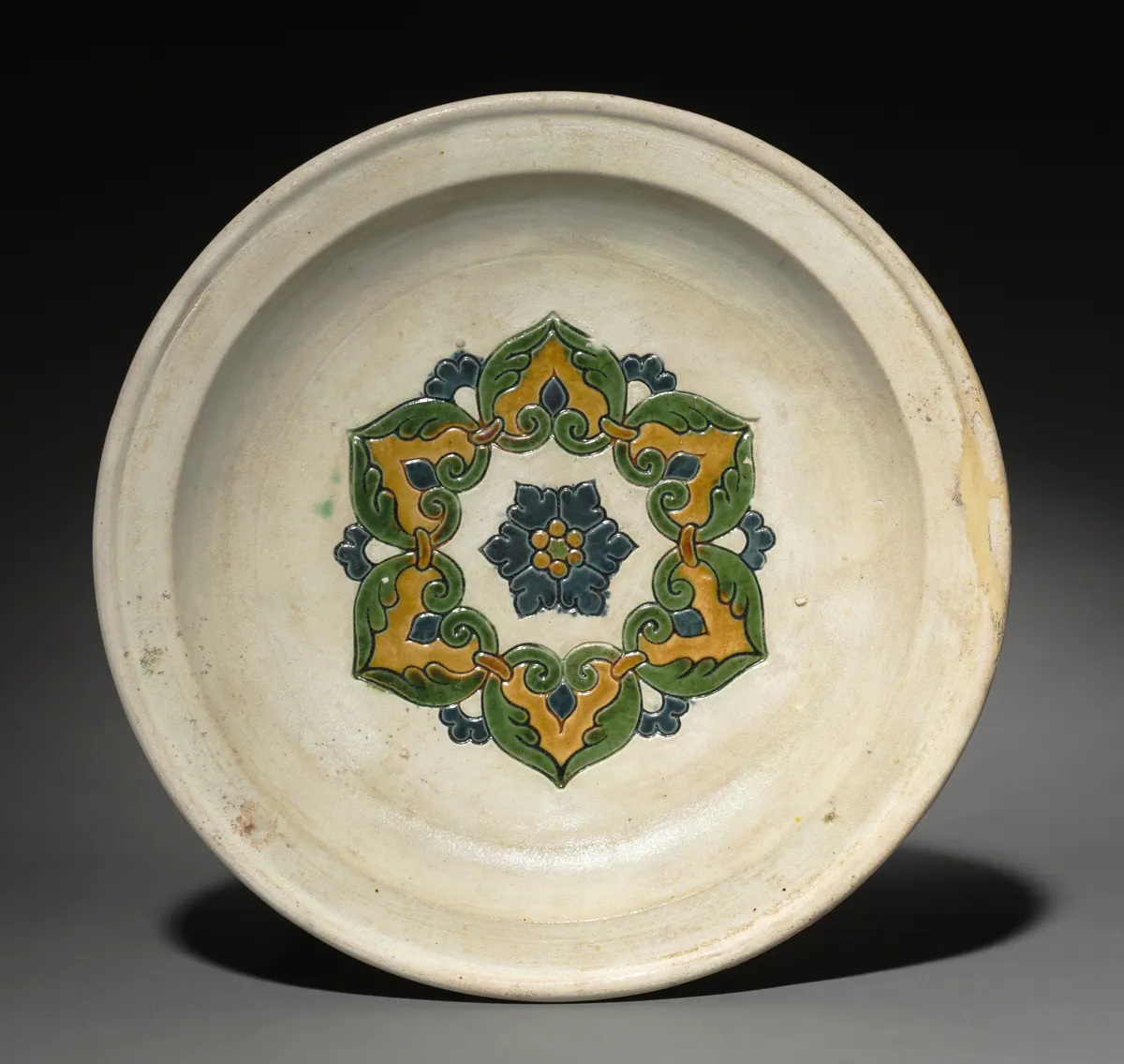
A shallow sancai plate seen from above, its cream ground centred on an impressed six-petalled floral medallion glazed in green, amber and blue.
Museum exampleSancai footed plate with an impressed floral medallion, dated by the museum to the early 700s, the years of Ruizong's second reign.Cleveland Museum of Art, 1989.268. Public domain (CC0).

To seek blessings for his father's spirit, Xuanzong had his daughter, Princess Wan'an, become a Daoist nun. The reign of Xuanzong that followed, lasting until 756, was the high point of Tang power and culture; more on the period can be found on our Tang dynasty page. It was also the great age of sancai, the three-colour lead-glazed earthenware made for burial, which is discussed in our article on Tang art and inventions.

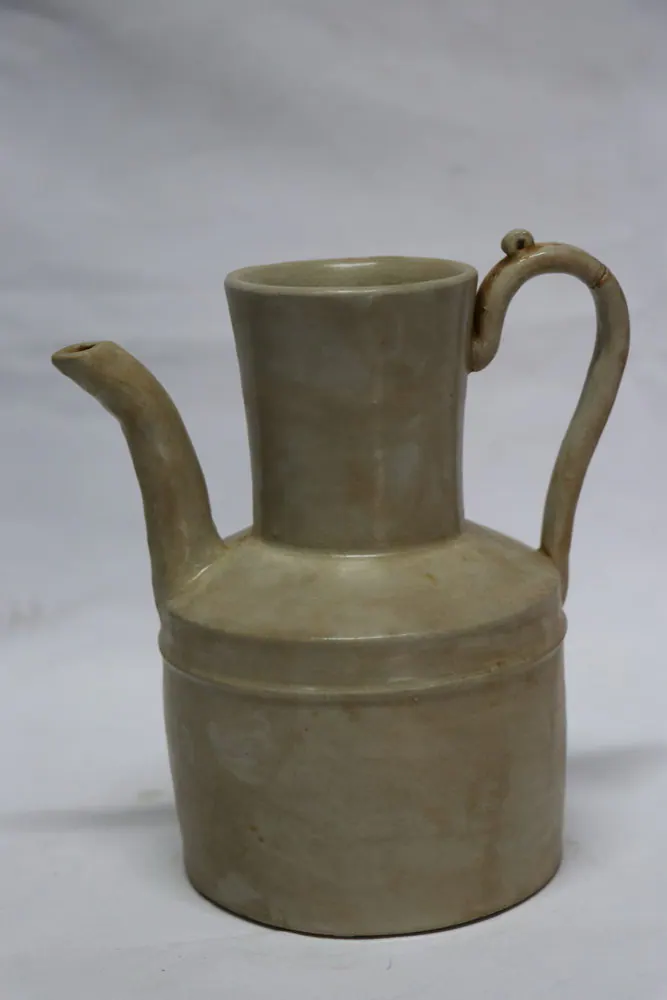
The wares that followed: Song porcelain

View all pieces in the collectionAsk about a piece

Be the first to see new pieces

Join our collectors' list for new arrivals, rare finds and private offers.