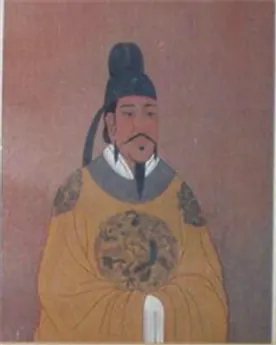
Portrait: public domain, via wikipedia.org

Tang Dynasty827–840

Emperor Wenzong

大和 · 開成

Reign facts
Reigned
827–840 (13 years)
Lived
809–840
Personal name
Li Ang 李昂
Temple name
Wenzong 文宗
Era names
Dahe 大和 827–835Kaicheng 開成 836–840

Li Ang (李昂, 809–840), born Li Han and known by his temple name Wenzong, reigned over the Tang dynasty from 827 to 840, under the era names Dahe (827–835) and Kaicheng (836–840). He was the second son of Emperor Muzong. His elder brother Jingzong reigned before him and his younger brother Wuzong after him, one of the few occasions in Chinese history when three brothers held the throne in succession.

Wenzong's reign was dominated by his struggle with the palace eunuchs, who commanded the imperial guard armies and had put him on the throne. His attempts to break their power failed, most disastrously in the Sweet Dew Incident of 835, when several of his chancellors and many other officials were killed. For the rest of his reign the eunuchs held the upper hand, and after his death they set aside the heir he had chosen.

Accession

Li Han was born in 809, in the reign of his grandfather Emperor Xianzong, a few months after his elder half-brother Li Zhan, the future Emperor Jingzong.

At the start of 827 Jingzong was murdered by a group of eunuchs and guardsmen led by Liu Keming, who tried to place Li Wu, Prince of Jiang, a younger brother of Muzong, on the throne. Other senior eunuchs, led by Wang Shoucheng, turned the palace armies on the conspirators and killed them, and Li Wu died in the fighting.

Wang Shoucheng and his allies then issued orders in the name of Grand Empress Dowager Guo, Xianzong's widow, making Li Han emperor. It was at this point that he changed his name to Li Ang.

The Reign

Wenzong began his reign determined to be diligent and frugal, having seen the extravagance of his father and brother. He met his officials often, and there were hopes of a better age. He was modest and willing to listen, but he was also indecisive, and he was known to change his mind soon after accepting his chancellors' advice.

His government's first major undertaking was military. At the end of Jingzong's reign, the military governor of Henghai Circuit, Li Quanlüe, had died, and his son Li Tongjie had taken over the circuit without imperial approval in the hope of inheriting it. Wenzong refused to accept this, and after a costly campaign Li Tongjie surrendered in 829.

The Niu–Li Factional Struggle

Wenzong's court was also divided by the long-running rivalry between two groups of officials, known after their leaders as the Niu and Li factions. In the early 830s the chancellors Niu Sengru and Li Zongmin used their positions to push the allies of their rival Li Deyu out of the government.

The First Plot Against the Eunuchs

Resenting the eunuchs' hold over him, Wenzong made secret plans with the official Song Shenxi to curb their power, especially that of Wang Shoucheng, and he made Song a chancellor. Wang and his associate Zheng Zhu learned of the plan and struck back, accusing Song of plotting to replace Wenzong with the emperor's brother Li Cou, Prince of Zhang. In 831 both Song and Li Cou were demoted and sent away.

The Sweet Dew Incident

In 833 Wenzong suffered a stroke. Wang Shoucheng recommended Zheng Zhu, who had a reputation as a physician, and after treating the emperor successfully Zheng became one of his closest confidants, together with the official Li Xun. The emperor never fully recovered his health.

With Zheng and Li Xun, Wenzong now planned a second attempt on the eunuchs. In 835 Wang Shoucheng was removed from power and poisoned. Late that year the conspirators announced that sweet dew, an auspicious omen, had appeared in the grounds of the guard headquarters, intending to lure the leading eunuchs there and kill them. The ambush was discovered. The eunuch commander Qiu Shiliang seized the emperor and turned the palace armies on the officials: Li Xun and Zheng Zhu were killed, the chancellors Wang Ya, Jia Su and Shu Yuanyu were executed although they had known nothing of the plot, and a great many others died.

After the Sweet Dew Incident, Wenzong was little more than a figurehead. Qiu Shiliang and the eunuchs of the palace armies controlled the court for the rest of his reign.

Culture

Wenzong was a cultivated ruler. He issued a decree naming Li Bai's poetry, Pei Min's sword dancing and Zhang Xu's cursive calligraphy the "Three Wonders" of the Tang. In 837 he completed a project to have the Confucian classics carved on stone tablets and set up at the Imperial Academy in Chang'an. Known as the Kaicheng Stone Classics, they survive today in the Forest of Stone Steles in Xi'an.

Relations with Japan

The last official Japanese embassy to reach the Tang court arrived during his reign, in 838, and returned to Japan in 839. The Japanese monk Ennin travelled to China with it and left a celebrated diary of his years in the country.

Death and Succession

Wenzong's own son and heir, Li Yong, died suddenly in 838, and the emperor then chose his nephew Li Chengmei, a son of Jingzong, as crown prince. When Wenzong fell gravely ill in 840, he had trusted eunuchs summon the chancellors Yang Sifu and Li Jue to the palace so that he could place Li Chengmei in their care.

Qiu Shiliang and his fellow eunuch Yu Hongzhi forestalled them, issuing an edict that made the emperor's brother Li Chan heir instead. Wenzong died soon afterwards. At Qiu's urging, Li Chan had Li Chengmei, Li Rong, Prince of An, and Consort Yang, Wenzong's favourite, put to death, and took the throne as Emperor Wuzong.

Ceramics of the Reign

For Chinese ceramics, the years around Wenzong's accession are unusually well documented, thanks to a single shipwreck. A ship of Arab or Indian Ocean type sank off Belitung island in the Java Sea carrying some 60,000 pieces, almost all of them Chinese ceramics and most of those bowls from the Changsha kilns in Hunan, many of them painted under the glaze in brown and green. One bowl is inscribed with a date equivalent to 826, a few months before Wenzong came to the throne, and the ship probably sank within a few years of it.

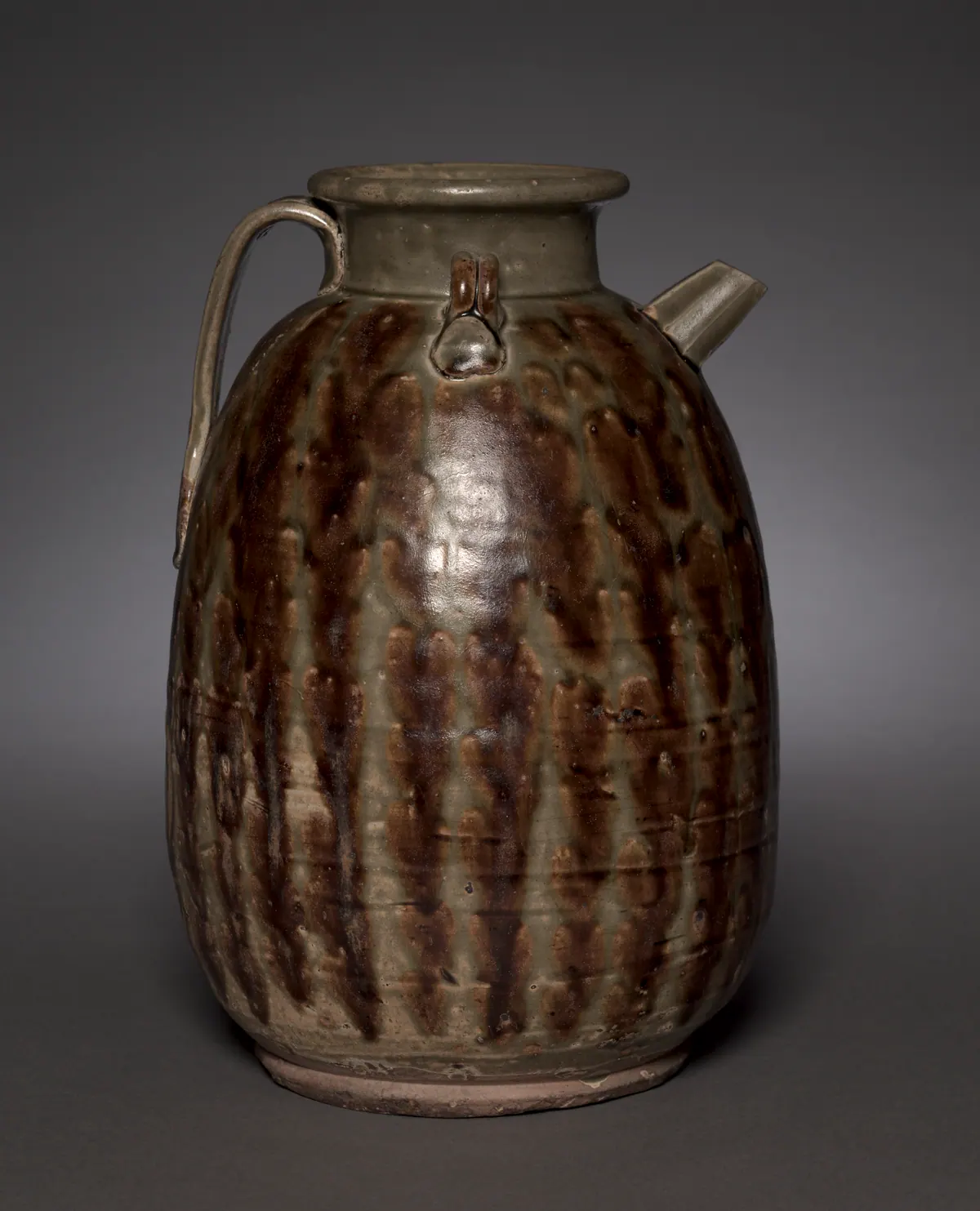
A Changsha ware stoneware ewer with an ovoid body, short spout and strap handle, its olive-green glaze streaked with rows of dark iron-brown splashes.
Museum exampleChangsha ware ewer with iron-brown splashes over an olive-green glaze, dated by the museum to the 800s, the century of Wenzong's reign.Cleveland Museum of Art, 2005.57. Public domain (CC0).

The cargo also held Yue celadons, northern white wares and three of the earliest known blue and white dishes. Changsha ewers like the one shown here, with iron-brown splashes, were also made in quantity, and the cargo included many of them.

The wares that followed: Song porcelain

View all pieces in the collectionAsk about a piece

Be the first to see new pieces

Join our collectors' list for new arrivals, rare finds and private offers.