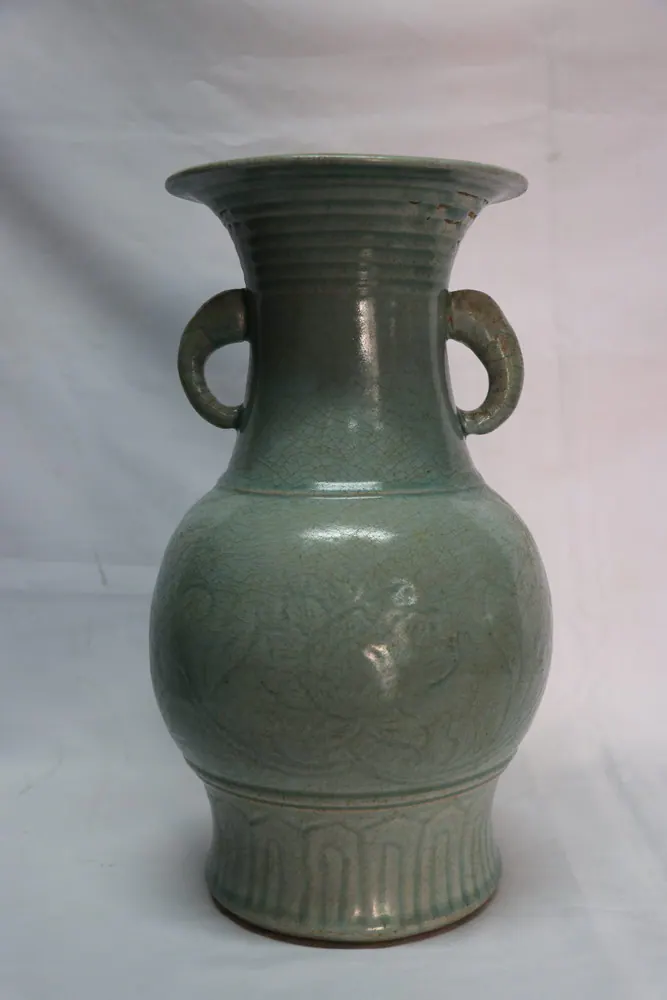
Portrait: public domain, via wikipedia.org

Tang Dynasty756–762

Emperor Suzong

至德 · 乾元 · 上元

Reign facts
Reigned
756–762 (6 years)
Lived
711–762
Personal name
Li Heng 李亨
Temple name
Suzong 肅宗
Era names
Zhide 至德 756–758Qianyuan 乾元 758–760Shangyuan 上元 760–761
On this page
  1. Life before the Throne
  2. The An Lushan Rebellion and the Recovery of the Capitals
  3. Court Politics and the Death of Suzong
  4. Ceramics of the Reign

Li Heng (李亨, 711–762), known by his temple name Suzong (肅宗), was the son and successor of Emperor Xuanzong. He took the throne in 756, in the darkest months of the An Lushan rebellion, after his father had fled to Sichuan, and reigned until his death in 762. His era names were Zhide (至德), Qianyuan (乾元) and Shangyuan (上元).

With the help of Uyghur cavalry and contingents from Central Asia, his armies recovered both Tang capitals, Chang'an and Luoyang, in 757. Chinese records list soldiers from the Abbasid caliphate among these foreign allies. His reign also saw eunuchs take command of the palace armies for the first time, a development that shaped the rest of the dynasty.

He was known by several names before he reigned. Born Li Sisheng, he was later called Li Jun, Li Yu and Li Shao, and finally Li Heng.

Life before the Throne

Li Sisheng was born in 711, during the second reign of his grandfather, Emperor Ruizong. His father was the crown prince Li Longji, who became Emperor Xuanzong the following year. His mother, Consort Yang, came from a family descended from the imperial house of the Sui dynasty.

Soon after Xuanzong's accession the boy was created Prince of Shan. He was brought up by his father's wife, Empress Wang, who had no children of her own. In 724 she was deposed, in part through the rivalry of Xuanzong's favourite, Consort Wu, and she died soon afterwards.

In 737 the crown prince, Li Ying, was forced to commit suicide after being accused of plotting, and in 738 Li Heng was chosen to replace him. For the next eighteen years he lived in the shadow of powerful chancellors, first Li Linfu and then Yang Guozhong, both of whom regarded him with hostility.

The An Lushan Rebellion and the Recovery of the Capitals

In late 755 An Lushan, a Tang frontier general of Sogdian and Turkic descent, rebelled in the north-east. By the summer of 756 his forces had taken Luoyang, where he proclaimed himself emperor of a new Yan dynasty, and were advancing on Chang'an. Xuanzong fled towards Sichuan. At Mawei, the escorting soldiers mutinied and killed the chancellor Yang Guozhong, and the emperor was forced to order the death of his consort, Yang Guifei.

Li Heng did not continue to Sichuan. He went north-west with part of the escort and, at Lingwu, was proclaimed emperor in 756. Xuanzong accepted the change and took the title of retired emperor.

Allies from the Steppe and the West

Suzong's position depended on the frontier armies under generals such as Guo Ziyi and on foreign help. The Uyghur khagan sent cavalry, and troops came from the Tang protectorates and from Central Asia. The Tang histories name the Dashi, the Arabs of the Abbasid caliphate, among these contingents.

A later tradition, not confirmed by the Tang histories, says the caliph sent several thousand men and that many of them stayed in China afterwards and married local women. It is often told as the origin of China's Muslim communities, but Muslim merchants were already settled in southern ports such as Guangzhou by this time; in 758 Arab and Persian raiders sacked Guangzhou itself.

Chang'an and Luoyang

Rebel rule in Guanzhong, the region around Chang'an, was weakened by local resistance, and early in 757 An Lushan was murdered by his son An Qingxu. Later that year an army under Suzong's eldest son, Li Chu, as nominal commander, with Guo Ziyi and the Uyghur horsemen, retook Chang'an and then Luoyang. Xuanzong returned to the capital.

The war was far from over. The rebel general Shi Siming took Luoyang again in 759, and the rebellion did not end until 763, the year after Suzong's death.

Court Politics and the Death of Suzong

Suzong's most trusted servant was the eunuch Li Fuguo, who had been with him since before his accession. Li Fuguo was given command of the palace guards and control of the documents that passed to and from the emperor, a degree of power no eunuch had held before. He was allied with Suzong's favourite, Consort Zhang, who was made empress in 758.

They were opposed by the emperor's son Li Tan, Prince of Jianning, by Li Chu, and by the emperor's adviser Li Mi. When Li Tan accused Consort Zhang and Li Fuguo of wrongdoing, they accused him in turn of plotting against his elder brother Li Chu. Suzong ordered Li Tan to commit suicide. Li Mi, fearing for himself, soon withdrew from court. Li Chu was made crown prince in 758 and renamed Li Yu.

The Retired Emperor

After his return to Chang'an, Xuanzong lived in the Xingqing Palace. In 760 Li Fuguo, suspicious of the old emperor's contacts, moved him to the Taiji Palace and sent away his long-serving attendants, among them the eunuch Gao Lishi. Suzong placed his daughters, the princesses Wan'an and Xianyi, in attendance on his father, but Xuanzong grew withdrawn and ill.

Li Fuguo went on to hold high office and effectively controlled access to the emperor, although Suzong refused his request to be made a chancellor.

Death and Succession

Xuanzong died in the spring of 762. Suzong was by then gravely ill himself, and the crown prince, Li Yu, was given charge of the government.

Empress Zhang had by now fallen out with Li Fuguo. She asked Li Yu to join her in killing Li Fuguo and his fellow eunuch Cheng Yuanzhen, but he refused, not wishing to alarm his sick father. She then turned to another of Suzong's sons, Li Xi, Prince of Yue, and gathered some two hundred armed eunuchs. When she summoned Li Yu to the palace in the emperor's name, Cheng Yuanzhen warned Li Fuguo and took the crown prince to the headquarters of the guards. Li Fuguo's soldiers then entered the palace and arrested the empress and her followers.

Suzong died a day or two later, only thirteen days after his father. Li Fuguo had Empress Zhang, Li Xi and another prince, Li Xian, put to death, and Li Yu took the throne as Emperor Daizong. Li Fuguo's power did not long survive the new reign, but the pattern of eunuch control of the palace armies, set under Suzong, lasted to the end of the Tang dynasty.

Ceramics of the Reign

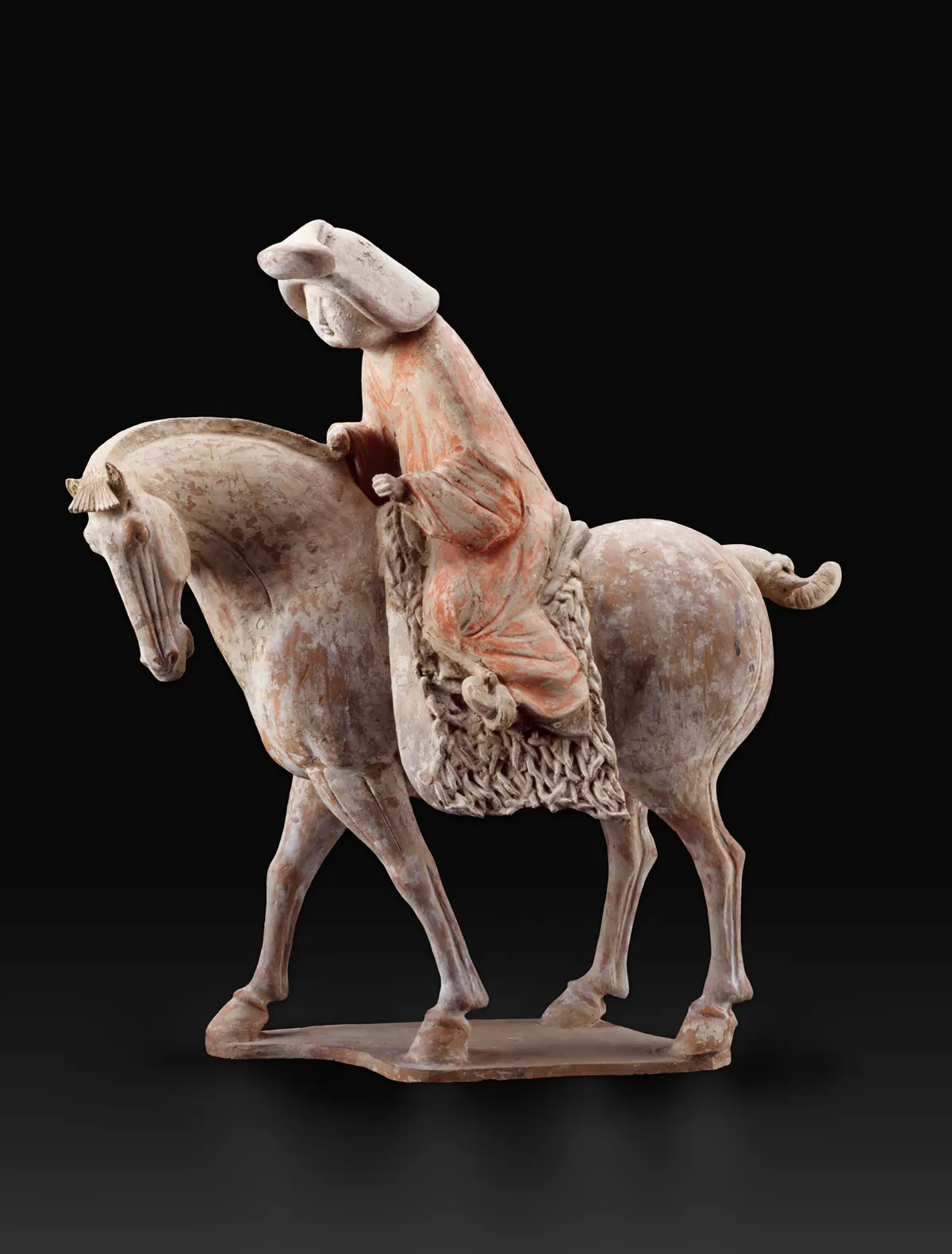
The An Lushan rebellion marks a turning point in Tang ceramics. The great age of sancai and painted tomb figures, centred on the elite cemeteries of Chang'an and Luoyang, faded in the decades after 755, in part because the war ruined many of the families who had commissioned them. Figures such as the rider shown here belong to the final years of that tradition.

Painted earthenware tomb figure of a woman riding a walking horse, wearing a broad hat and a long red-painted robe, seated on a fringed saddle cloth.
Museum examplePainted earthenware tomb figure of a woman on horseback, dated by the museum to the mid-8th century, the years of the An Lushan rebellion.Art Institute of Chicago, 1970.1073. Public domain.

Afterwards the emphasis moved to stonewares and porcelain for daily use: the white wares of Xing, the green Yue wares of Zhejiang and the kilns of Changsha in Hunan, which grew rapidly after the rebellion. Tea drinking was spreading at the same time and created a demand for fine bowls. Lu Yu's Classic of Tea, written between about 760 and 780, compares the bowls of the Yue and Xing kilns.

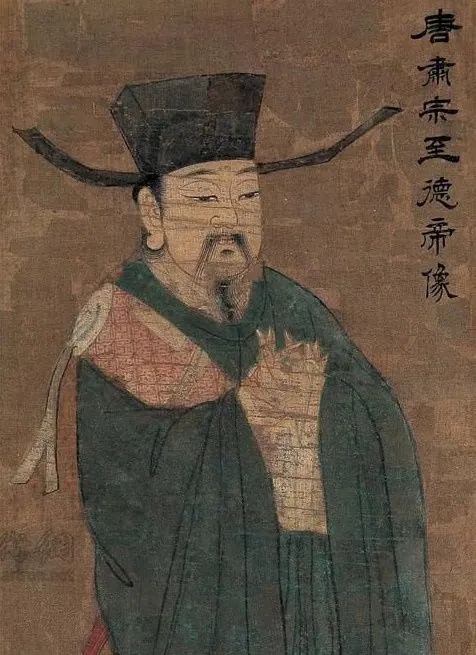
The wares that followed: Song porcelain

View all pieces in the collectionAsk about a piece

Be the first to see new pieces

Join our collectors' list for new arrivals, rare finds and private offers.