The Fall of Kaifeng and a New Emperor
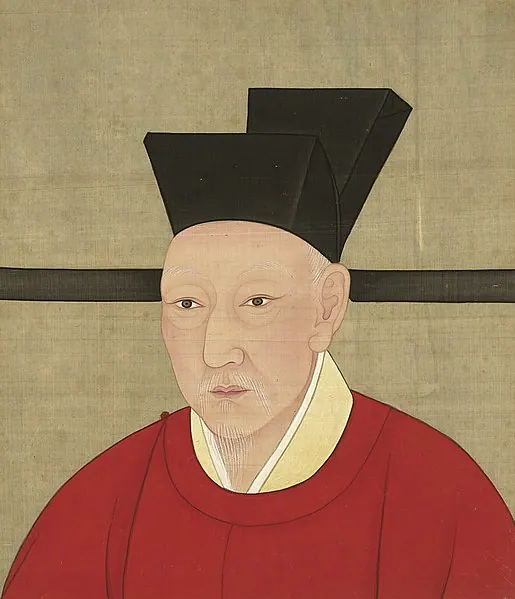
Zhao Gou was the ninth son of Huizong, by a lesser consort, Lady Wei, and held the title Prince of Kang. When the Jin first besieged Kaifeng early in 1126 he was sent to their camp as a hostage during the peace talks. Late that year he was sent north again on a mission to the Jin, and he was away from the capital when it fell in January 1127. His father, his half-brother Emperor Qinzong and thousands of the imperial clan were carried off into captivity.
The Jin did not try to rule the conquered capital directly. They set up a client state called Da Chu, with the former Song chancellor Zhang Bangchang as its emperor. It lasted only about a month. Once the Jin armies had withdrawn, Zhang gave up the title and brought forward Empress Meng, the deposed empress of Emperor Zhezong, who had escaped capture because she no longer lived in the palace. She acted briefly as regent and gave her backing to Zhao Gou, who was enthroned at Yingtian, modern Shangqiu in Henan, in the summer of 1127.
Zhang Bangchang submitted to the new emperor but was soon banished and made to take his own life. The Jin treated the end of their client state as a reason to renew the war. Between 1127 and 1129 the Song sent thirteen embassies to the Jin to seek peace and the release of Huizong and of Gaozong's mother, and the Jin court ignored them all.
Years of Flight, 1127–1132
Gaozong made no serious attempt to recover Kaifeng. The general Zong Ze held the old capital for the Song and repeatedly urged the emperor to return, but Gaozong never did, and Zong Ze died there in 1128. Later historians often criticised Gaozong for putting the survival of his court before the rescue of his family and the north.
Late in 1127 the court moved to Yangzhou. Early in 1129 a Jin raid on the city forced Gaozong to flee across the Yangtze, and that spring two officers of his guard, Miao Fu and Liu Zhengyan, mutinied at Hangzhou and forced him to abdicate in favour of his infant son. Loyal generals restored him within about a month.
At the end of 1129 the Jin general Wuzhu crossed the Yangtze, and Gaozong escaped only by taking to the sea off the Zhejiang coast. Wuzhu withdrew in 1130, and on his way north the general Han Shizhong trapped his fleet on the Yangtze for more than a month. The same year the Jin set up a second client state, Qi, under the former Song official Liu Yu, to rule the lands between the Yellow River and the Huai. From 1132 the court was based at Hangzhou, renamed Lin'an in 1129, and in 1138 the city was named the capital, officially only a temporary residence until the north was recovered.
Yue Fei and the Treaty of Shaoxing
Through the 1130s the Song armies grew stronger under generals such as Yue Fei, Han Shizhong and Wu Jie. Yue Fei recovered Xiangyang in 1134, and in 1140 he defeated Wuzhu at Yancheng and advanced towards Kaifeng. Gaozong, guided by his chancellor Qin Hui, chose peace instead. Yue Fei was recalled, imprisoned on charges now regarded as false and put to death early in 1142.
Traditional historians argued that Gaozong and Qin Hui did not want a full victory, because it might have brought Qinzong, still a captive of the Jin, back to claim the throne. The interpretation is still debated.
The Treaty of Shaoxing, which took effect in 1142, recognised the Jin conquests and fixed the border along the Huai River. The Song emperor accepted the status of a vassal of the Jin and agreed to send 250,000 taels of silver and 250,000 bolts of silk every year. In return the Jin sent back the coffin of Huizong, who had died in captivity in 1135, and released Gaozong's mother, Empress Dowager Wei.
Lin'an and the Southern Song Economy
Peace allowed the south to prosper. With the northern plains lost, the state relied on the rice lands of the Yangtze delta and on trade. War had drained the treasury, and Gaozong encouraged shipbuilding and overseas commerce through ports such as Guangzhou and Quanzhou. He is recorded as remarking that the profits of maritime trade, properly managed, could run to millions, and were a better source of revenue than taxing the people.
Lin'an grew into a great city of palaces, markets and gardens around the West Lake. Gaozong's own calligraphy was a model for the court. He wrote out the Confucian classics in his own hand, and the texts were carved on stone for the Imperial Academy; many of the stones survive in Hangzhou. One of his surviving works of calligraphy is the Quatrain on Heavenly Mountain.