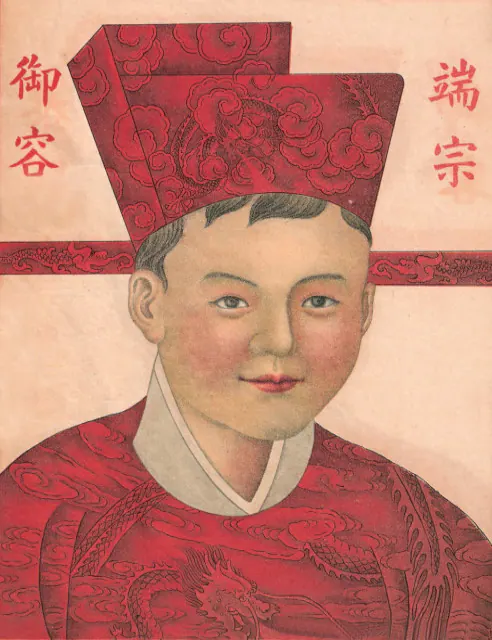
Reign of Emperor Duanzong
The Mongol Advance
From the late 1260s the Mongols pressed the Southern Song on several fronts, helped by Chinese auxiliary troops and by foreign engineers who built powerful siege engines. The key target was Xiangyang, a fortress city on the Han River that barred the way to the Yangtze.
The Mongols besieged Xiangyang for about five years. In 1273 its commander, Lü Wenhuan, surrendered after being promised that the people would be spared, and he then took office under the Mongols.
The road down the Yangtze was now open to Kublai Khan's armies. Early in 1276 they reached the Song capital, Lin'an (modern Hangzhou), which surrendered. The young Emperor Gong and senior members of the imperial family were taken north as captives.
A Court in Flight
Before the capital fell, Zhao Shi and his younger brother Zhao Bing had been taken to safety in the south. With them went a small group of loyal ministers and relatives, among them the official Lu Xiufu, the general Zhang Shijie, the chancellor Chen Yizhong and Consort Yang.
Later in 1276 Zhao Shi was enthroned at Fuzhou as Emperor Duanzong, and the Jingyan era began. Lu Xiufu was given charge of military affairs, with the task of continuing the resistance.
The Mongols soon pressed into Fujian, and the court took to the sea, moving south along the coast towards Guangdong. Loyalist resistance continued on land, but the emperor and his ministers were never again safe on the mainland.